

काण्डानि
THE SEVEN KANDASअध्याय १ आरम्भ भवति
द्रवहु सुदसरथ अजिर बिहारी ॥
श्रीराम जन्म • रामनवमी
The Divine Incarnation & Ram Navami
Emperor Dasharatha of Ayodhya performs the solemn Putrakameshti Yagna. Lord Agni appears from the sacrificial flames offering divine nectar, blessing the three queens with four radiant princes: Rama, Bharata, Lakshmana, and Shatrughna.
राजा दशरथस्य विषादः • सन्तति चिन्ता
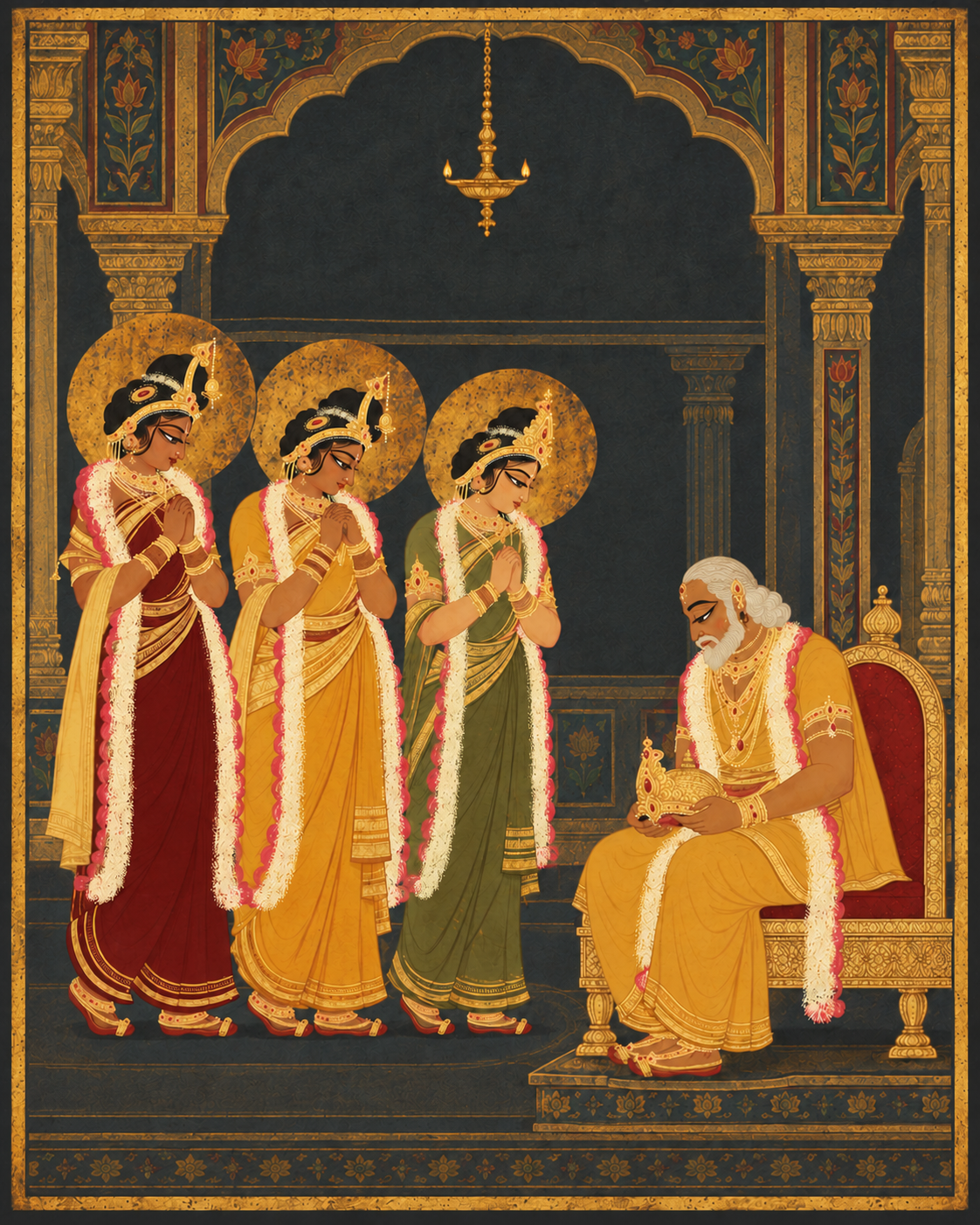
Chapter 1: Rama’s Birth • Scene 1: A King Without an Heir
“King Dasharatha ruled the great city of Ayodhya. He had everything, but he had no child to carry his name.”
King Dasharatha ruled the magnificent city of Ayodhya on the banks of the sacred river Sarayu. Under his benevolent and righteous reign, the kingdom of Kosala flourished in unbroken peace, celestial virtue, and abundant splendor. Granaries overflowed, the earth yielded golden harvests, and the citizens lived in joy and harmony.
Yet within the grand gilded chambers of the royal palace, an aching silence lingered. In quiet despair, the aging monarch set down his imperial crown upon his lap. Behind his throne stood his three devoted queens—Kaushalya in crimson, Kaikeyi in gold, and Sumitra in emerald—with folded hands and sorrowful eyes. Though he had everything, the King had no child to carry the sacred lineage of the Solar Dynasty into the ages.
पुत्रकामेष्टि महायज्ञः • ऋष्यशृङ्ग आह्वानम्
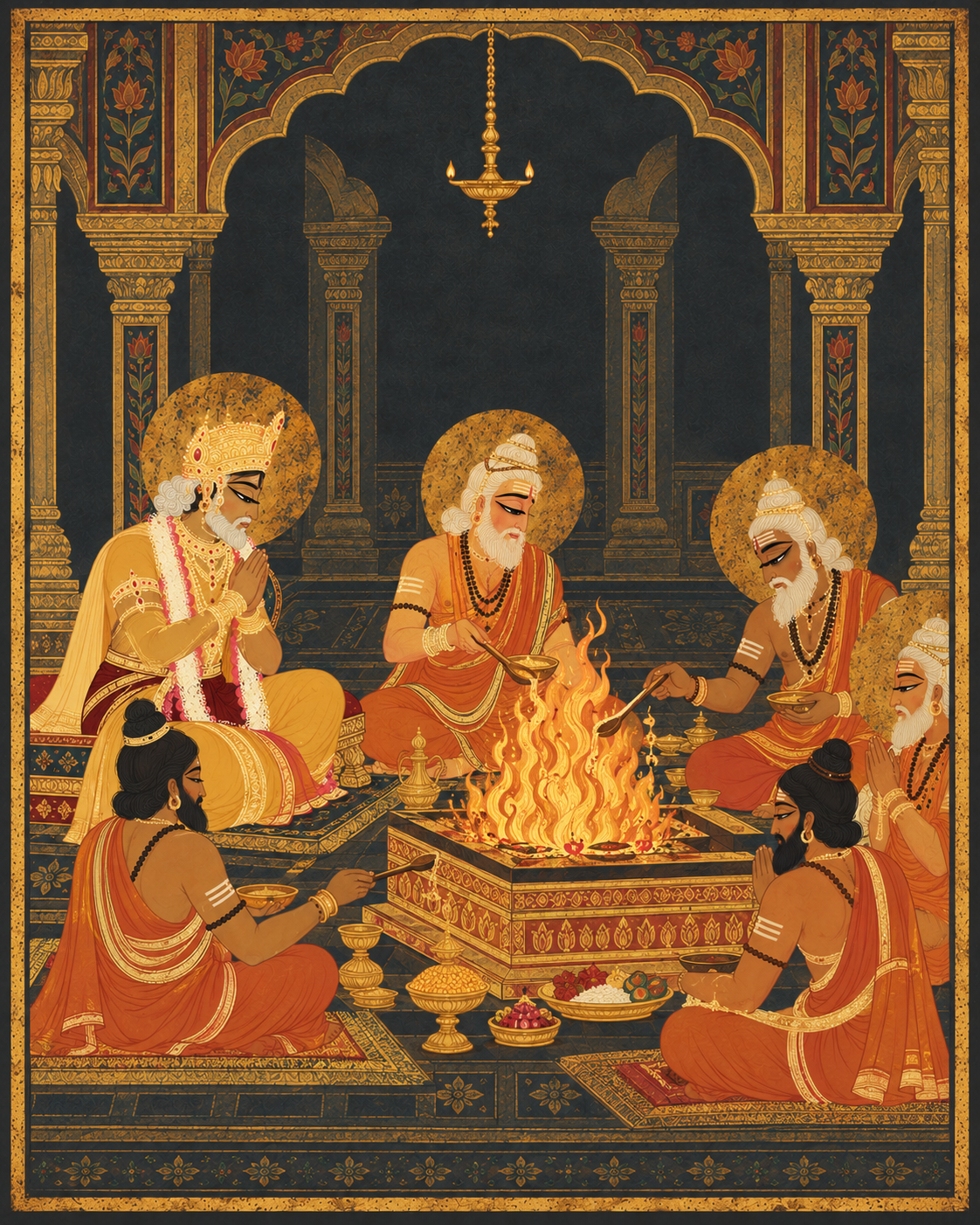
Chapter 1: Rama’s Birth • Scene 2: The Sacred Fire
“On the advice of the sages, the king performed a holy fire ritual, the Putrakameshti Yagna.”
Guided by royal preceptor Brahmarshi Vasishtha and the wise counselor Sumantra, King Dasharatha summoned the revered tapasvi Sage Rishyashringa to consecrated grounds by the holy Sarayu. There, an auspicious Vedic sacrificial arena was prepared according to the eternal scriptures.
Venerable rishis and priests encircled the glowing havan kunda, intoning sacred verses from the Sama and Yajur Vedas. King Dasharatha knelt reverently before the altar with palms joined in prayer. As golden ladles poured pure ghee and sweet samidha herbs into the sanctified fire, brilliant golden flames rose toward the heavens, carrying the King's earnest prayers directly to the Supreme Lord.
यज्ञपुरुषाविर्भावः • दिव्य पायस प्रादुर्भावः
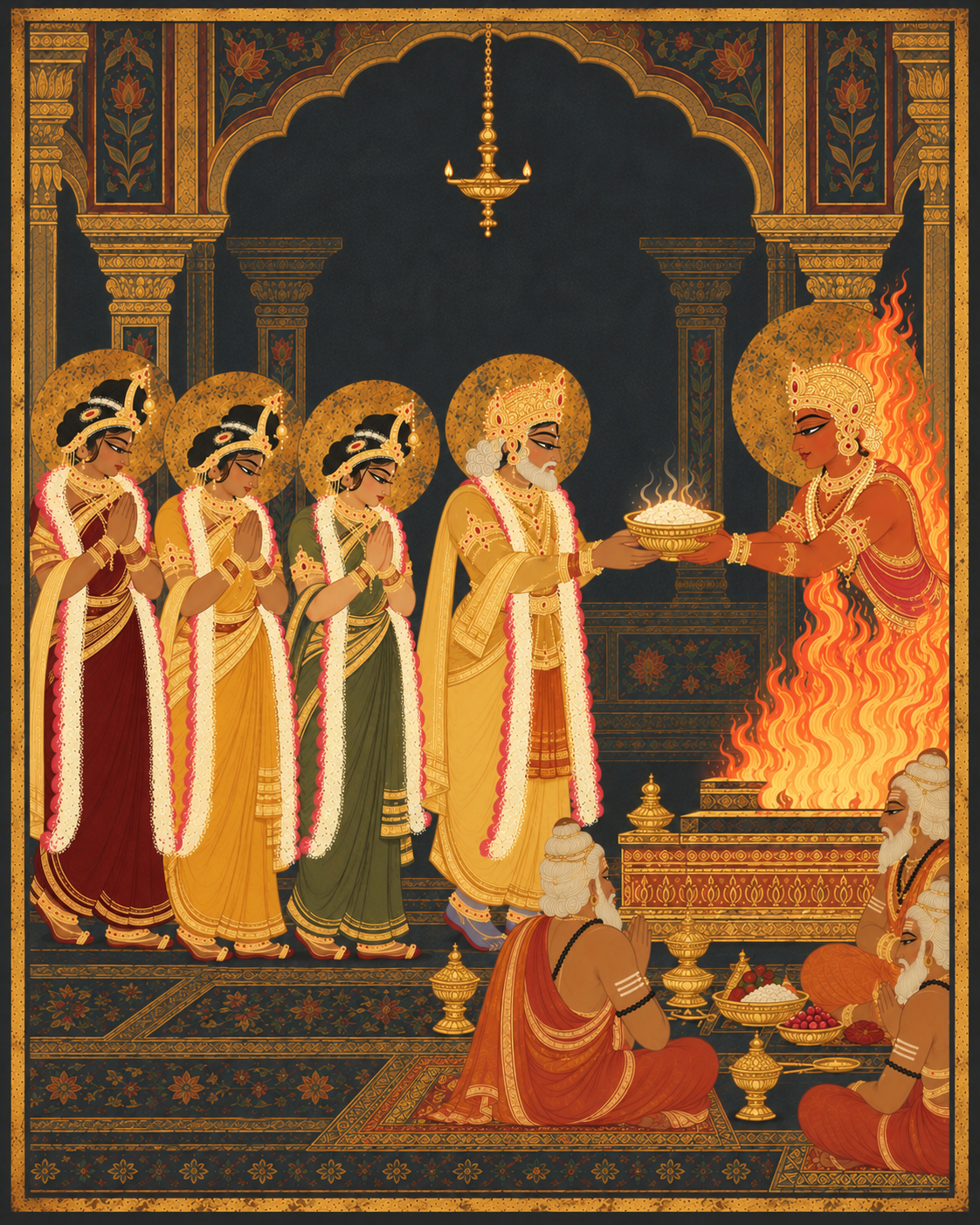
Chapter 1: Rama’s Birth • Scene 3: The Golden Bowl (Part I)
“From the fire came a golden bowl of divine kheer. The king received it with both hands.”
As the final oblation touched the sacred embers, a divine luminescence filled the sacrificial hall. From the heart of the roaring flames arose Lord Agni—the radiant Yajnapurusha—shining with the brilliance of a thousand suns, adorned in fiery crowns and glowing celestial raiment.
In his glowing hands rested a magnificent golden bowl of steaming, sweet divine payasam consecrated by Lord Vishnu Himself. "Take this celestial nectar, O King," spoke the Lord of Fire in thunderous grace. "Give this sacred share to your virtuous queens, and noble sons shall be born to uphold Dharma across the universe." With trembling hands and tears of gratitude, Dasharatha bowed and received the glowing vessel.
पायस वितरणम् • तृषु राज्ञीषु अमृतप्रसादः
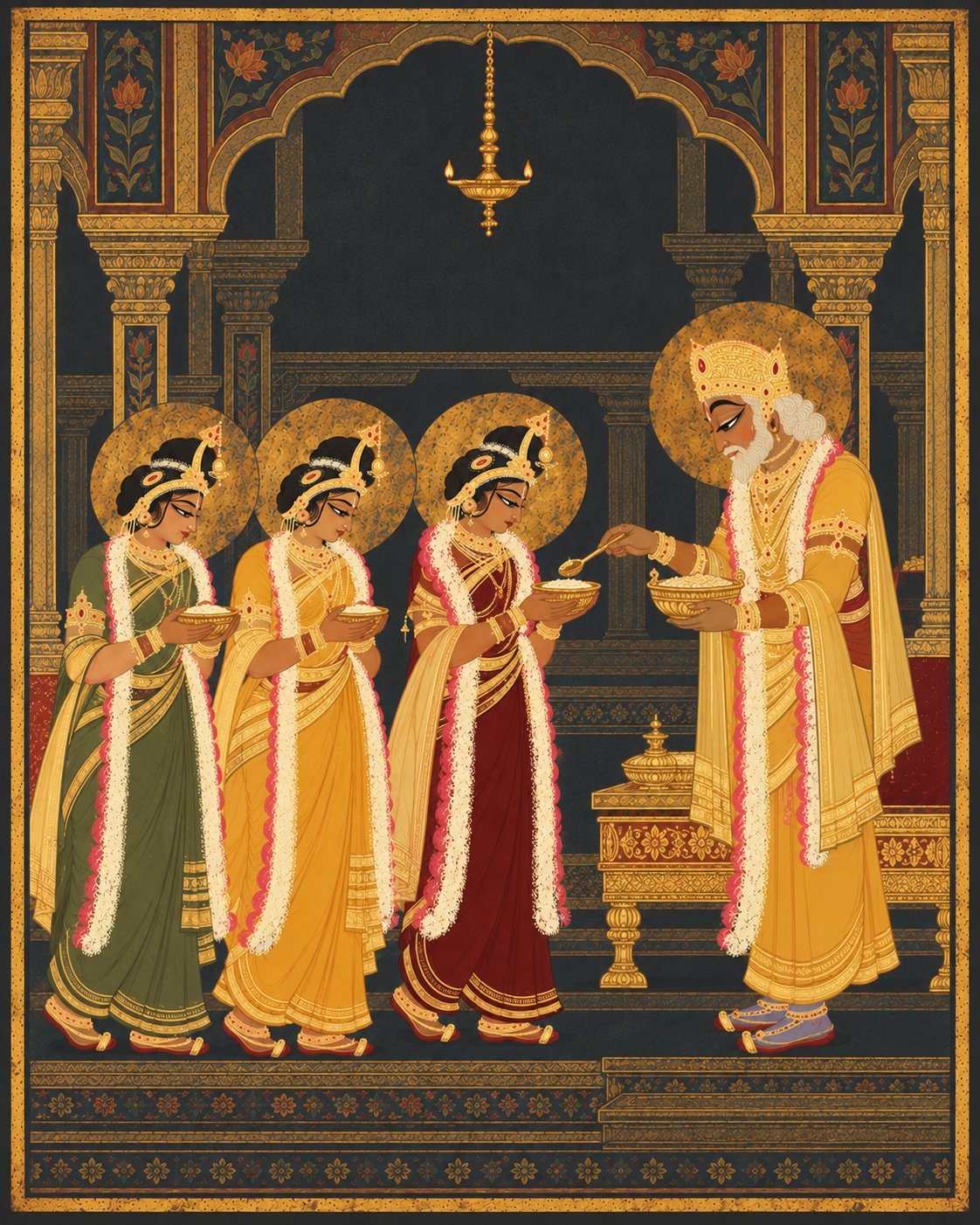
Chapter 1: Rama’s Birth • Scene 3: Sharing the Divine Kheer (Part II)
“The king shared the divine kheer among his three queens.”
Bearing the sacred golden vessel back into the royal chambers, King Dasharatha summoned his three queens. The sweet, ambrosial aroma of the divine kheer perfumed the palace with the promise of new life and the descent of the Divine.
With deep reverence and tenderness, the King poured the divine kheer with a golden spoon. First, he offered a cherished portion to Queen Kaushalya. Next, he presented a share to Queen Kaikeyi. Then, turning to Queen Sumitra, he gave her a portion, and from the remaining nectar, lovingly shared another blessed part with her. With serene smiles and folded hands, the queens partook of the heavenly gift, feeling supreme grace fill their hearts.
भए प्रगट कृपाला • चतुर्भ्रातृ प्रादुर्भावः
Chapter 1: Rama’s Birth • Scene 4: Four Sons are Born
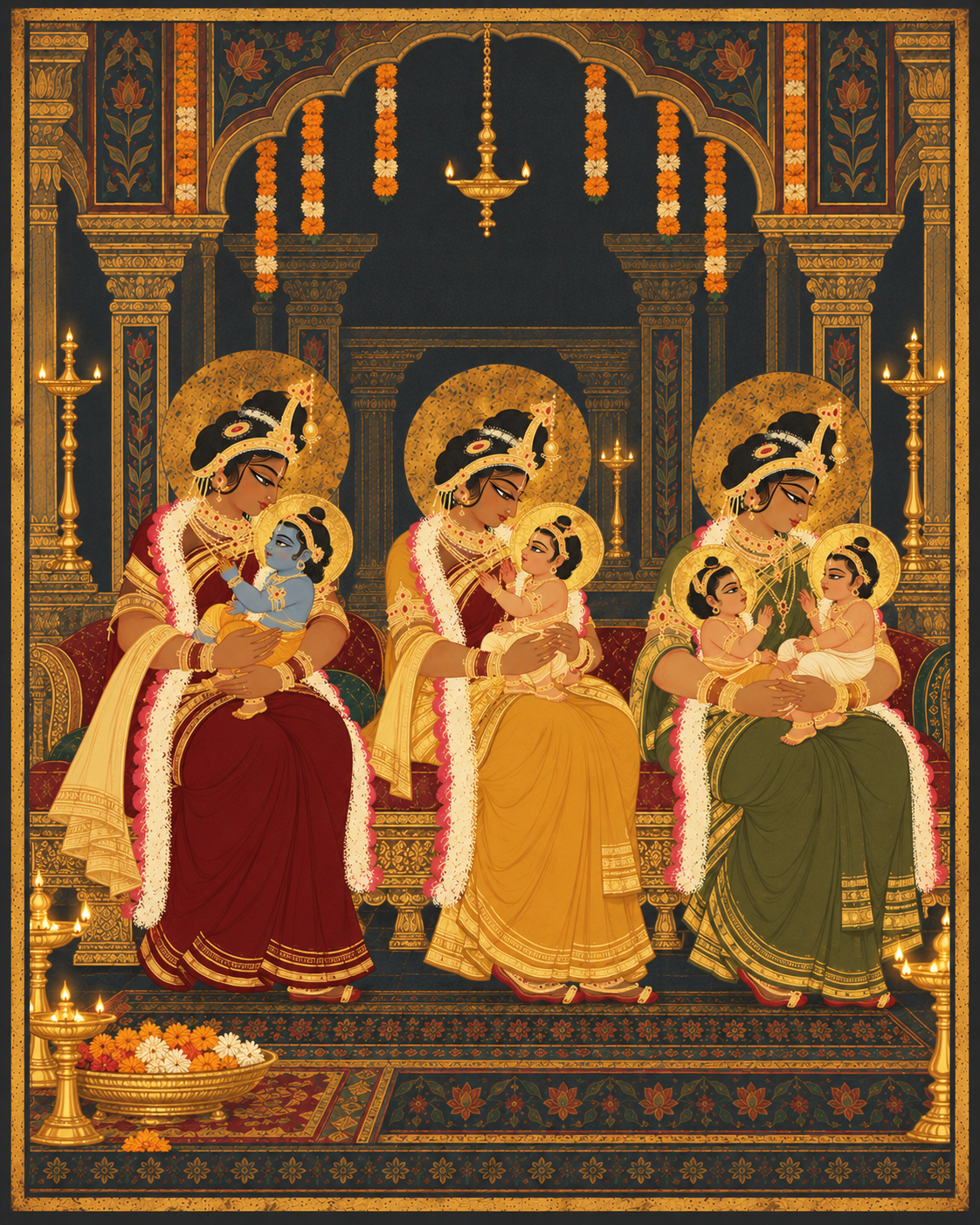
“On the ninth day of Chaitra, Rama was born to Kaushalya. Then came Bharata, and the twins Lakshmana and Shatrughna.”
On the sacred ninth day of the waxing moon in the month of Chaitra, under the auspicious Punarvasu nakshatra, Lord Vishnu descended upon earth. In chambers adorned with marigolds and glowing brass lamps, Queen Kaushalya gave birth to Sri Rama, radiant with cloud-blue skin, lotus eyes, and a golden celestial halo.
Soon after, under the Pushya star, Queen Kaikeyi gave birth to handsome Prince Bharata. And to Queen Sumitra, under the Ashlesha star, were born the noble twin princes Lakshmana and Shatrughna. The three mothers sat together on the golden diwan, cradling their divine children as songs of praise and heavenly parijata blossoms blessed the royal household.
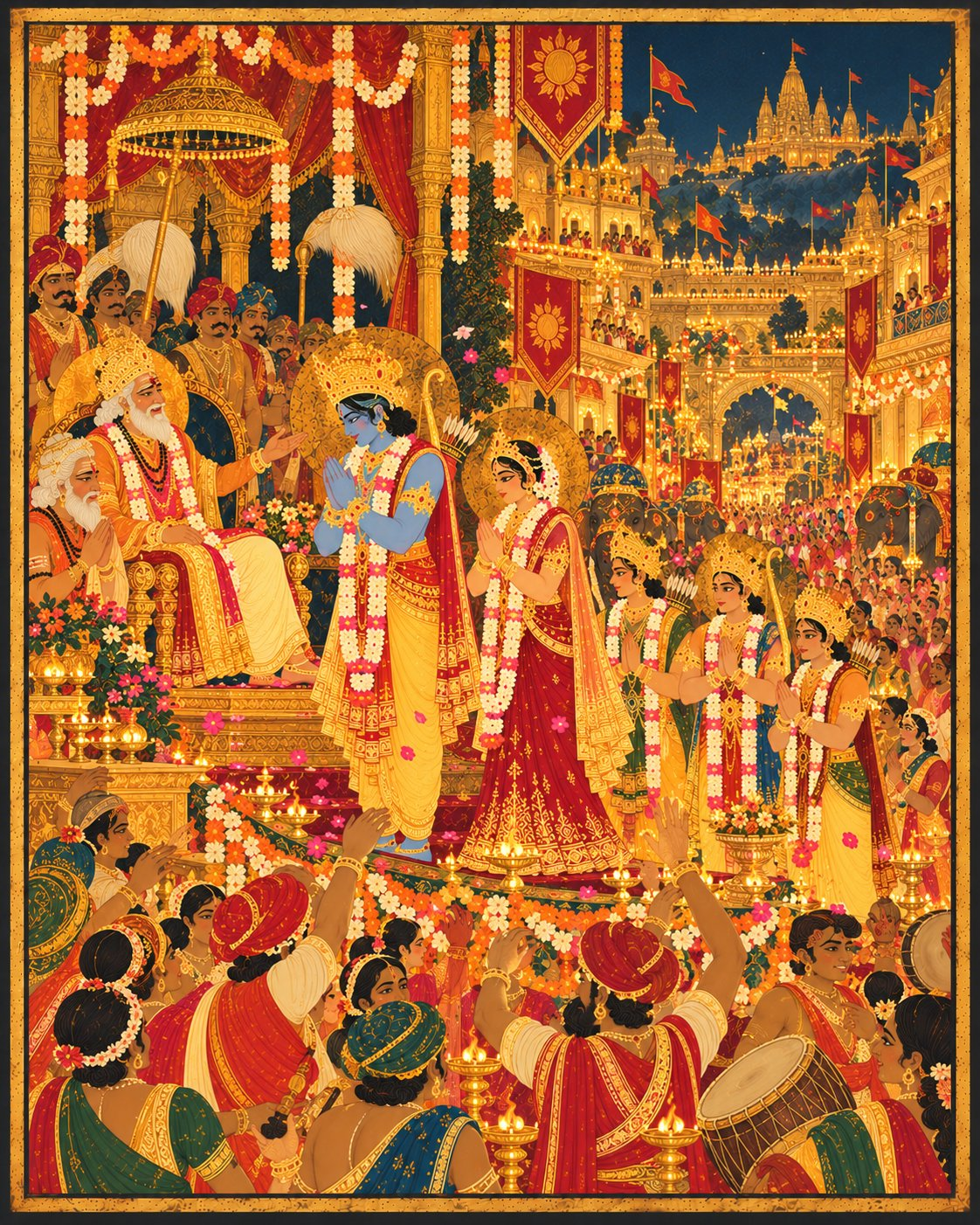
अयोध्यायाम् आनन्दोत्सवः • रामनवमी पर्व
Chapter 1: Rama’s Birth • Scene 5: Ayodhya Celebrates
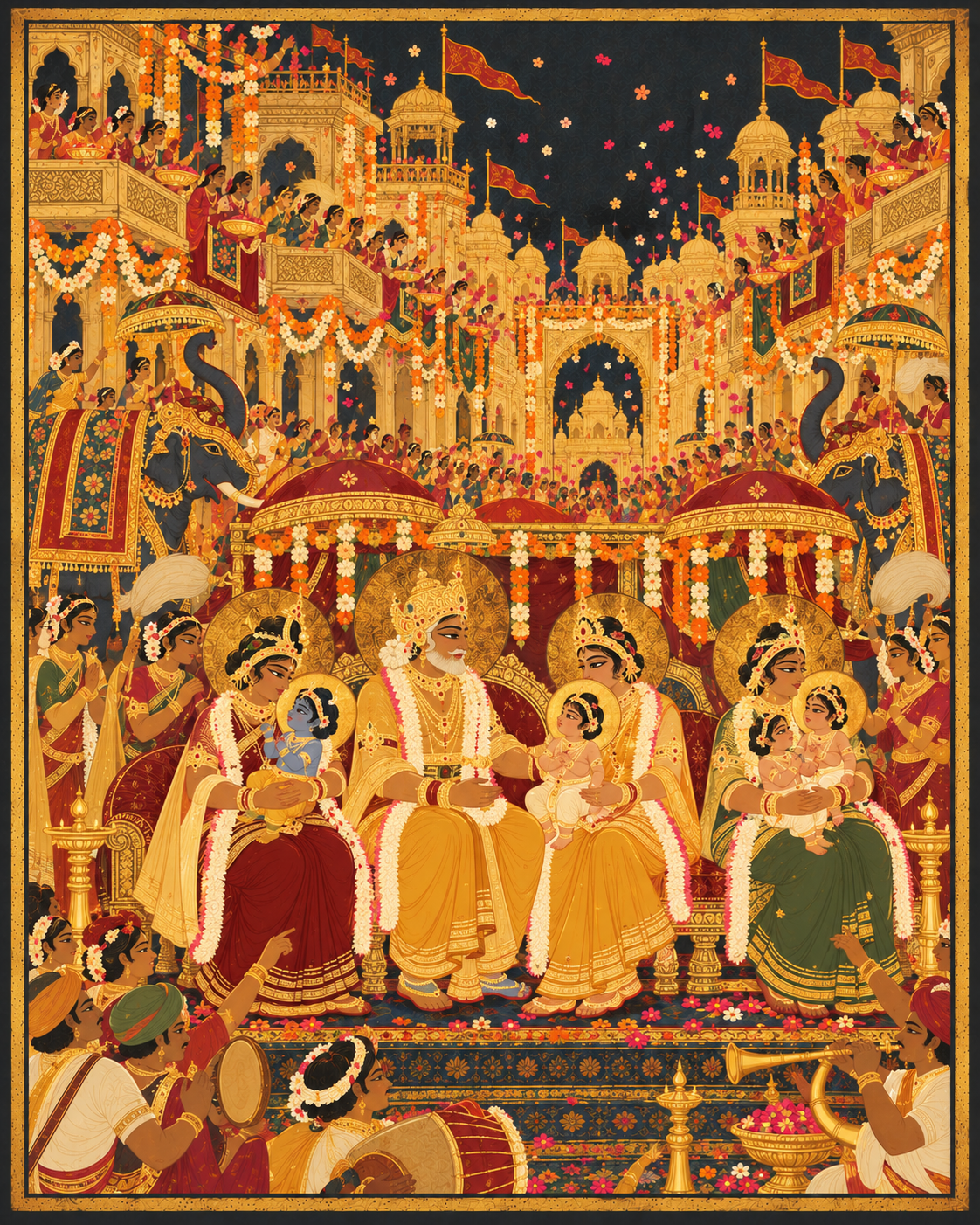
“All Ayodhya rejoiced, and that day is still celebrated as Ram Navami. From the start, Rama and Lakshmana, and Bharata and Shatrughna, were inseparable.”
All Ayodhya rejoiced in an ecstasy of devotion. Draped in golden silks and garlands of fresh marigolds, the entire city transformed into a realm of celebration. Trumpets sounded, kettle drums beat rhythmic pulses of victory, and citizens danced in the flower-strewn avenues as sweet scented water washed the streets.
Beneath imperial parasols on a royal balcony, King Dasharatha and the three queens presented the four infant brothers to the kingdom. From their very first moments, Sri Rama and Lakshmana were bound in an eternal embrace of devotion, while Bharata and Shatrughna were inseparable companions of love and duty. That wondrous day is celebrated for all eternity as Ram Navami.
अध्याय २ आरम्भ भवति
द्रवहु सुदसरथ अजिर बिहारी ॥
यज्ञ रक्षा • ताड़का वध
Protection of the Sacred Yagna
Sage Vishwamitra arrives in Ayodhya requesting youthful Sri Rama and Lakshmana to defend his holy sacrifice at Siddhashrama. Receiving divine astras and mantras, Rama slays demoness Tadaka and protects the sacred fire from Maricha and Subahu.
विश्वामित्र आगमनम् • दशरथ प्रतिज्ञा
Chapter 2: Protecting the Sages • Scene 1: The Sage’s Request
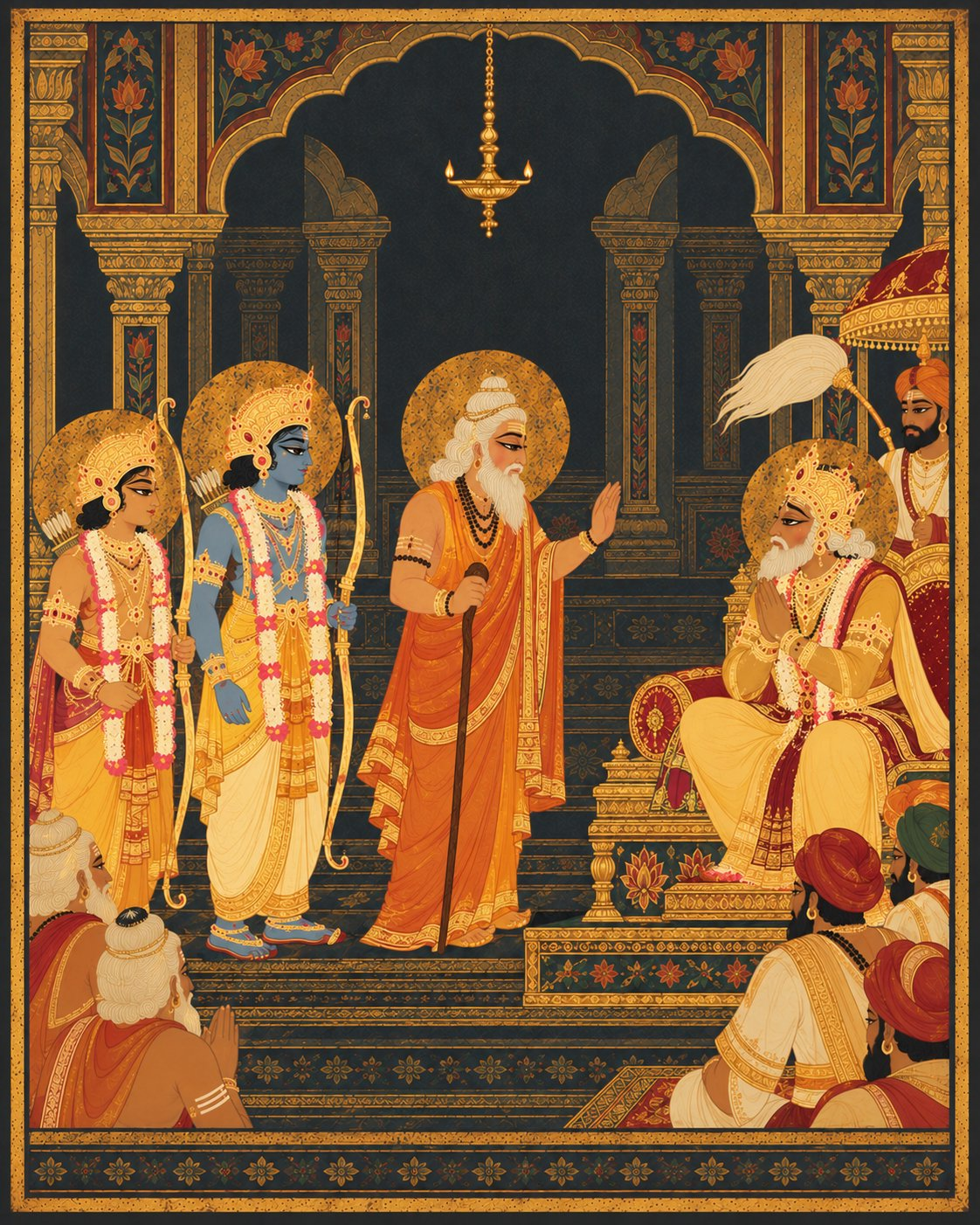
“Demons were desecrating the sacred fire sacrifices of the hermits. Guru Vishwamitra arrived at Ayodhya requesting young Rama and Lakshmana’s protection. With faith in dharma, King Dasharatha entrusted his beloved sons into the sage’s care.”
Deep in the sacred forests, ferocious demons unleashed relentless torment upon the hermitages, polluting holy altars and disturbing solemn prayers. Seeking divine protection for his sacrificial rituals, the venerated Guru Vishwamitra journeyed to the royal court of King Dasharatha in Ayodhya.
Though the King trembled at the thought of sending his tender, lotus-eyed prince into perilous battles, he bowed before the sage’s spiritual authority. With steadfast devotion to dharma, Dasharatha entrusted youthful Rama and the steadfast Lakshmana into Vishwamitra’s guardianship, sending the brothers forth upon their first heroic journey.
सरयू यात्रा • बला-अतिबला दीक्षा
Chapter 2: Protecting the Sages • Scene 2: Journey & Divine Mantras
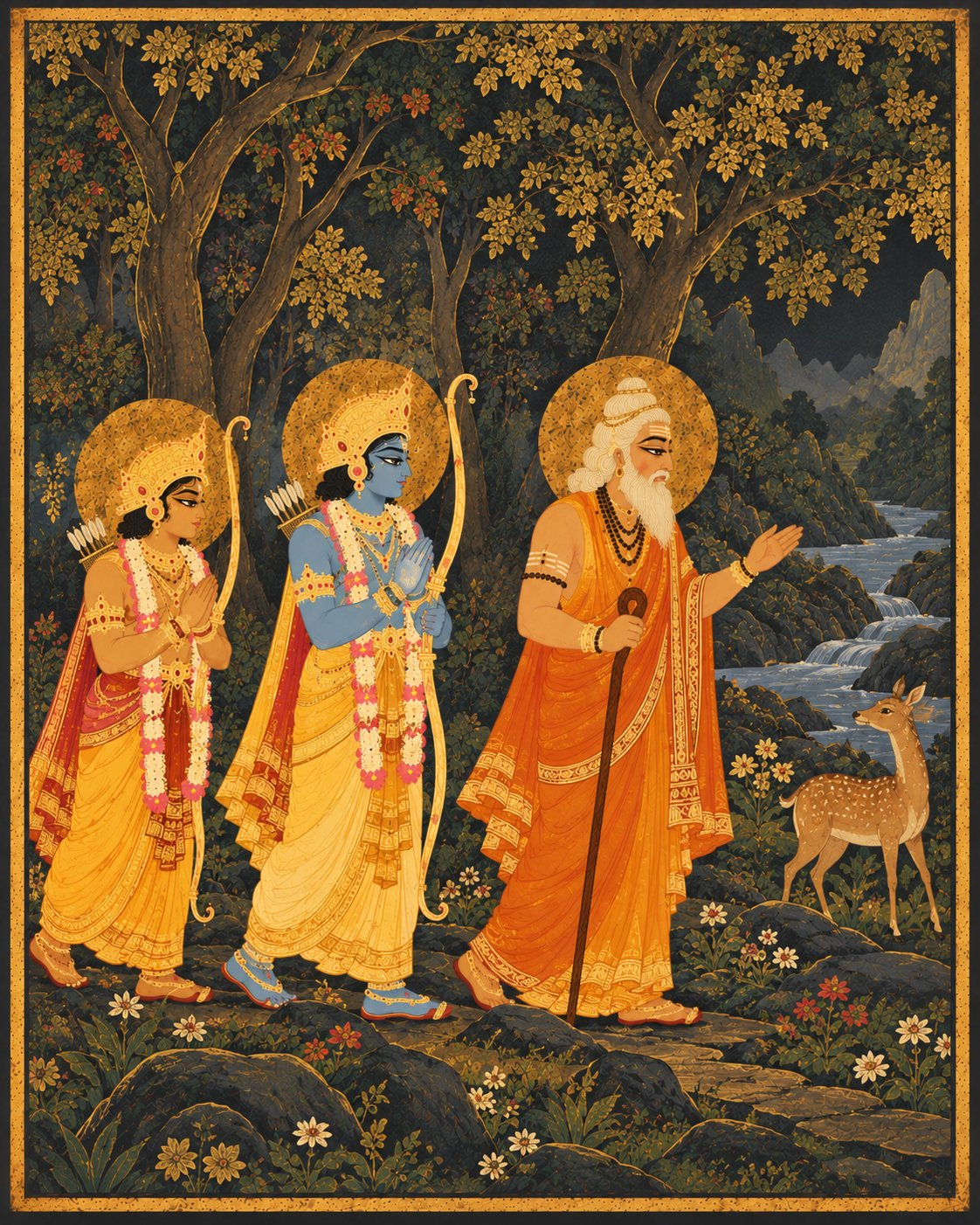
“Walking along the sacred Sarayu, Sage Vishwamitra initiated Rama and Lakshmana into the secret sciences of Bala and Atibala, bestowing inexhaustible strength and immunity from all fatigue.”
Along the verdant banks of the holy Sarayu river, Sage Vishwamitra led the two princes into the whispering wilderness. Delighted by Rama's natural humility, boundless grace, and unwavering devotion, the great sage paused by the pristine mountain streams to impart sacred knowledge.
Having the young princes sip the purifying waters, Vishwamitra initiated Rama and Lakshmana into the primordial secret mantras of Bala and Atibala—the twin daughters of Brahma. Through these divine syllables, the brothers were blessed with boundless endurance, immune to hunger, thirst, sleep, and fatigue, shining with radiant celestial splendor as they ventured deeper into the wild realm.
ताड़का वध • दिव्य अस्त्र प्राप्ति
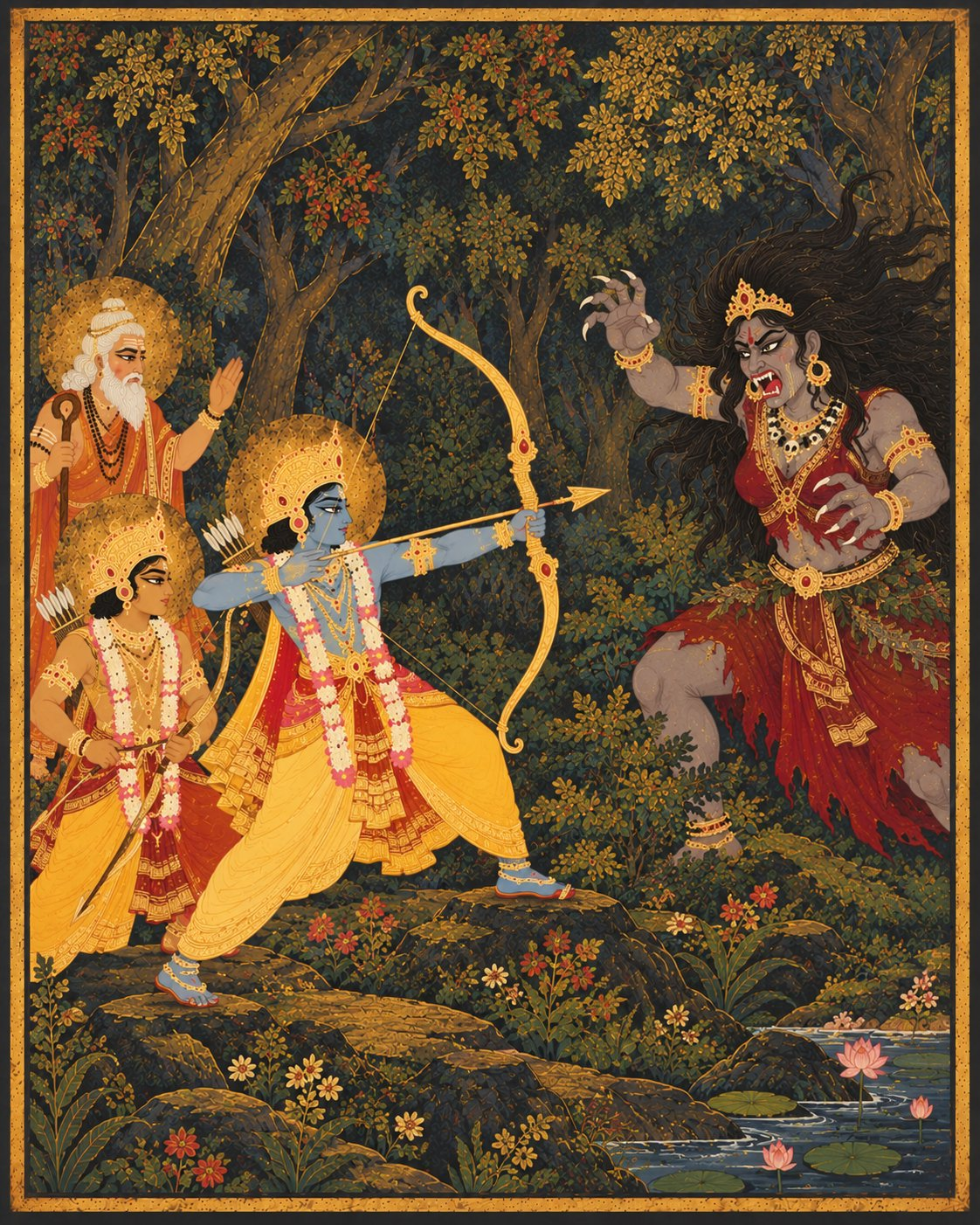
Chapter 2: Protecting the Sages • Scene 3: Tadaka Falls
“In the dark, cursed forest, the ferocious demoness Tadaka attacked with monstrous fury. Guiding by his Guru’s command to defend dharma, young Rama felled her with a single arrow.”
Into the sinister gloom of the Malada forest the travelers stepped, where the soil was barren and silence hung heavy with fear. Suddenly, the earth shook with thunderous roars as the dreaded demoness Tadaka charged forth, brandishing savage claws and conjuring a tempest of stone and dust.
Instructed by Vishwamitra that righteous warriors must never waver in neutralizing evil that harms innocent life, Sri Rama stood steadfast upon the mossy stone. Drawing his golden bow with serene precision, he released a fatal, luminous shaft. The dread demoness fell, and the cursed forest breathed once more in green tranquility. In joy, Vishwamitra rewarded Rama with an armada of invincible celestial Astras.
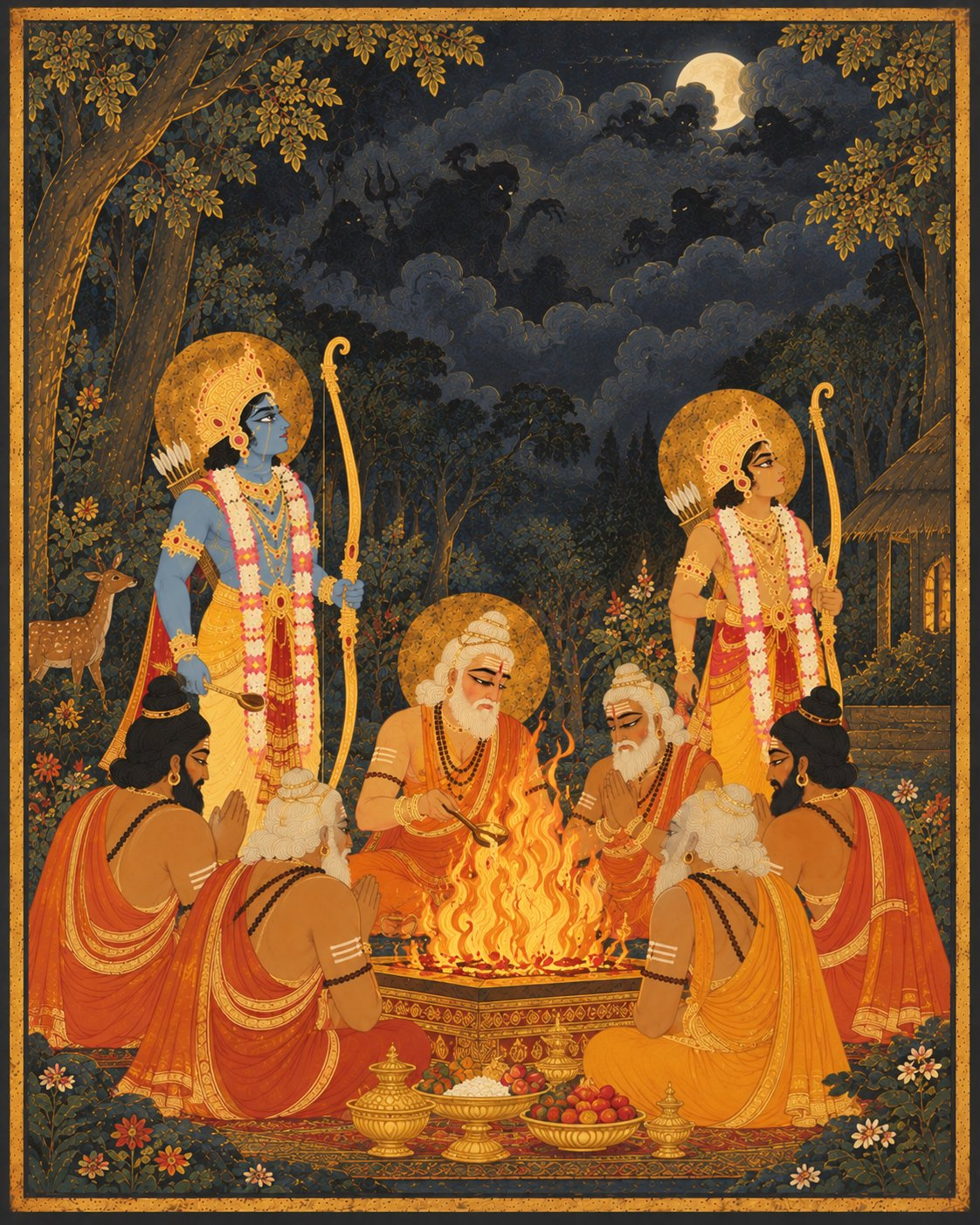
सिद्धाश्रम यज्ञ • रात्रि जागरण
Chapter 2: Protecting the Sages • Scene 4: The Sacred Yagna & Night Vigil
“At the sacred hermitage of Siddhashrama, the sages lit the sacrificial fire. For six continuous days and nights, Rama and Lakshmana stood sleepless guard under the moonlit canopy.”
At the enchanted hermitage of Siddhashrama, Sage Vishwamitra and the assembly of holy ascetics initiated the solemn Vedic sacrifice. Pledging a strict vow of sacred silence for six continuous days and nights, the rishis sat around the golden fire altar, offering sacred oblations into the consecrated flame.
Taking their stations on either side of the havan kunda, Rama and Lakshmana stood as unyielding celestial sentinels. Beneath the brilliant full moon, as ominous dark clouds gathered and demonic silhouettes lurked with tridents above the canopy, the princes stood sleepless with notched arrows, their unwavering vigil protecting the sanctity of the sacred rites.
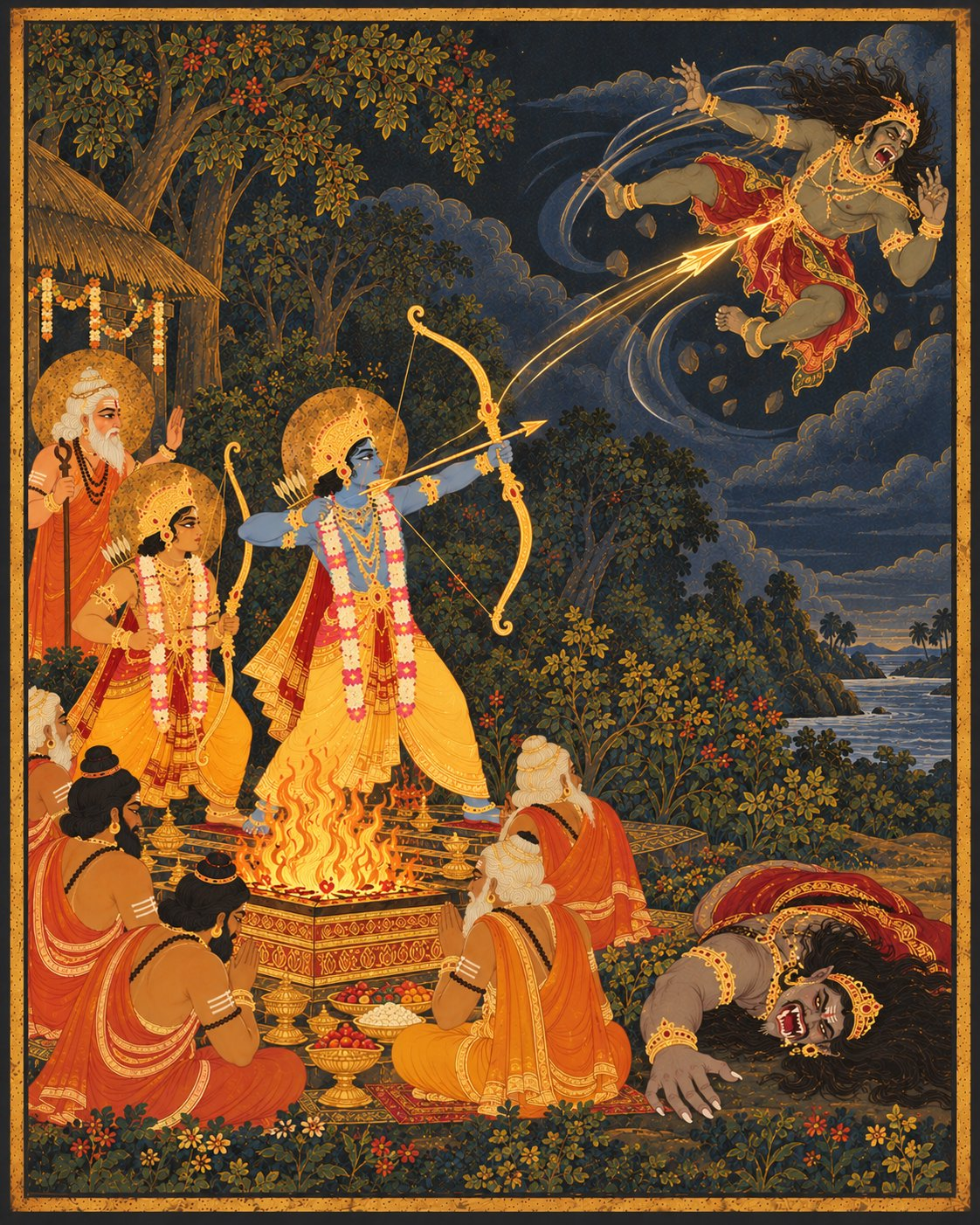
मारीच-सुबाहु दमनम् • यज्ञ सिद्धि
Chapter 2: Protecting the Sages • Scene 5: Victory at the Yagna
“On the final day, the demons Maricha and Subahu attacked the altar. Sri Rama unleashed the Manavastra, throwing Maricha across the distant sea, and felled Subahu. The sacred yagna concluded in triumph and peace.”
On the sixth and crowning day of the ritual, the sky turned ink-black as the demon brothers Maricha and Subahu descended like thunderbolts, intent on defiling the sacrificial flames with flesh and blood. Calm and majestic amidst the storm, Sri Rama acted with celestial speed.
Invoking the mystic Manavastra, Rama struck Maricha with a gale-force impact, hurling him a hundred leagues across the continent into the distant ocean without slaying him. Simultaneously, his blazing Agneyastra struck down the ruthless Subahu dead upon the forest floor. With Lakshmana routing the retreating fiends, the yagna was completed in glorious purity, and celestial flowers showered from the heavens upon the victorious brothers.
अध्याय ३ आरम्भ भवति
द्रवहु सुदसरथ अजिर बिहारी ॥
सीता स्वयंवर • शिवधनुर्भङ्ग
Sita’s Swayamvara & The Shiva Bow
En route to Janakpur, Sri Rama liberates Ahilya from her stone curse. At King Janaka’s grand court, Rama effortlessly lifts and bends Lord Shiva’s colossal Pinaka bow, which breaks with the roar of thunder, culminating in the sacred wedding of Rama and Sita.
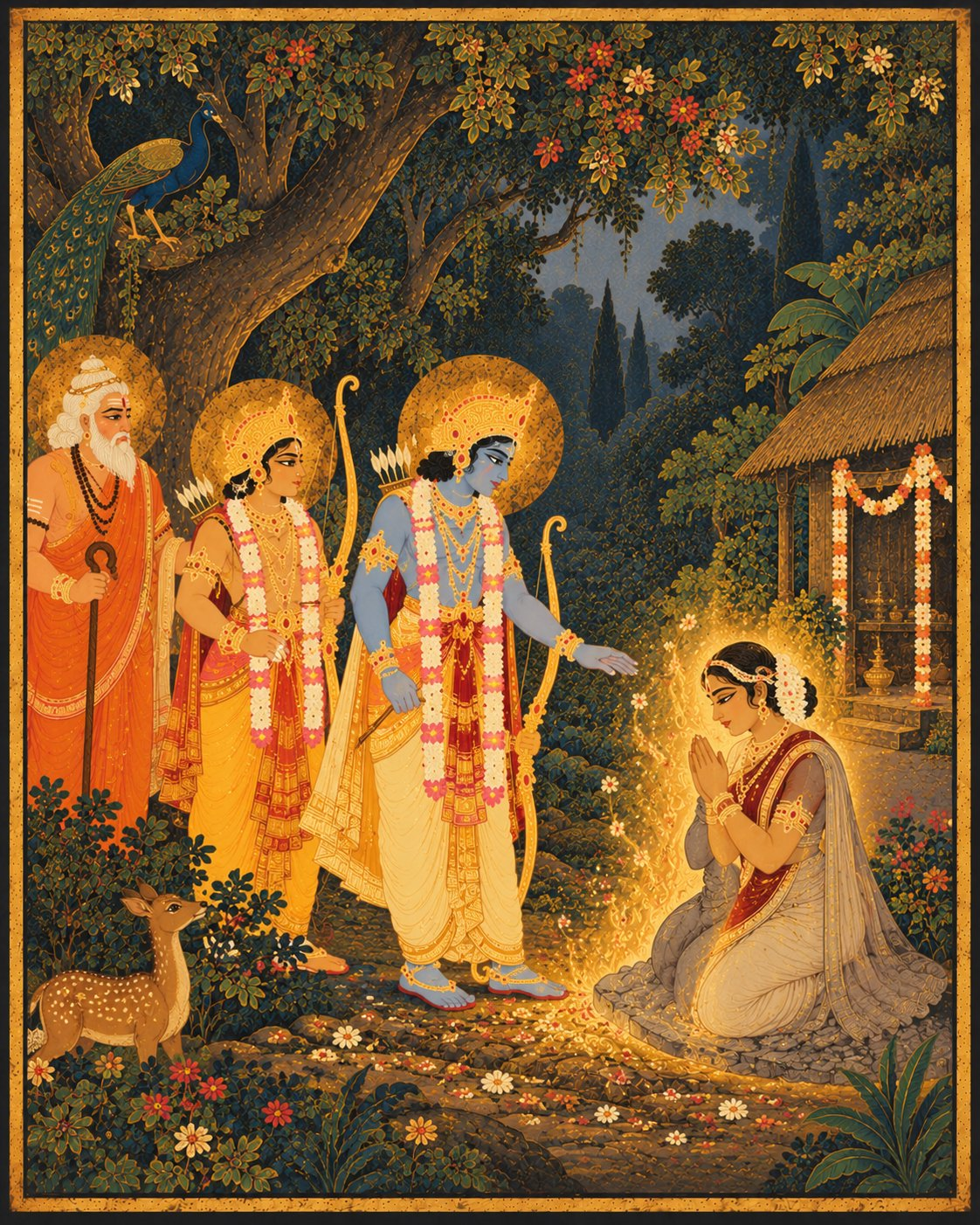
अहल्या उद्धार • पावन चरण स्पर्श
Chapter 3: Sita’s Swayamvara • Scene 1: Ahilya is Freed
“On the road to Janakpur, they passed an empty hermitage. Ahilya, turned to stone by an old curse, became human again when Rama’s feet touched the ground.”
On the road toward the holy kingdom of Mithila, Sage Vishwamitra led Sri Rama and Lakshmana past the quiet, deserted hermitage of Sage Gautama. For untold ages, an eerie stillness had enveloped the grove, where Devi Ahilya remained trapped under an ancient curse, waiting in silent penance.
As youthful Rama took a reverent step onto the hallowed ground, the sacred dust of His lotus feet touched the stone. In an instant, radiant golden light erupted through the grove; the stone dissolved, and Ahilya arose in radiant human form. With folded hands and tears of deep devotion, she bowed in profound gratitude before the Lord who had redeemed her soul.
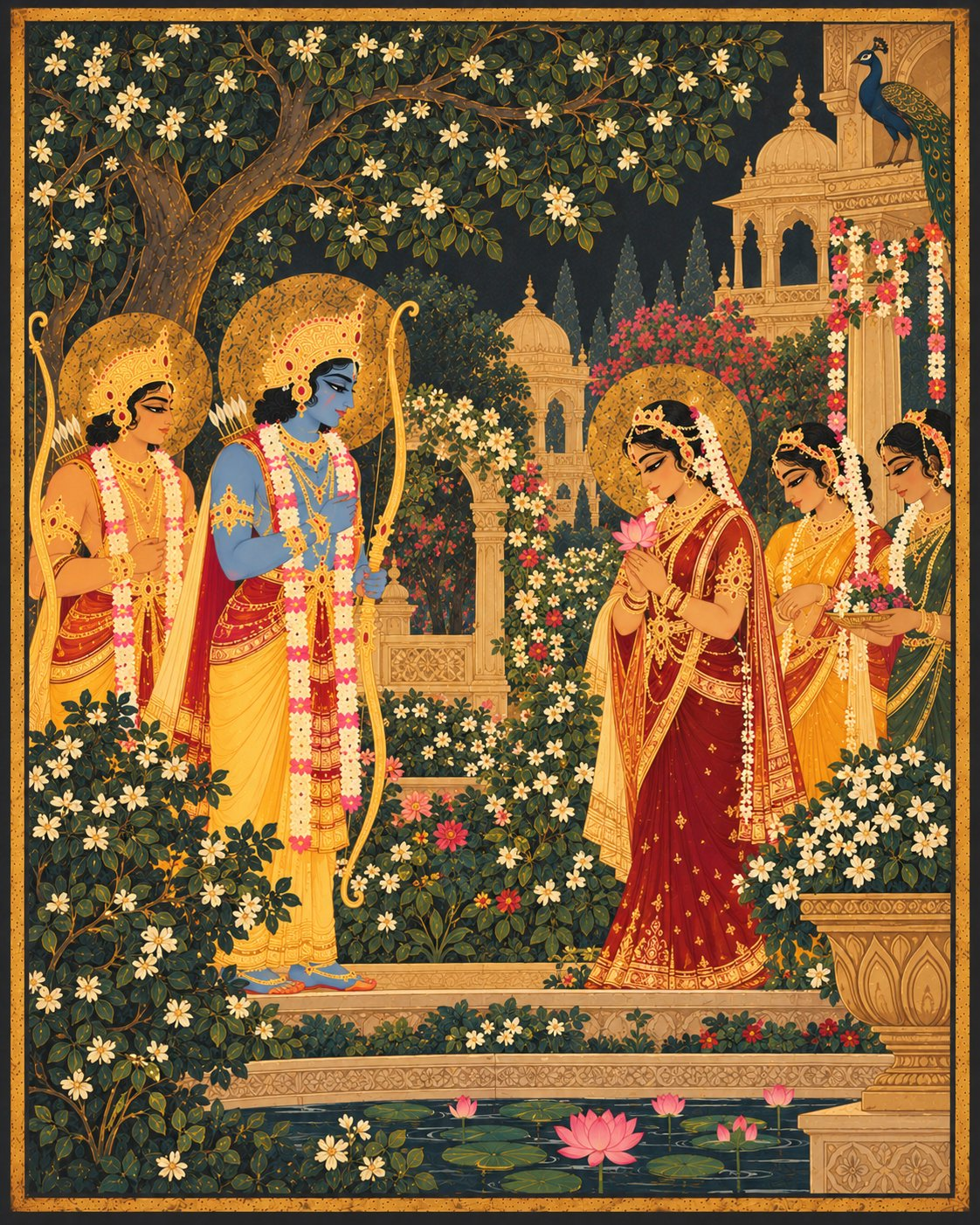
पुष्पवाटिका मिलन • प्रथम दृष्टि
Chapter 3: Sita’s Swayamvara • Scene 2: A Glance in the Garden
“In Janakpur, Rama and Sita saw each other in a flower garden. Neither spoke, but both knew.”
In the imperial gardens of Janakpur, fragrant jasmine blossoms showered petals upon crystal ponds where pink lotuses swayed in gentle breezes. Sri Rama and Lakshmana arrived in the morning light to gather fresh blossoms for Guru Vishwamitra's sacred worship.
Through the flowering branches, Princess Sita walked with her companion maidens to offer prayers at the shrine of Devi Parvati. In a timeless moment of breathless silence, Rama and Sita's eyes met. Not a single word was spoken, yet across the blooming jasmines, their hearts recognized the eternal divinity that had united them across the ages.
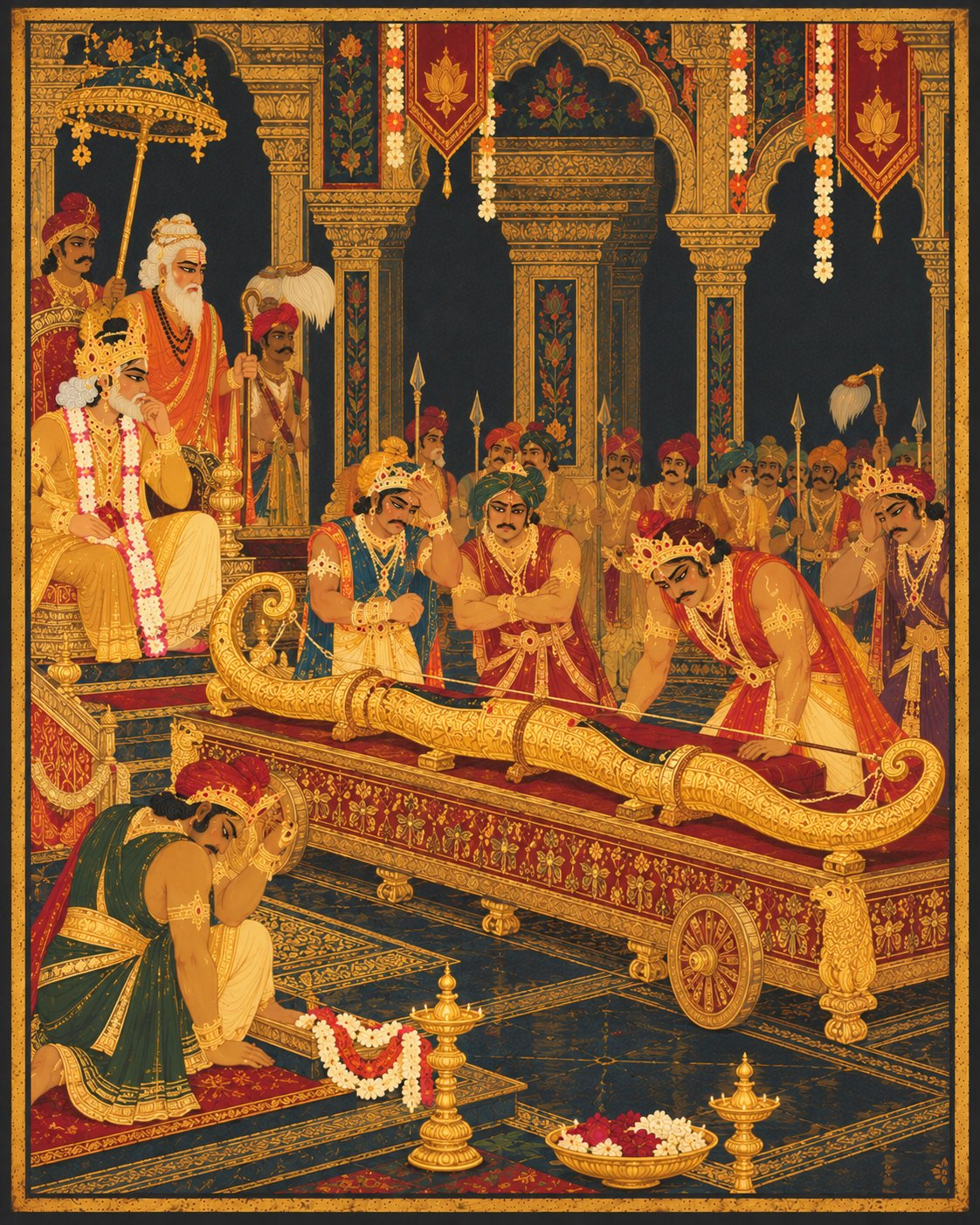
शिवधनुष आह्वान • जनक प्रतिज्ञा
Chapter 3: Sita’s Swayamvara • Scene 3: The Challenge of the Bow
“King Janaka had made a promise. Whoever lifted Lord Shiva’s great bow would marry Sita. Many strong princes tried, but none could move it.”
King Janaka proclaimed a solemn vow before the assembled royal court: only the supreme hero who could lift and string the celestial bow of Lord Shiva—the mighty Pinaka—would win the hand of Princess Sita in sacred matrimony. Drawn by her fame, valiant kings and haughty princes arrived from every corner of the earth.
Resting upon an eight-wheeled golden carriage that required hundreds of strong men just to move, the massive bow radiated divine majesty. One by one, boastful monarchs and muscular warriors strained with all their might, yet none could tilt or budge it by even an inch. Despair and shame hung heavy over the royal pavilion as King Janaka and Sage Vishwamitra watched in quiet contemplation.
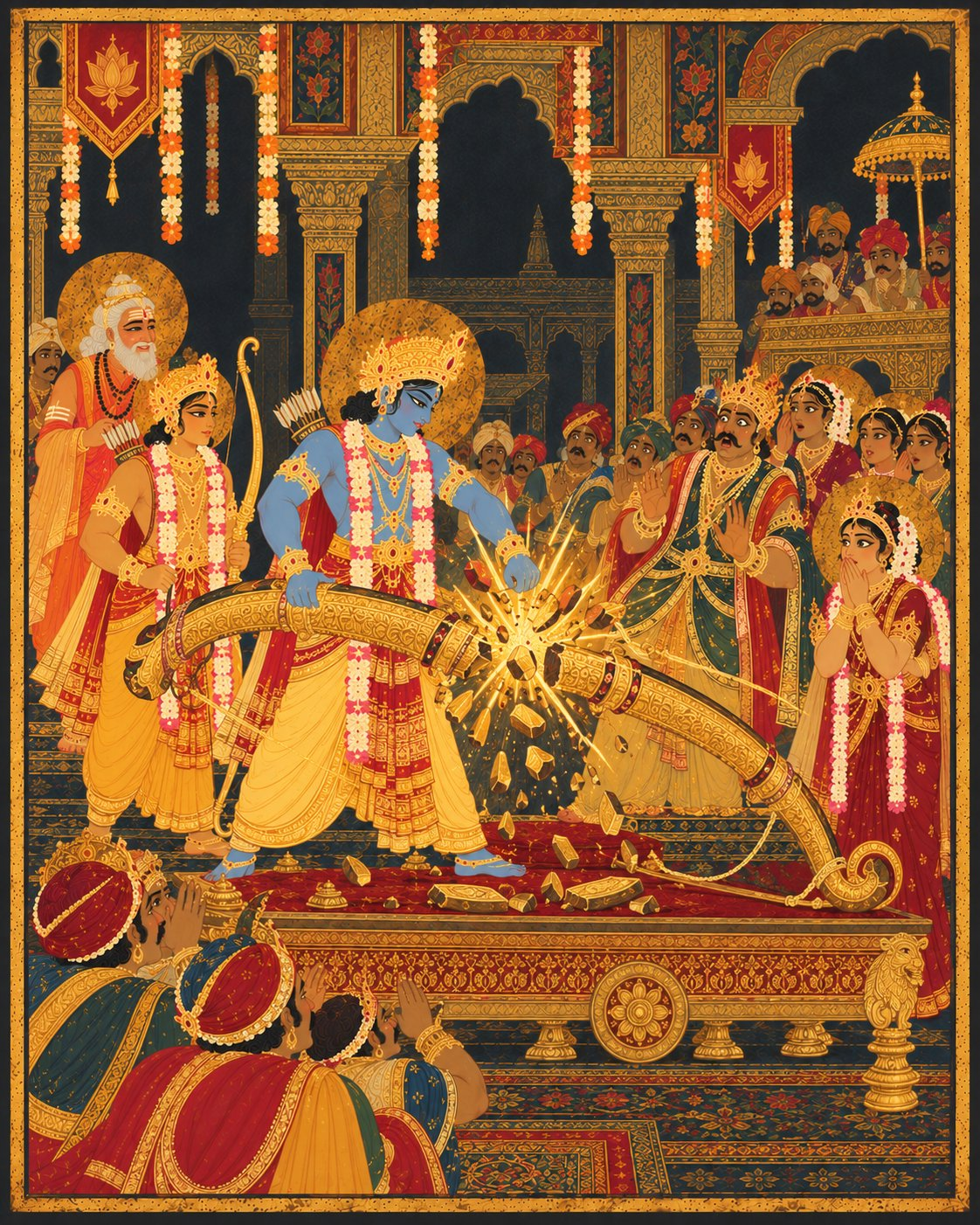
शिवधनुष भंजन • राम पराक्रम
Chapter 3: Sita’s Swayamvara • Scene 4: The Bow Breaks
“Rama lifted the bow with ease. As he strung it, it broke with a sound like thunder.”
At a nod and blessing from Sage Vishwamitra, young Sri Rama stepped calmly toward the colossal platform. With majestic serenity and divine grace, He reached out and lifted the immense bow with one hand as effortlessly as a child lifting a lotus stalk.
Stepping firmly onto the royal dais, Rama bent the celestial bow to fix the cord upon its tip. Suddenly, a deafening crack like a lightning strike shattered the silence—the mighty bow snapped into two pieces with a brilliant burst of golden sparks! The earth trembled, kings and courtiers recoiled in awe, Sage Vishwamitra beamed with pride, and Princess Sita folded her hands in overjoyed devotion.
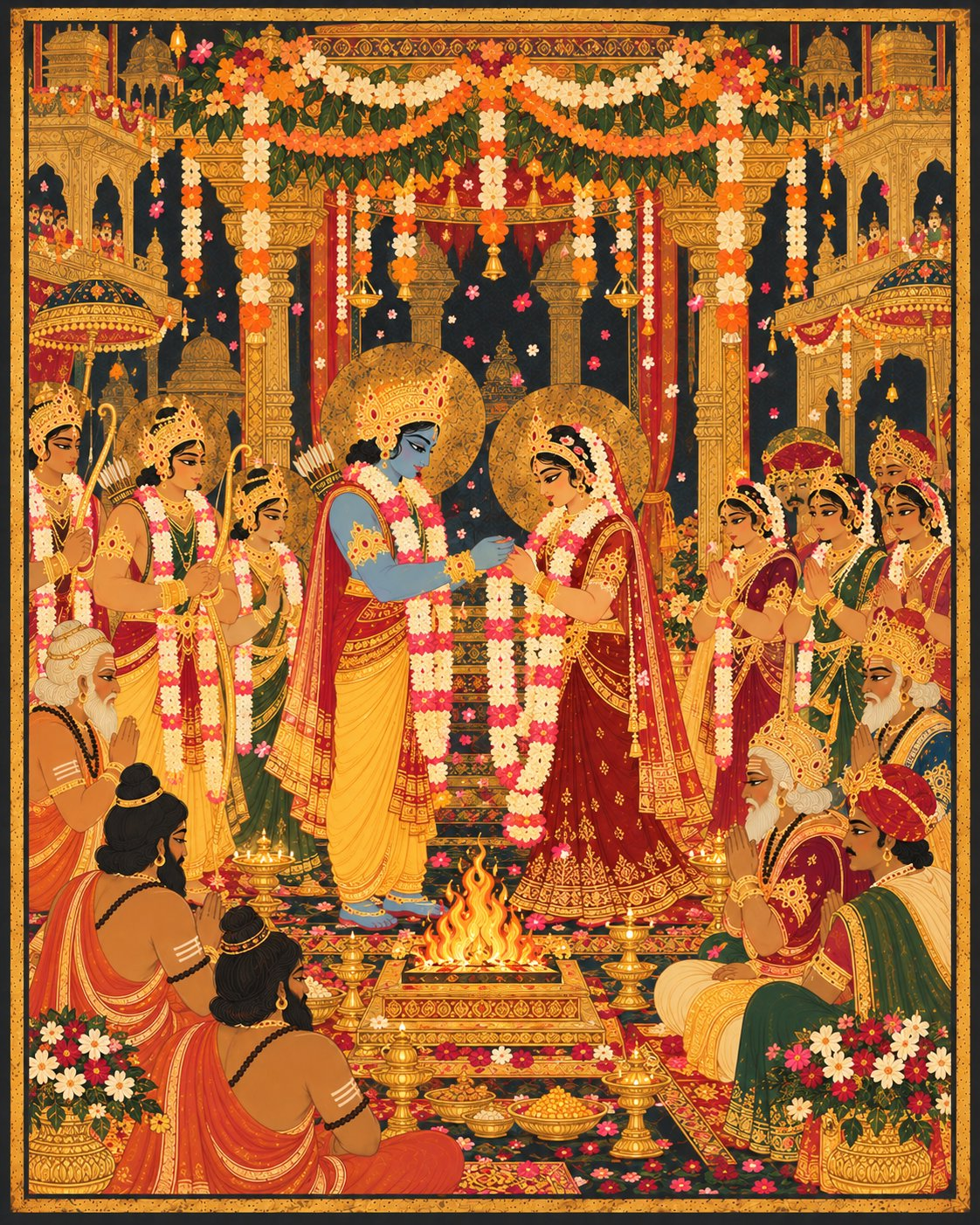
सीता-राम कल्याणम् • चतुर्भ्रातृ विवाह
Chapter 3: Sita’s Swayamvara • Scene 5: The Wedding
“Sita garlanded Rama. Dasharatha came to Janakpur, and Rama and Sita were married, along with his three brothers and Sita’s family.”
Amidst showers of celestial blossoms, Princess Sita placed the fragrant Jayamala garland around Sri Rama’s neck. Envoys galloped swiftly to Ayodhya, and King Dasharatha arrived with his royal retinue in boundless joy to celebrate the divine union.
Under an opulent mandap woven of fresh marigolds, golden lamps, and silk draperies, Sri Rama and Devi Sita took sacred vows around the blazing sacrificial fire. Alongside them in fourfold splendor, Lakshmana wed Urmila, Bharata wed Mandavi, and Shatrughna wed Shrutakirti. Sages chanted auspicious Vedic hymns, divine conches sounded through the skies, and all creation rejoiced in the holy wedding of Sita and Rama.
अध्याय ४ आरम्भ भवति
द्रवहु सुदसरथ अजिर बिहारी ॥
कैकेयी वरदान • कोपभवन
Kaikeyi’s Two Boons & The Exile Decree
On the eve of Rama’s joyous coronation as Yuvaraja, the hunchbacked maid Manthara instills fear in Queen Kaikeyi. Demanding the two boons once promised by Dasharatha, Kaikeyi asks for Bharata’s coronation and fourteen years of forest exile for Rama.
राज्याभिषेक घोषणा • अवध आनन्द
Chapter 4: Kaikeyi’s Two Boons • Scene 1: The Coronation is Announced
“Dasharatha grew old and decided to crown Rama as king. All Ayodhya was overjoyed, and the city was decorated for the next morning.”
Feeling the weight of advancing years and desiring the eternal welfare of his kingdom, King Dasharatha resolved to crown his beloved eldest son, Sri Rama, as the crown prince of Ayodhya. The imperial assembly of sages, ministers, and citizens erupted in thunderous cheers of joyful acclaim.
Overnight, the sacred capital of Ayodhya transformed into an earthly paradise of celebration. Streets were draped in vibrant marigold garlands, thousands of golden lamps illuminated palace balconies, and fragrant water cooled the wide avenues. Drums beat rhythmic pulses of jubilation and flowers showered through the air as all Ayodhya eagerly awaited the dawn of Sri Rama's coronation.
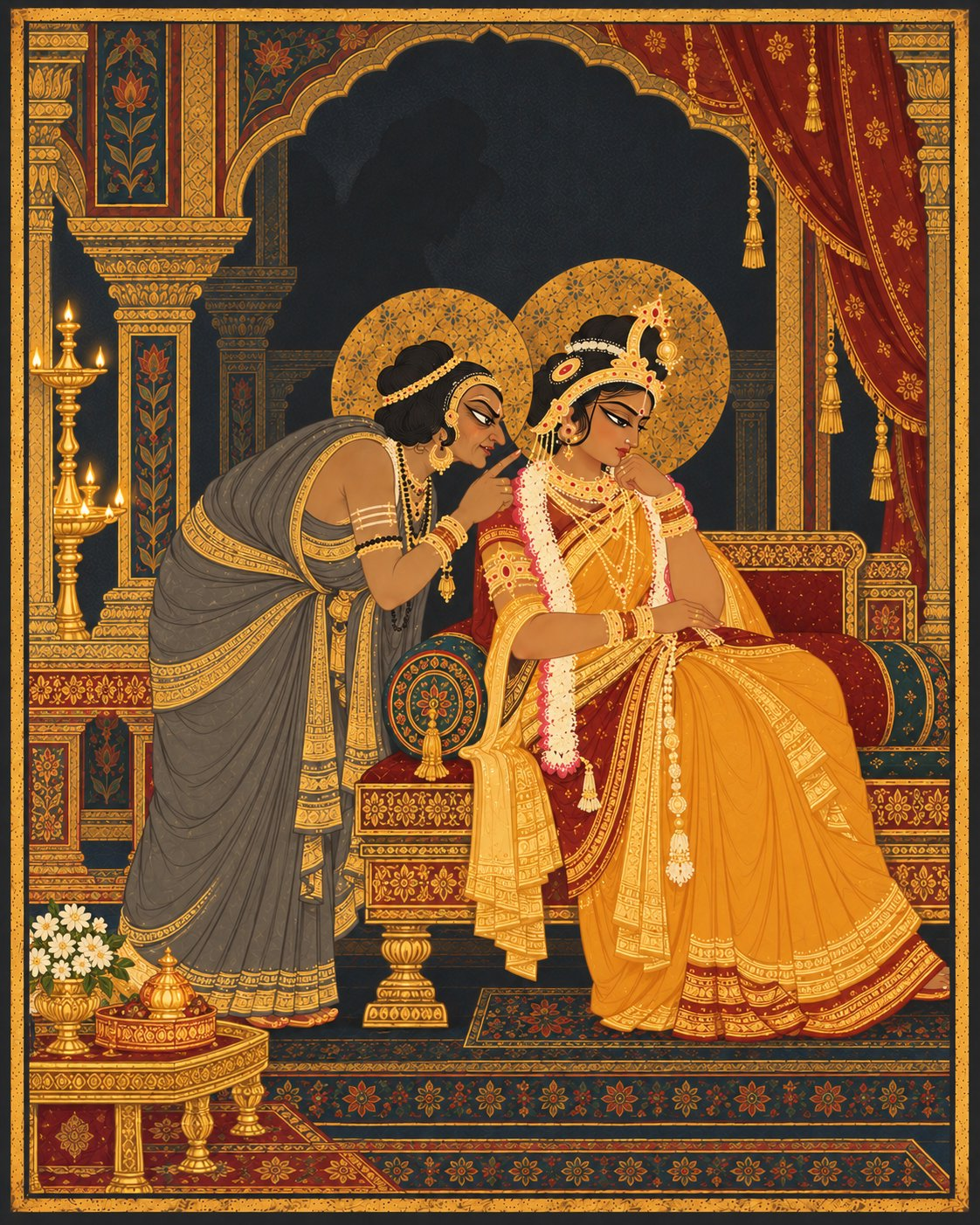
मन्थरा कुमंत्रणा • विषबीज वपन
Chapter 4: Kaikeyi’s Two Boons • Scene 2: Manthara’s Whisper
“Kaikeyi’s maid Manthara could not bear the news. She whispered fears into the queen’s ear until Kaikeyi’s love for Rama turned to worry for her own son Bharata.”
While all the kingdom rejoiced in festive ecstasy, dark malice festered in the heart of Queen Kaikeyi’s hunchbacked maid, Manthara. Incensed by the news of Rama's impending coronation, she rushed into Kaikeyi's luxurious private chambers to shatter the queen's joyous peace.
Leaning close with a pointed finger, Manthara poured deceitful venom into Kaikeyi’s ear, conjuring fearful illusions that once Rama ascended the throne, her own beloved son Bharata would be exiled or enslaved. Slowly, the relentless poison took root, twisting Kaikeyi’s profound affection for Rama into consuming anxiety and hardened ambition.
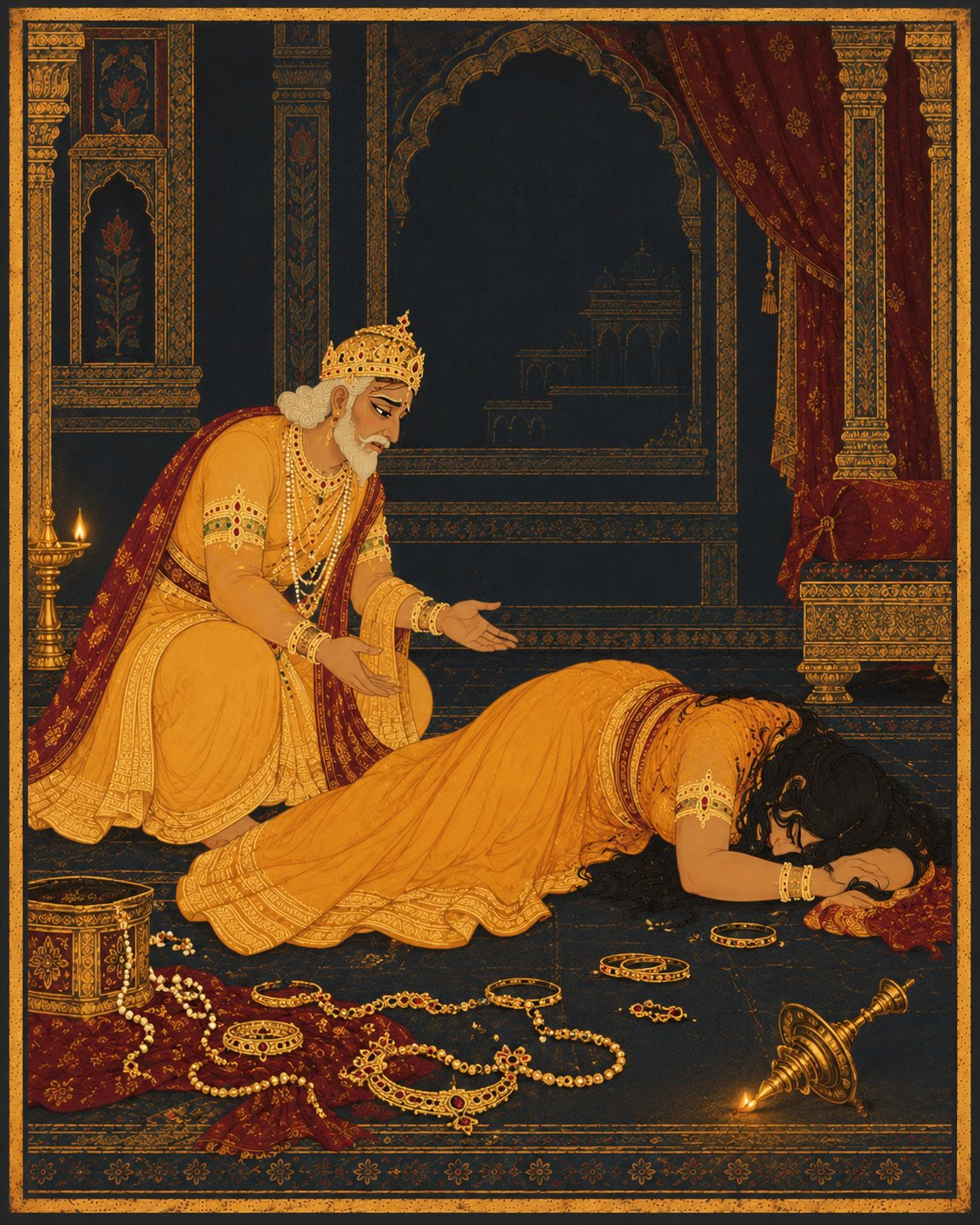
कोपभवन प्रवेश • वरदान याचना
Chapter 4: Kaikeyi’s Two Boons • Scene 3: The Anger Room
“Kaikeyi took off her jewels and lay down on the floor of the anger room. When the king came, she reminded him of the two boons he had once promised her, after she saved his life in battle.”
Divesting herself of royal diadems, pearl necklaces, and silk garments, Queen Kaikeyi flung herself onto the cold marble floor of the palace's chamber of sorrow—the Kopabhavan. Her long hair fell disheveled across the stones, and tears of bitter defiance streaked her countenance as the lamp burned low.
When an unsuspecting King Dasharatha entered to share his royal joy, he was horrified to find his beloved queen weeping upon the bare ground. Kneeling beside her with outstretched hands, he pleaded to know her grief. Seizing upon his tender love, Kaikeyi reminded him of the two boons he had solemnly promised her long ago during the fierce battle with Sambara, demanding their immediate fulfillment.
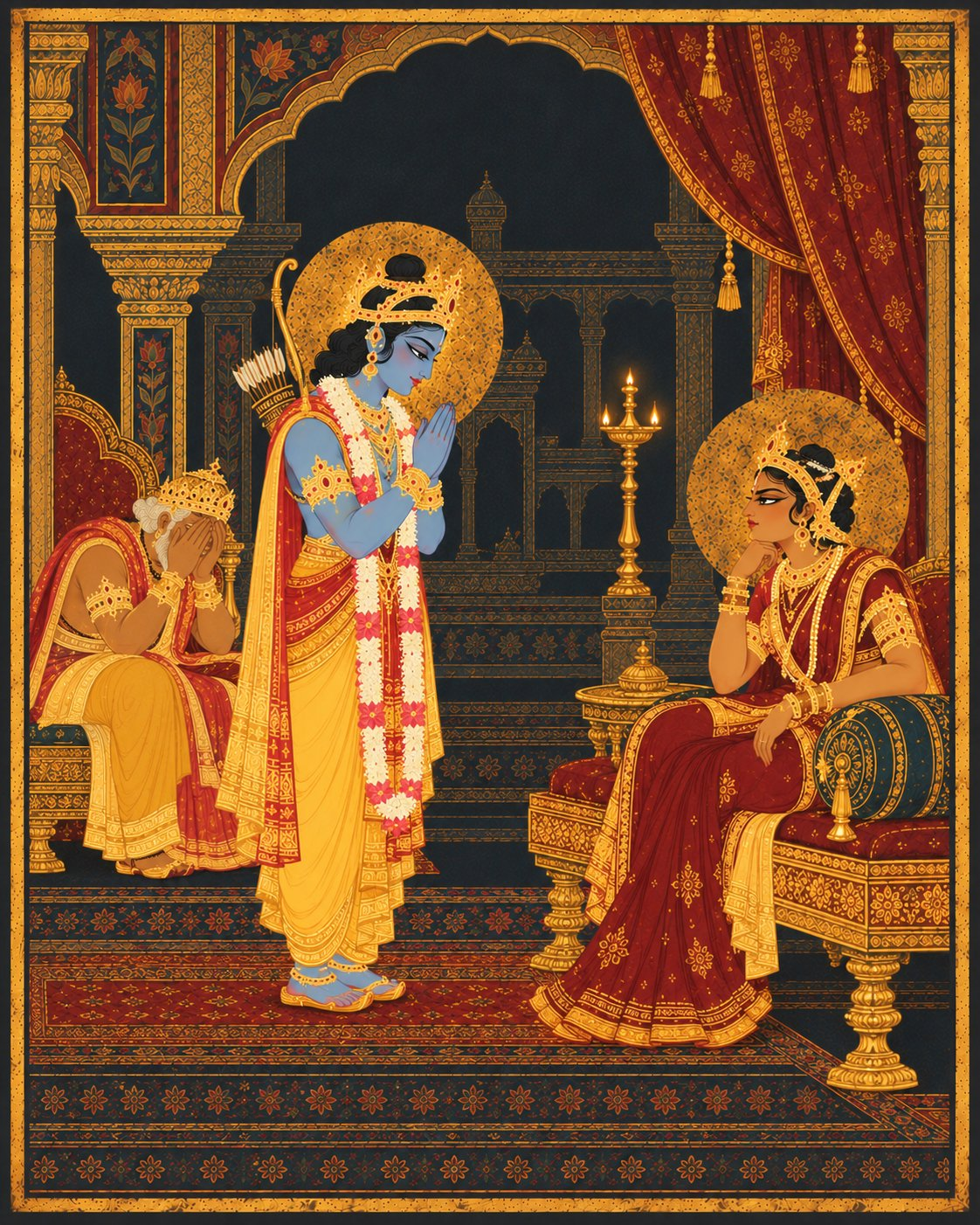
राम सौम्य वचन • पितृवाक्य परिपालन
Chapter 4: Kaikeyi’s Two Boons • Scene 4: Rama’s Calm Answer
“Kaikeyi asked for Bharata to be crowned, and for Rama to live in the forest for fourteen years. When Rama heard it, he smiled, bowed and agreed to keep his father’s word.”
The dreadful decree fell like a bolt of lightning: Prince Bharata was to be consecrated upon the throne of Ayodhya, while Sri Rama must depart in ascetic robes to live in the wild Dandaka forest for fourteen long years. King Dasharatha sat shattered in the corner, covering his tear-stained face in unspeakable agony.
Yet when Sri Rama was summoned and heard the harsh demands, no trace of sorrow or bitterness touched His divine countenance. Smiling with serene compassion, He folded His hands and bowed before Kaikeyi, declaring that no duty in all the three worlds was greater than honoring a father's sacred word. Unshakable in dharma, Rama accepted exile with the joy of a son serving righteousness.
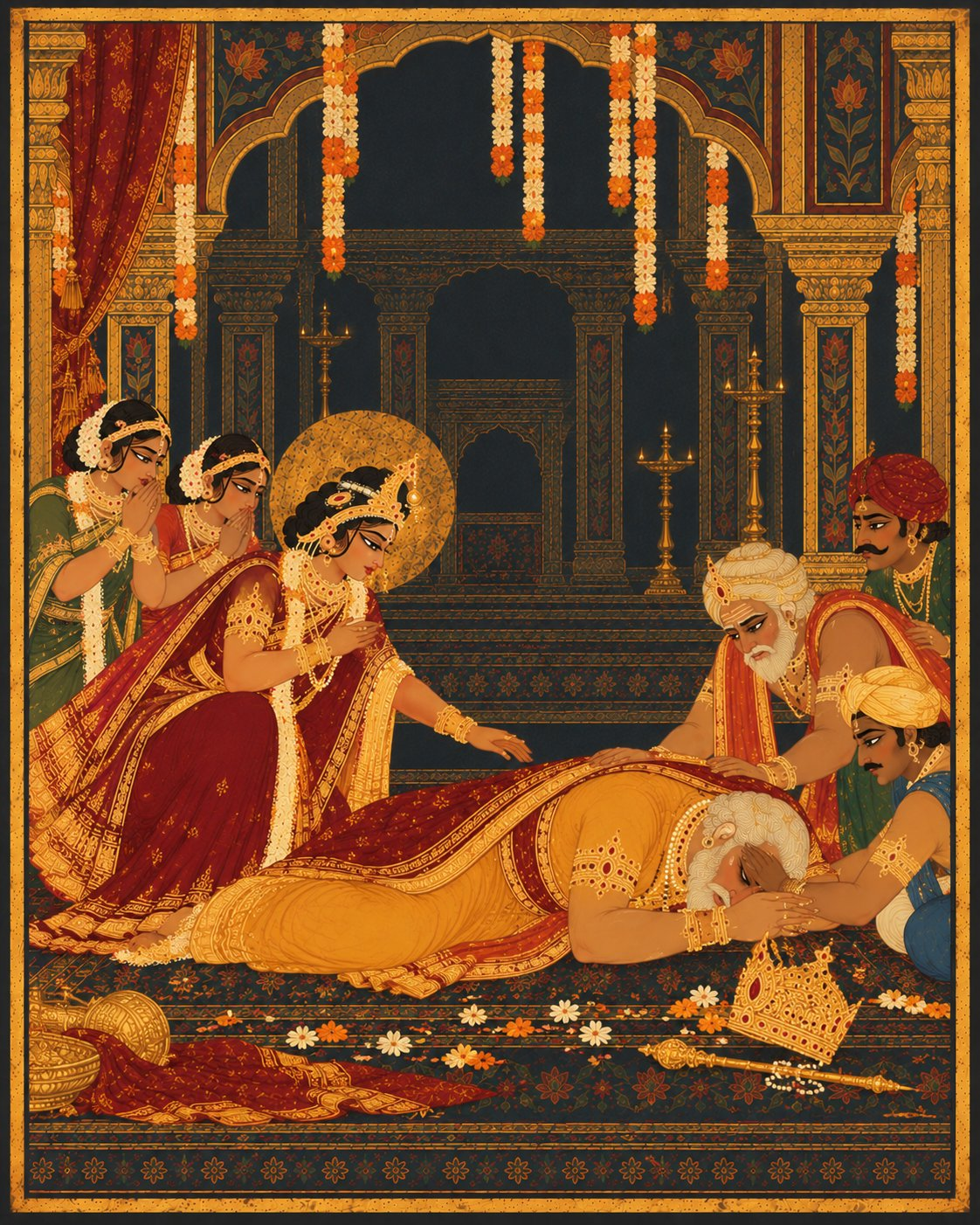
दशरथ विलाप • विषाद रजनी
Chapter 4: Kaikeyi’s Two Boons • Scene 5: A Father’s Grief
“Dasharatha could not bear it and fell to the floor, broken by sorrow. The night before a celebration turned into a night of silence.”
Crushed beneath the insurmountable weight of sorrow and powerless against his own royal pledge, King Dasharatha collapsed upon the palace floor, his golden crown slipping from his brow. The venerable monarch lay motionless in utter desolation, crying out Sri Rama’s name through tearless sobs.
Queen Kausalya and loyal minister Sumantra rushed in horror to the King's side, while attendants wept in stunned disbelief. In the courtyard outside, the vibrant coronation garlands hung limp against silent pillars, and the joy of a kingdom vanished into an agonizing night of mournful silence. The dawn that was meant for celebration had turned into the darkest eclipse of destiny.
अध्याय ५ आरम्भ भवति
द्रवहु सुदसरथ अजिर बिहारी ॥
श्रीराम वनगमन • अयोध्यातपः
Leaving for Exile & Ayodhya’s Tears
Steadfast in upholding his father's truth, Sri Rama dons simple bark robes. Accompanied by devoted Sita and faithful Lakshmana, they bid farewell to heartbroken Queen Kaushalya, cross the holy Ganga with boatman Guha, while King Dasharatha passes away in inconsolable sorrow.
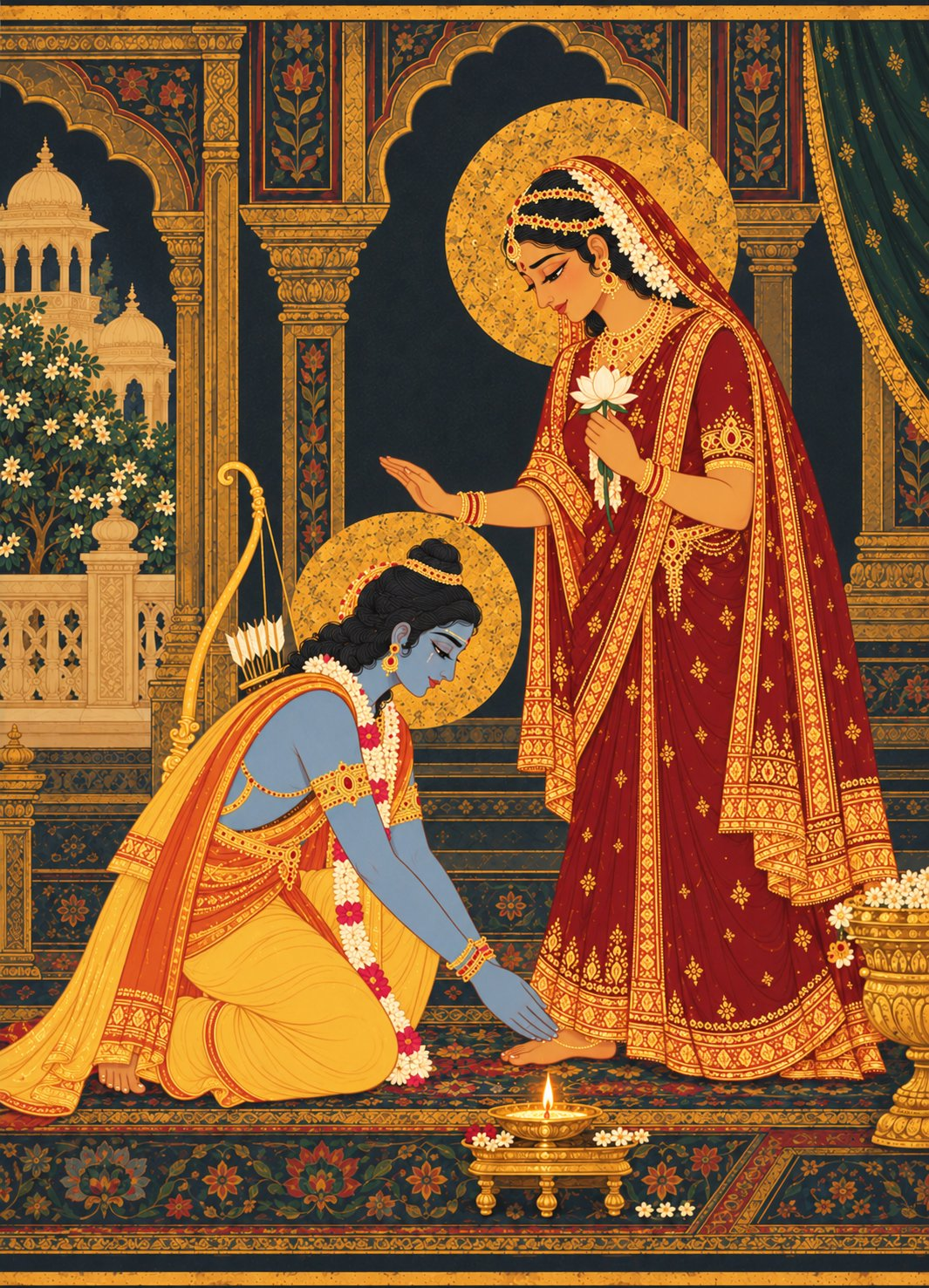
कौसल्यायाः आशीर्वादः • मातृवन्दनम्
Chapter 5: Leaving for Exile • Scene 1: Farewell to his Mother
“Rama bowed to his mother Kaushalya and asked for her blessing. Heartbroken, she blessed him and let him go.”
Clad in simple ascetic attire and relinquishing every royal ornament, Sri Rama walked with tranquil grace into the inner palace to meet Queen Kaushalya. Falling at her feet with folded hands, he gently broke the heavy tidings of his fourteen-year exile, seeking his mother's blessing to fulfill King Dasharatha's solemn promise.
Overwhelmed by motherly sorrow, Kaushalya wept tears that bathed her golden robes, yet seeing Rama's resolute devotion to righteousness, she raised her hand in supreme benediction. Beside a flickering sacred lamp, she invoked all celestial devas, holy sages, and the cosmic order of dharma to guide and shield her peerless son through every forest path.
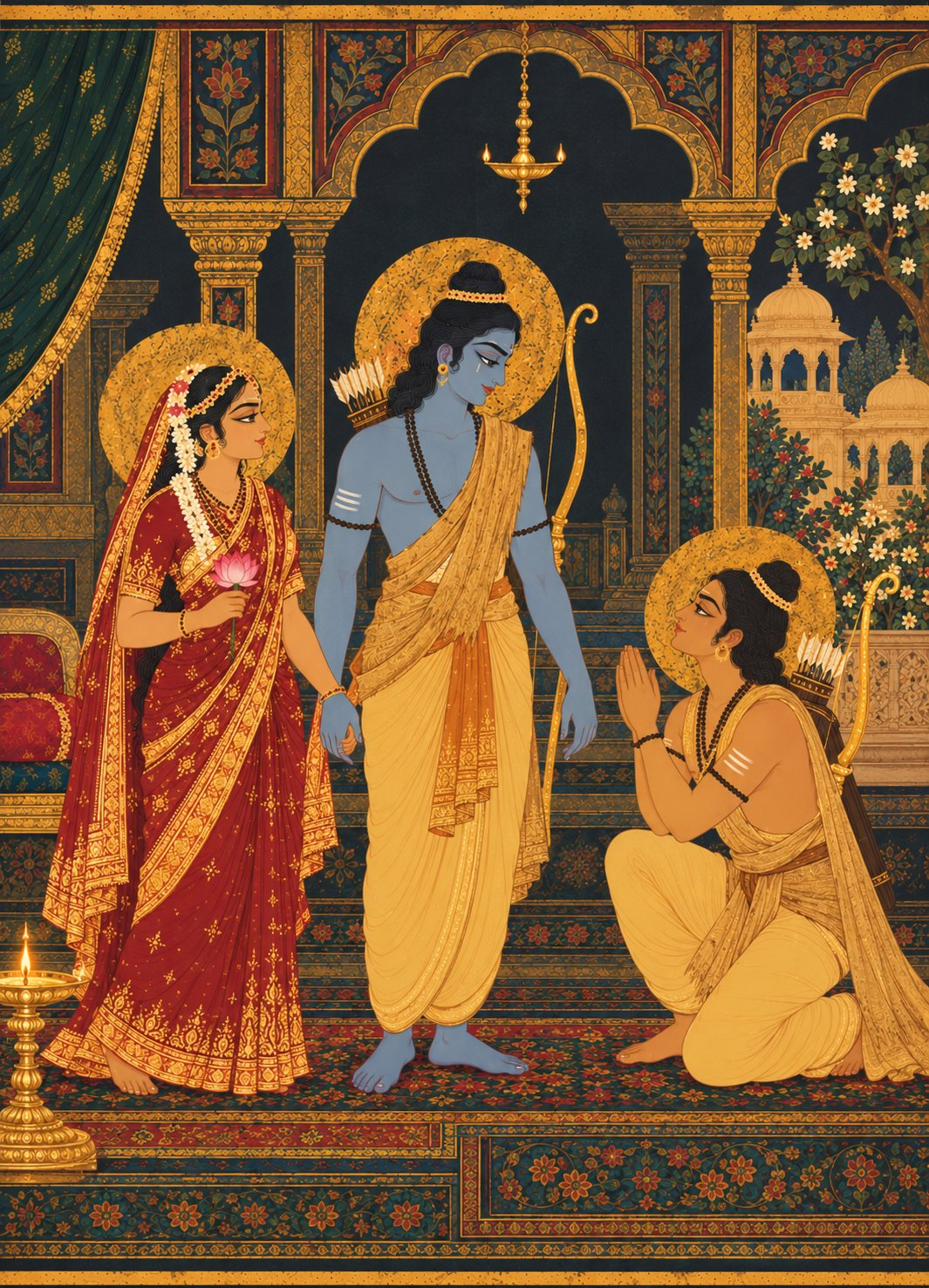
सीता-लक्ष्मणयोः दृढसङ्कल्पः • अनन्यभक्तिः
Chapter 5: Leaving for Exile • Scene 2: Sita & Lakshmana Will Not Stay
“Rama asked Sita to stay in the palace, but she said, ‘Where you go, I go.’ Lakshmana also begged to follow, and Rama agreed.”
Desiring to spare his gentle princess the thorny trials of the wild forests, Sri Rama lovingly urged Sita to remain safe in Ayodhya, serving his aging parents. But the noble daughter of King Janaka held his hand steadfastly, clasping a sacred pink lotus in her hand, her face glowing with unshakeable resolve as she affirmed that where Rama walked, her place was ever by his side.
At that moment, prince Lakshmana fell to one knee before his elder brother with folded palms, passionately pleading that an Ayodhya without Rama would be like a scorched wasteland. Touched to his very soul by their unconditional love and pure devotion, Rama looked upon both with a gentle, tear-bright smile and welcomed them into his hermitage journey.
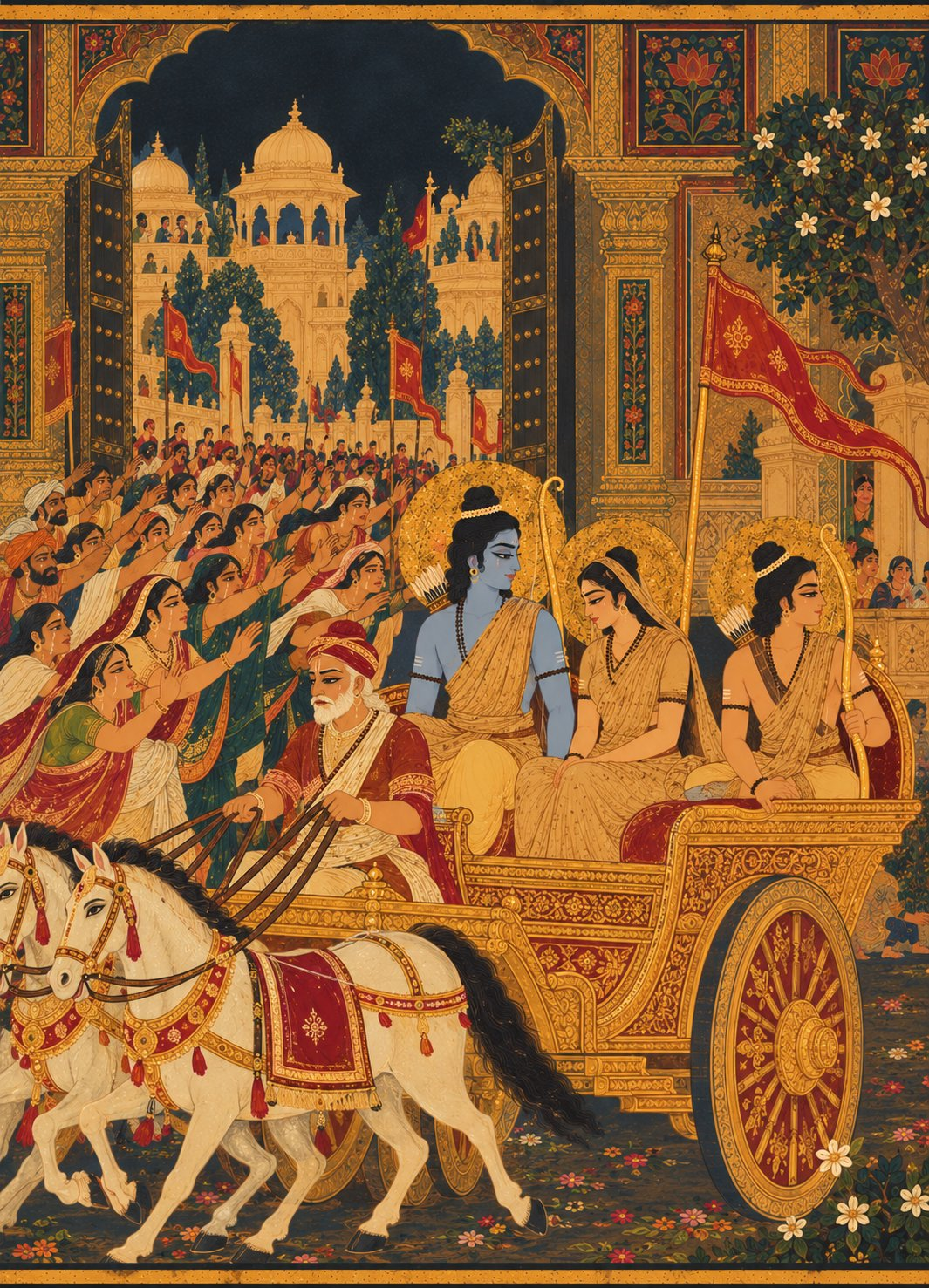
अयोध्यानगर्याः क्रन्दनम् • वनगमन प्रस्थानम्
Chapter 5: Leaving for Exile • Scene 3: Ayodhya Weeps
“Rama, Sita and Lakshmana put on simple bark clothes and left the palace. The people of Ayodhya wept and ran behind the chariot.”
Adorned only in austere bark garments and ascetic beads, Sri Rama, Sita, and Lakshmana mounted the royal chariot steered by the venerable minister Sumantra. As the golden-spoked wheels began to turn through the open arched gates of Ayodhya, an uncontrollable wave of anguish swept through the entire populace.
Men, women, and elders poured into the sunlit streets, weeping bitterly and running barefoot behind the churning wheels with outstretched arms. The citizens cried out to Sumantra to rein in his horses, lamenting that even the majestic temple peacocks and river lotuses withered in sorrow at the departure of their righteous prince.
गङ्गोत्तारी निषादराजः • शृङ्गवेरपुर सङ्गमः
Chapter 5: Leaving for Exile • Scene 4: Crossing the Holy Ganga
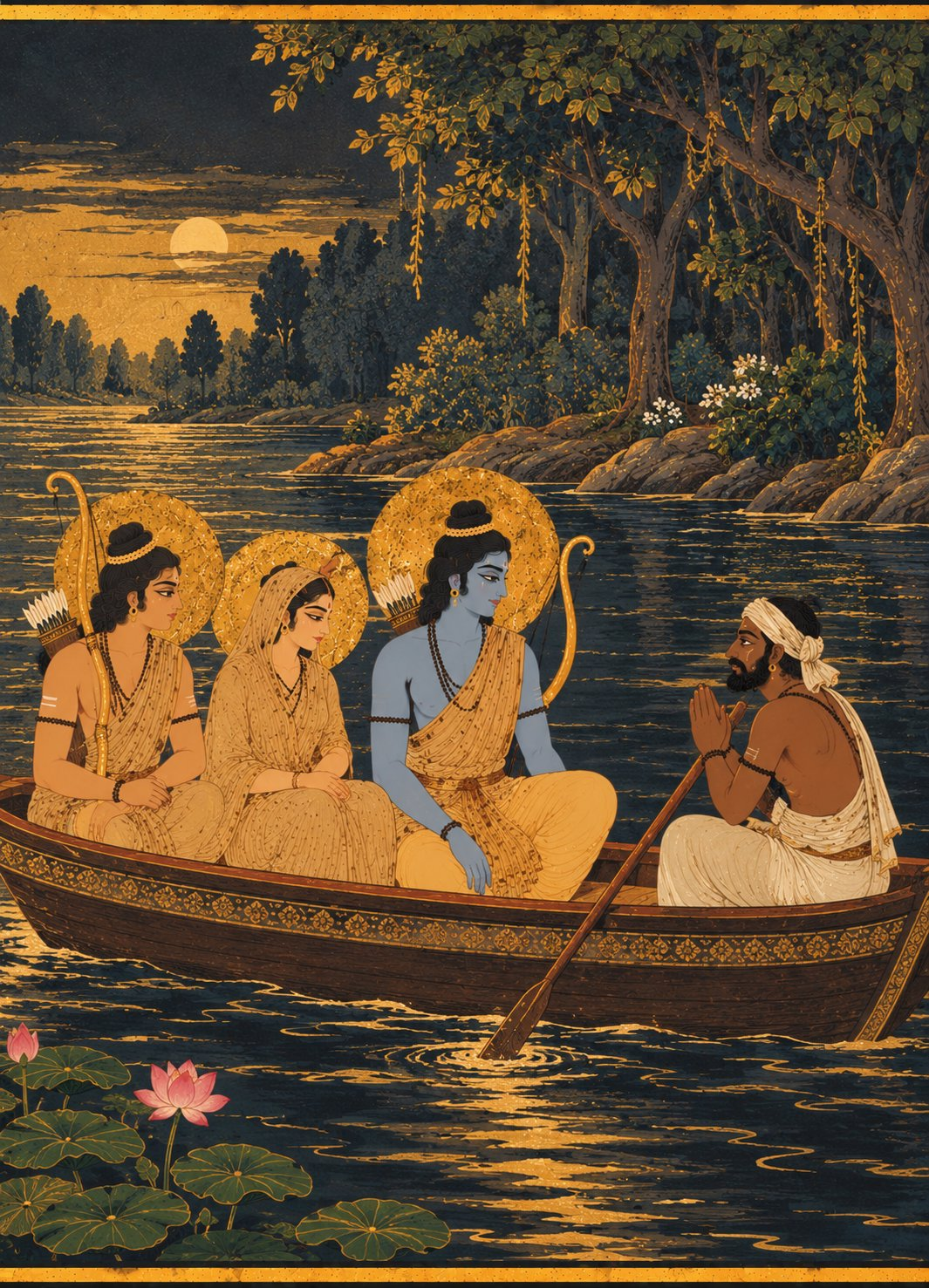
“At the river Ganga, the boatman Guha welcomed them with love and rowed them across. Rama sent the chariot home, and the forest journey began.”
Reaching the sacred waters of the River Ganga at Shringaverapura, the travellers were greeted by Guha, the devoted chieftain of the Nishadas, who ran forward with folded hands to surrender his entire kingdom at Rama's feet. Embracing him warmly as an equal and a brother, Rama gently declined all royal comforts to uphold his sacred vow.
Sending Sumantra and the chariot back to comfort his grieving father, Rama stepped aboard Guha's humble wooden skiff alongside Sita and Lakshmana. As golden ripples shimmered under the moonlit sky and the dark silhouettes of ancient trees beckoned on the distant shore, Guha rowed them serenely across, inaugurating their fourteen sacred years in the forest wilderness.
दशरथस्य महाप्रयाणम् • पितृ-वियोग विषादः
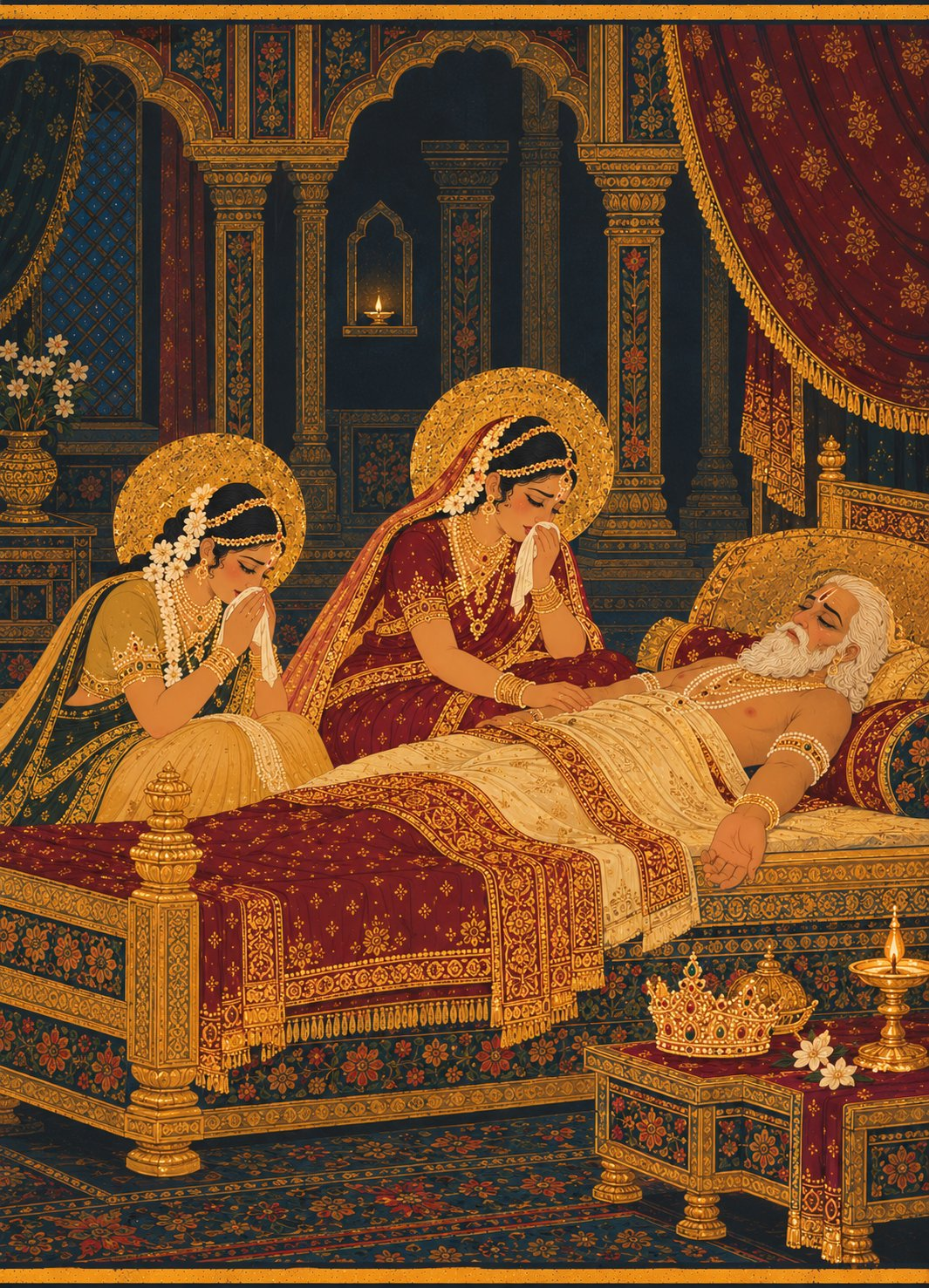
Chapter 5: Leaving for Exile • Scene 5: A Father’s Last Night
“Back in Ayodhya, Dasharatha could not stop calling out for his son. Heartbroken, he left this world, and Ayodhya fell silent.”
In the secluded twilight of the royal bedchamber, King Dasharatha lay upon his gilded couch, his golden crown laid aside upon a velvet stool. His aged heart, shattered by the departure of his most cherished son, could find no solace, and his outstretched hand reached into the void of the darkening hall.
Beside him, Queen Kaushalya and Queen Sumitra knelt in quiet sorrow, their tears falling upon his hands. As a solitary brass diya flickered its dying flame, Dasharatha called out Sri Rama's name one final time before breathing his last breath. At midnight, the king departed this mortal realm, leaving the magnificent city of Ayodhya shrouded in desolate, mournful silence.
अध्याय ६ आरम्भ भवति
द्रवहु सुदसरथ अजिर बिहारी ॥
चरण पादुका • नन्दिग्राम राज्य
Bharata & The Sacred Sandals
Returning to a desolate Ayodhya, Bharata angrily renounces the crown. Marching with the citizens to Chitrakoot, he implores Rama to return. When Rama insists on honoring his father's vow, Bharata places Rama’s consecrated wooden sandals upon the royal throne, ruling from Nandigram as his servant.
भरतागमनम् • कैकेयी धिक्कारः
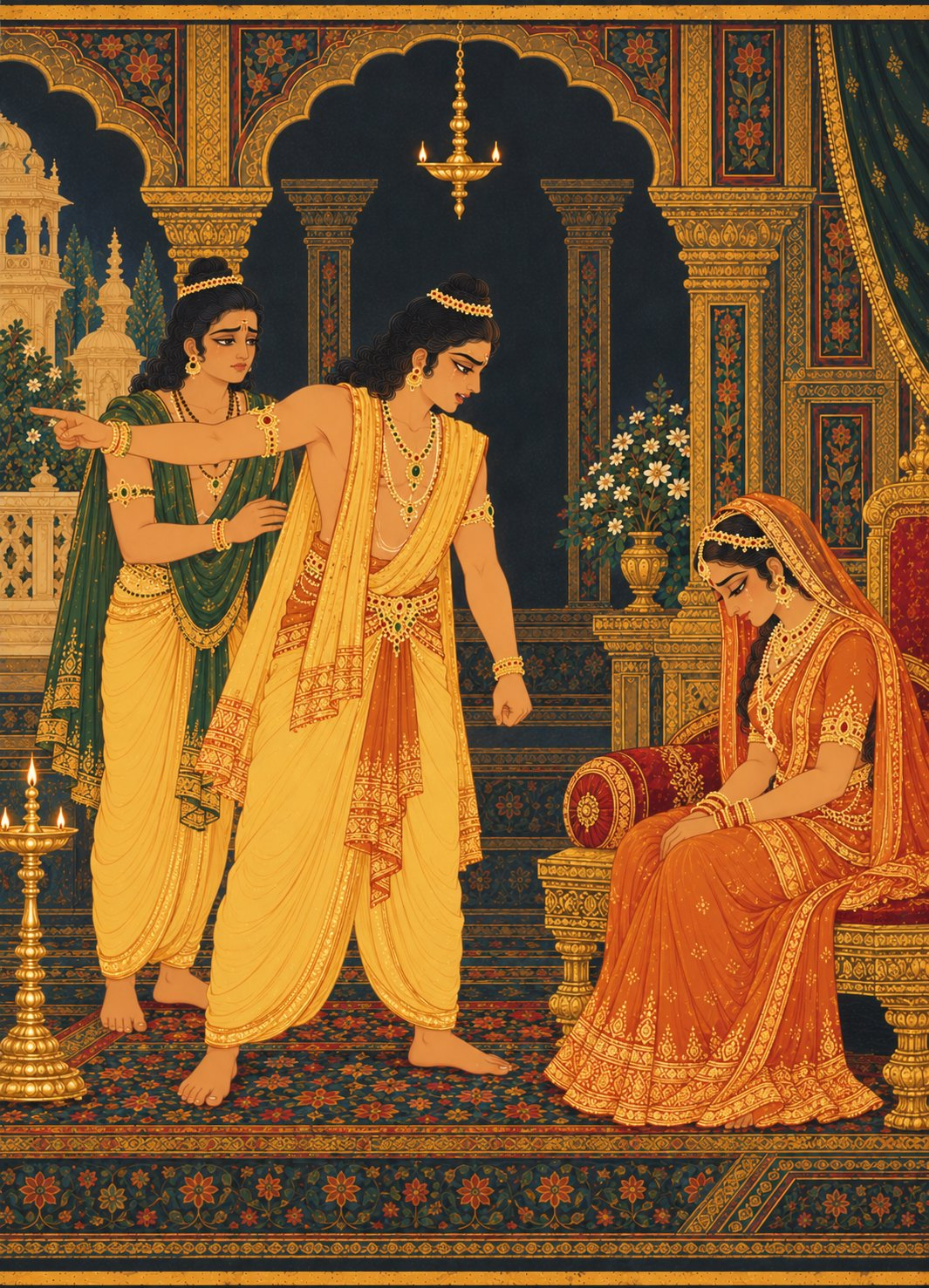
Chapter 6: Bharata and the Sandals • Scene 1: Bharata Comes Home
“Bharata returned from his uncle’s kingdom and found Ayodhya silent. When he learned that his father was gone and Rama was in exile, he was shattered. He refused to accept the crown his mother had won for him.”
Hurrying back from his maternal uncle’s kingdom of Kekaya upon an urgent summons, noble Bharata was horrified to find Ayodhya draped in ominous, deathly silence. Expecting festive preparations, he entered the royal palace only to be greeted by his mother Kaikeyi, who proudly revealed that Dasharatha had departed this life and Rama was exiled to the wild forests to secure Bharata’s sovereignty.
Shattered to his very marrow by grief and righteous fury, Bharata recoiled in horror, pointing an accusing hand at his scheming mother as bitter tears streamed down his cheeks. Beside him, Shatrughna stood paralyzed with shock. Vehemently disowning the ill-gotten crown, Bharata proclaimed that he would rather wander as a mendicant than usurp the birthright of his beloved elder brother.
पितृमेध संस्कारः • राज्याभिषेक प्रत्याख्यानम्
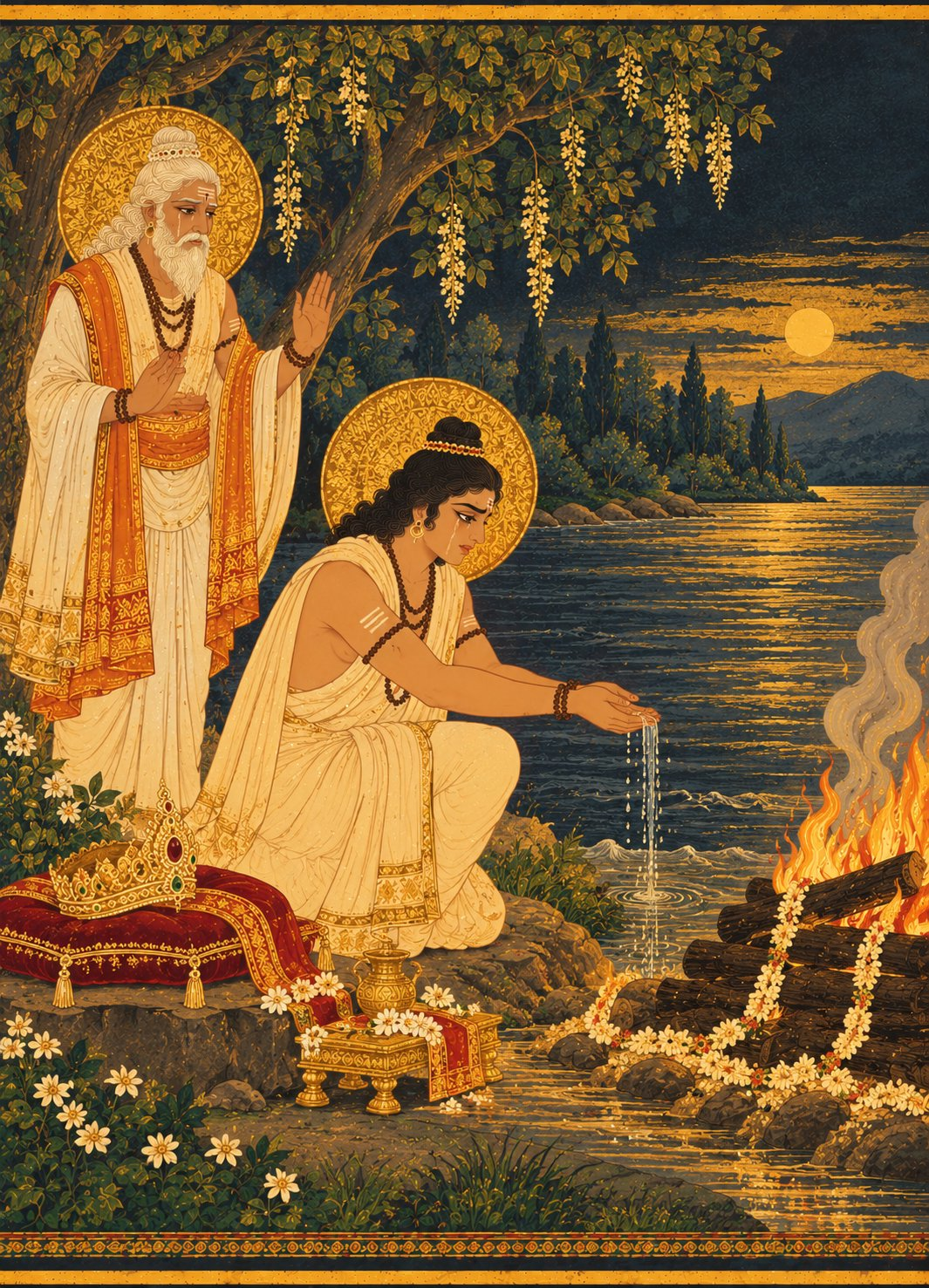
Chapter 6: Bharata and the Sandals • Scene 2: The Funeral and the Refused Crown
“After performing his father’s last rites, Bharata declared that the throne belonged to Rama. He decided to bring Rama back himself.”
Donning simple unstitched off-white robes and rudraksha beads, Bharata performed the solemn funeral rites and sacred water libations for his deceased father upon the banks of the sacred river. With sage Vasishtha guiding the oblations, the imperial ministers placed King Dasharatha's resplendent golden crown upon a silk cushion, imploring Bharata to mount the empty throne.
With tears glistening in his eyes, Bharata fell to the ground and firmly declined the royal insignia, refusing even to touch the unclaimed crown. Before the venerable preceptors and assembly of citizens, he made a solemn vow: he would march into the deep forest, locate Sri Rama, and place the crown where it rightfully belonged.
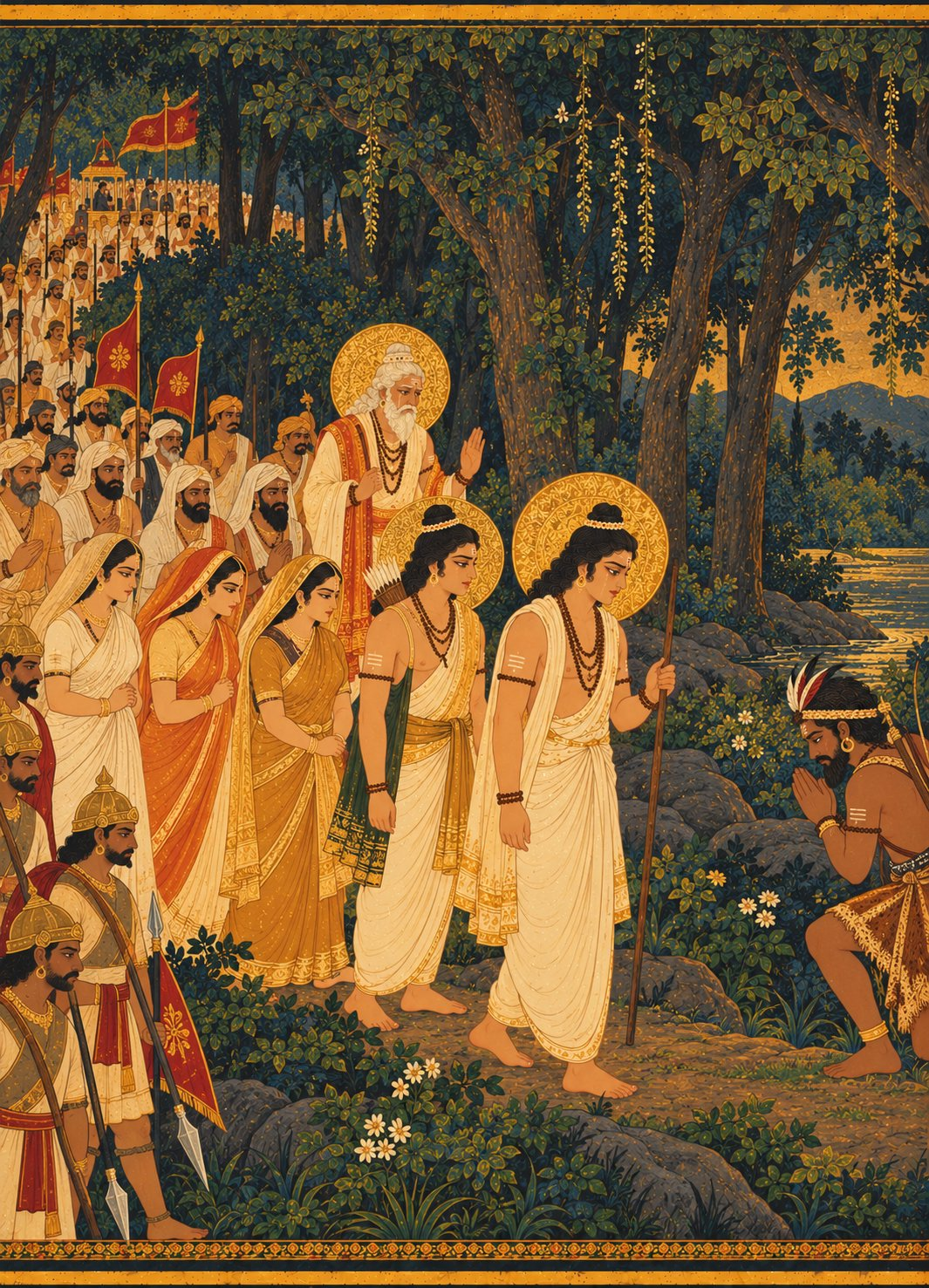
वनप्रस्थानम् • निषादराज समागमः
Chapter 6: Bharata and the Sandals • Scene 3: Journey to the Forest
“Bharata set out for the forest with the three queens, the sages and half of Ayodhya. At the Ganga, Guha feared an attack, but he wept when he saw Bharata’s simple clothes and sorrowful face.”
A monumental pilgrimage departed the city gates of Ayodhya: prince Bharata and Shatrughna walking barefoot at the vanguard, followed by the three mourning queens in humble saris, Sage Vasishtha, and thousands of devoted citizens in white and ochre cloth. The royal army marched with spears lowered in reverence rather than conquest.
Arriving at the banks of the Ganga, the tribal king Guha initially assembled his warriors, fearing an assault upon Rama. But when Guha gazed upon Bharata’s unadorned robes, humble wooden staff, and face hollowed by grief, his suspicion melted into overwhelming reverence. Weeping with emotion, Guha fell at Bharata’s feet and guided the grand procession across the waters toward Chitrakoot.
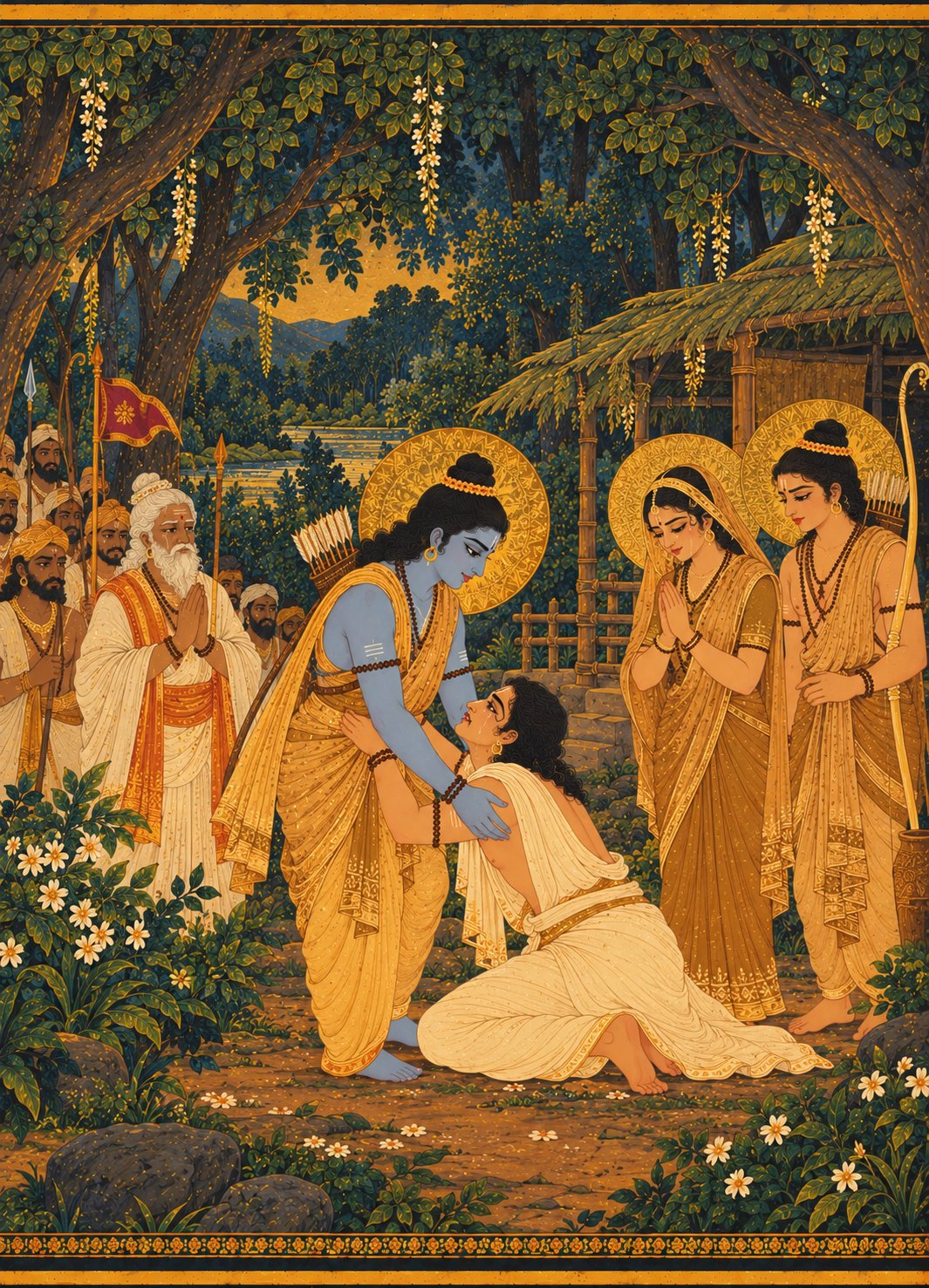
चित्रकूट मिलाप • भ्रातृस्नेह पराकाष्ठा
Chapter 6: Bharata and the Sandals • Scene 4: The Meeting at Chitrakoot
“At Chitrakoot, Bharata ran to Rama and fell at his feet. He begged his brother to return and be king. Rama hugged him, but he would not break his father’s promise.”
At the peaceful forest hermitage of Chitrakoot, Bharata caught sight of Sri Rama clad in rough bark cloth, his sacred hair tied in an ascetic knot. Overcome by intense love and sorrow, Bharata sprinted forward and collapsed prostrate at Rama’s lotus feet, weeping bitterly as he confessed their father's passing and begged his brother to return and rule.
Gently kneeling in the forest dust, Sri Rama lifted his weeping brother with both arms and drew him close to his heart. Mata Sita and Lakshmana watched with brimming eyes. Though grief pierced Rama’s soul at Dasharatha’s death, his commitment to truth remained unshaken; he comforted Bharata, affirming that a son must honor his father’s pledge unto the end.
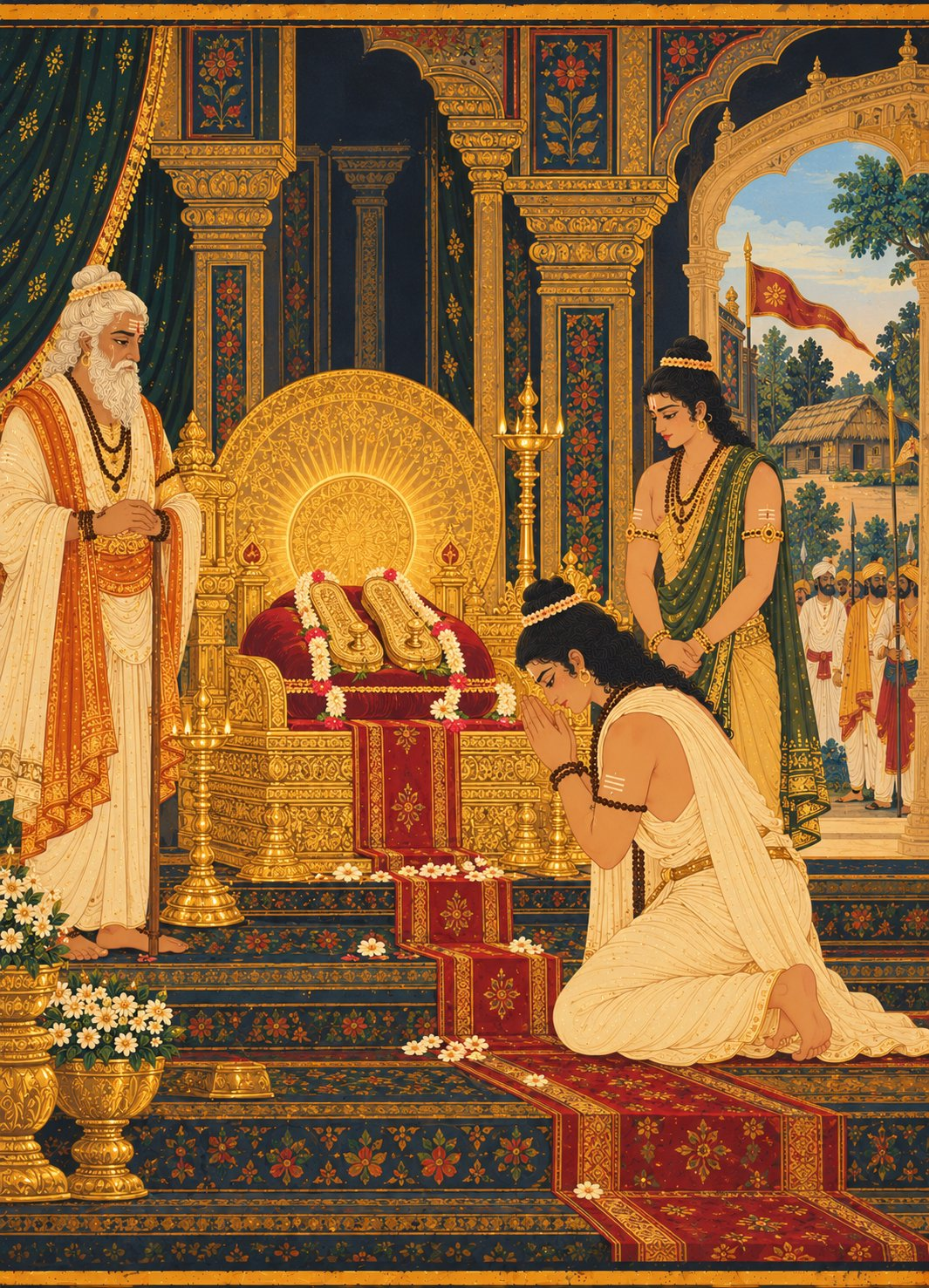
सिंहासनस्था पादुका • नन्दिग्राम तपस्या
Chapter 6: Bharata and the Sandals • Scene 5: The Sandals on the Throne
“Bharata asked for Rama’s sandals and carried them back on his head. He placed them on the throne and ruled in Rama’s name, living as a hermit outside the city and waiting for the fourteen years to end.”
Seeing Rama’s unwavering dedication to truth, Bharata made a final sacred petition: that Rama bestow his wooden sandals (Charan Padukas). Placing the sacred sandals reverently upon his head, Bharata carried them all the way back to Ayodhya with deep veneration, placing them upon the imperial golden throne amidst glowing halos and fresh flowers.
Refusing to enter the palace chambers or enjoy royal opulence, Bharata established his residence in a simple thatched cottage at Nandigram outside the city walls. Living the austere life of an ascetic in plain cloth with matted hair, he governed the kingdom solely as the servant of Rama’s sandals, counting each day until the fourteen years of exile reached their dawn.
अध्याय ७ आरम्भ भवति
द्रवहु सुदसरथ अजिर बिहारी ॥
सुवर्ण मृग • जटायु मोक्ष
The Golden Deer & Sita’s Abduction
At serene Panchavati, Surpanakha’s violent fury is thwarted and fourteen thousand demons fall before Rama. Enraged, Ravana enlists Maricha to lure Rama away as a sparkling golden deer, abducting Sita across the Lakshman Rekha as venerable Jatayu battles gallantly to his last breath.
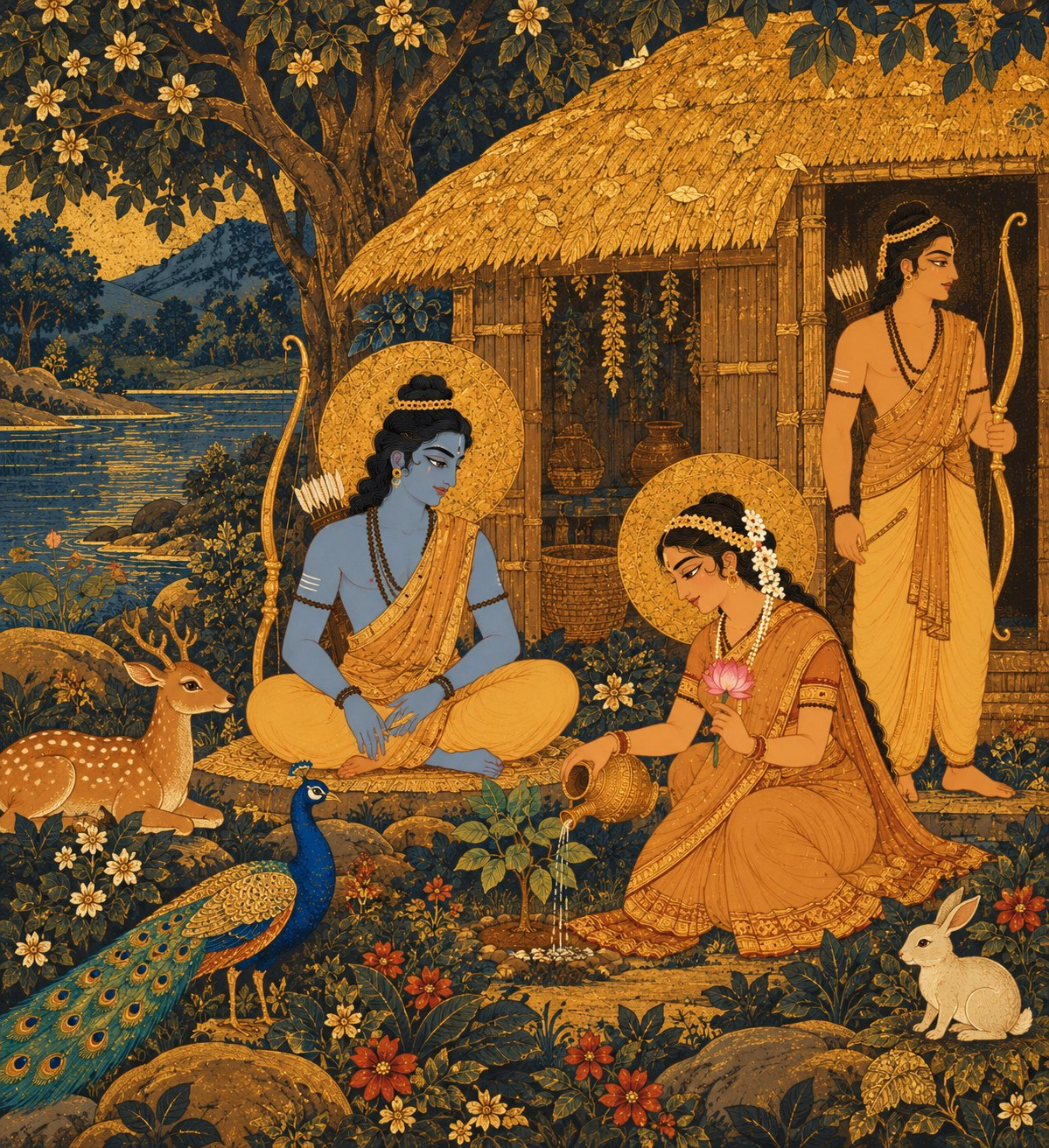
पञ्चवटी निवासः • पर्णकुटीर शान्तिः
Chapter 7: The Golden Deer • Scene 1: Home at Panchavati
“In the forest of Panchavati, Rama, Sita and Lakshmana built a small leaf hut. They lived in peace among the trees, animals and sages.”
Guided by Sage Agastya to the sacred woods of Panchavati along the serene banks of Godavari, Sri Rama, Sita, and Lakshmana built a graceful thatched hermitage of leaves and bamboo. Surrounded by fragrant jasmine blooms, blossoming trees, and pure mountain air, they lived in tranquil communion with nature.
Spotted deer, brilliant peacocks, and gentle forest rabbits rested fearlessly beside their doorway as Sita nurtured tender plants with water from golden jars. Sages gathered in peaceful satsang, and for years the wild forest flourished like a paradise under Rama’s righteous and protective presence.
शूर्पणखा विरूपकरणम् • लक्ष्मण शौर्यम्
Chapter 7: The Golden Deer • Scene 2: Surpanakha
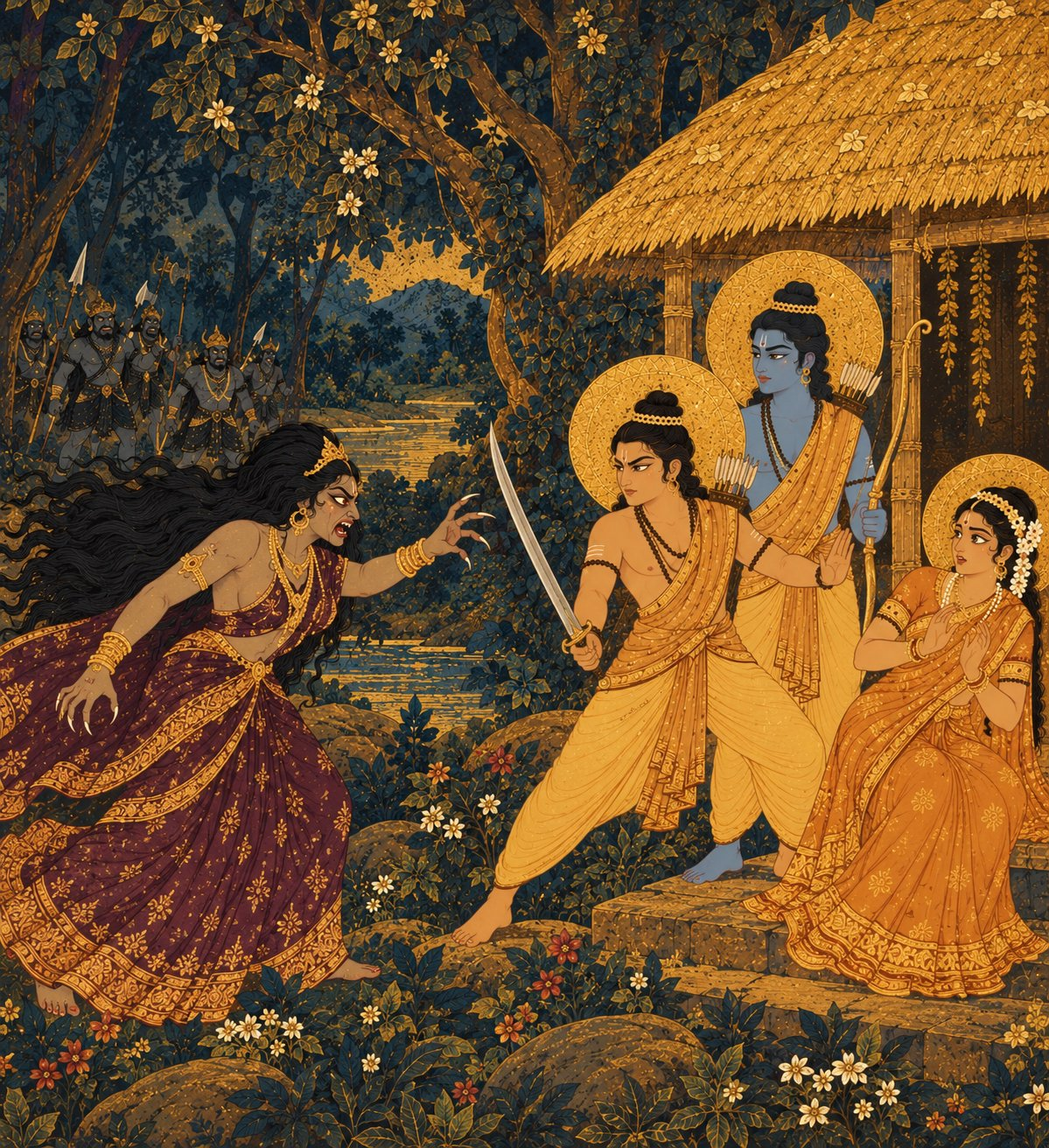
“The demoness Surpanakha saw Rama and fell in love with him. When he refused her, she turned fierce and tried to harm Sita. Lakshmana stopped her and cut off her nose.”
The serene peace of Panchavati was shattered when the fierce demoness Surpanakha, wandering through the woodlands, caught sight of Sri Rama’s matchless beauty. Enamored and brazen, she assumed an alluring form and demanded that Rama marry her, but Rama gently refused, declaring his devotion to his wife Sita.
Blinded by jealousy and demonic rage, Surpanakha revealed her hideous countenance with wild loose hair and razor claws, lunging viciously to devour terrified Sita. Swift as a lightning bolt, Lakshmana stepped forward with drawn blade, intercepting the assault and cutting off her nose and ears to punish her insolence and defend the hermitage.
खर-दूषण संहारः • राम पराक्रमः
Chapter 7: The Golden Deer • Scene 3: The Demon Army Falls
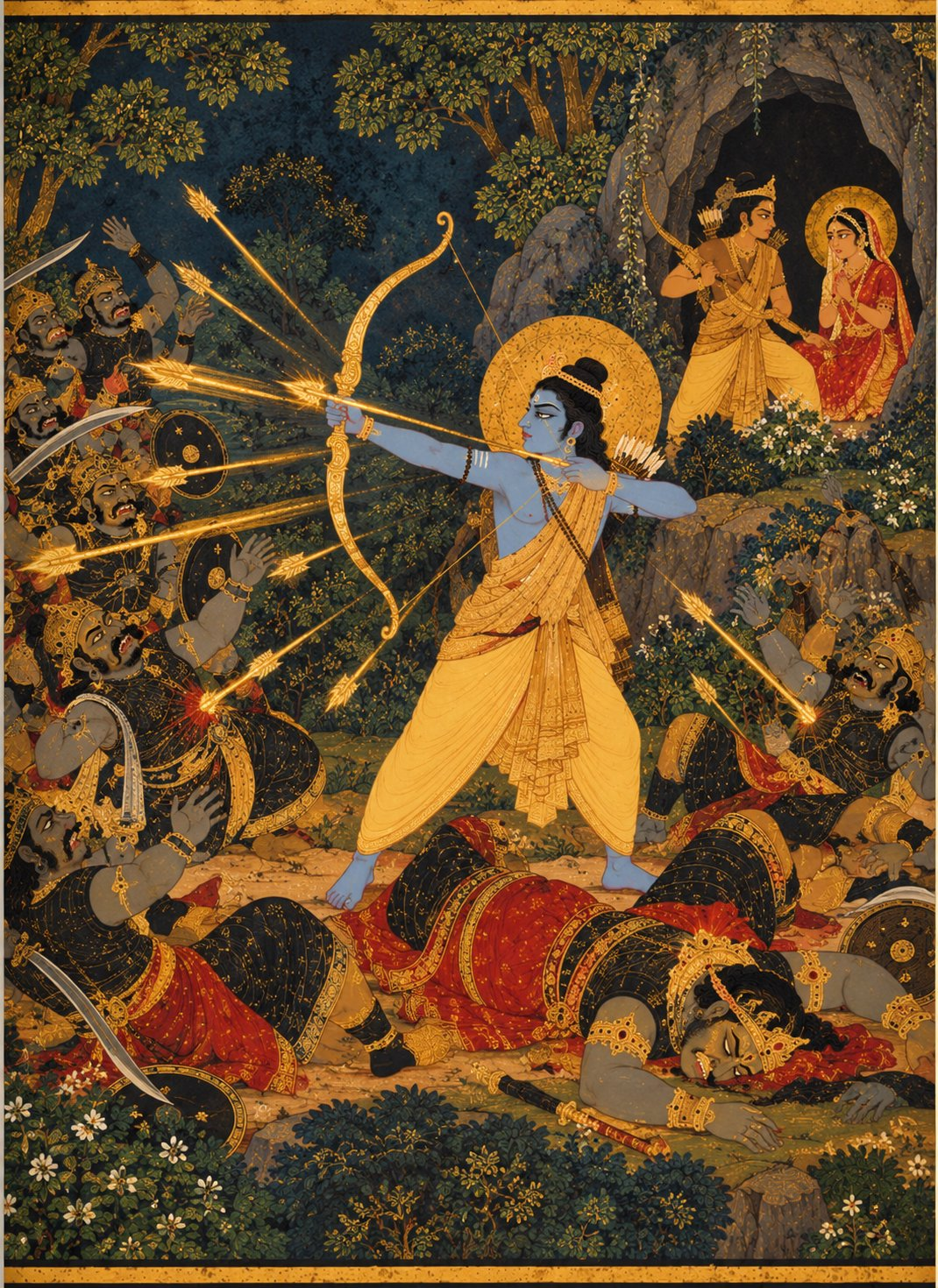
“Furious, Surpanakha ran to her brothers Khara and Dushana. They attacked with fourteen thousand demons. Rama stood alone and defeated them all.”
Shrieking with fury and humiliation, Surpanakha fled to Janasthana to summon her demon brothers Khara, Dushana, and their commander Trishiras. Marshalling a dreaded army of fourteen thousand armored rakshasas armed with spiked clubs and iron spears, the hordes marched like a black thundercloud upon Panchavati.
Placing Sita safely under Lakshmana’s guard within a sheltered cave, Sri Rama strung his celestial Kodanda bow and stood solitary against the entire demonic vanguard. Unleashing an unstoppable barrage of golden blazing arrows like beams of the midday sun, Rama annihilated the invading legion and felled Khara and Dushana, restoring divine peace to the forest.
रावण-मारीच मन्त्रणा • लङ्का षड्यन्त्रम्
Chapter 7: The Golden Deer • Scene 4: Ravana’s Plan
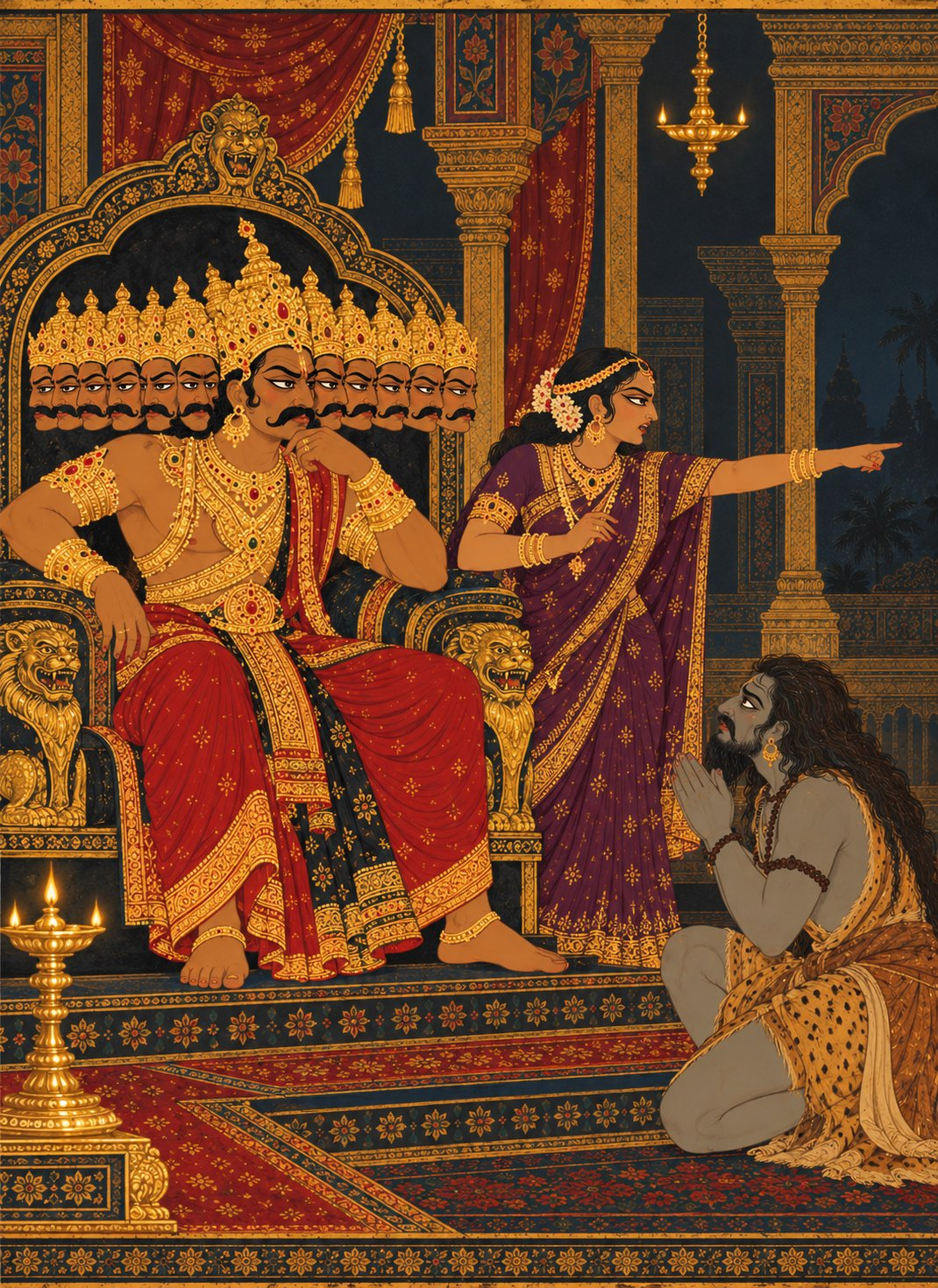
“Surpanakha ran to her brother Ravana, the ten-headed king of Lanka, and told him about Sita’s beauty. Ravana asked the demon Maricha to become a golden deer. Maricha was afraid of Rama, but he could not refuse.”
Humiliated and seeking total vengeance, Surpanakha fled across the southern sea to Lanka, entering the golden throne room of her brother Ravana, the ten-headed sovereign of the rakshasas. She incited his pride and inflamed his lust by painting an intoxicating description of Sita’s peerless grace and virtue.
Plotting to abduct Sita, Ravana sought out the ascetic demon Maricha on the seacoast, commanding him to transform into an enchanting golden deer to lure Rama away from the hermitage. Though terrified of Rama’s fatal arrows and pleading with Ravana to abandon the wicked scheme, Maricha faced instant death from Ravana’s sword and reluctantly consented.
सुवर्ण मृग दर्शनम् • माया रूपम्
Scene 5: The Golden Deer • Double-Page Panorama
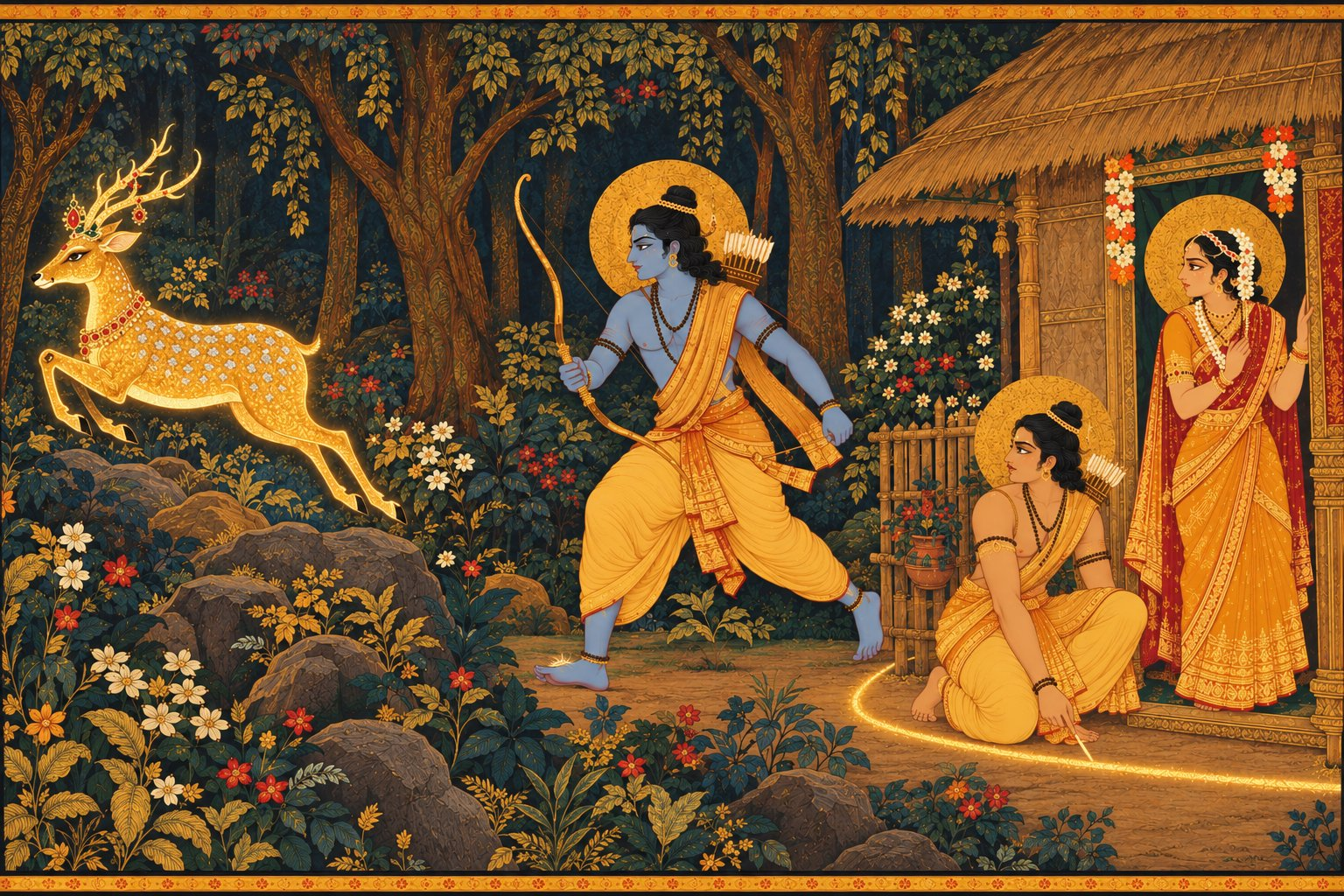
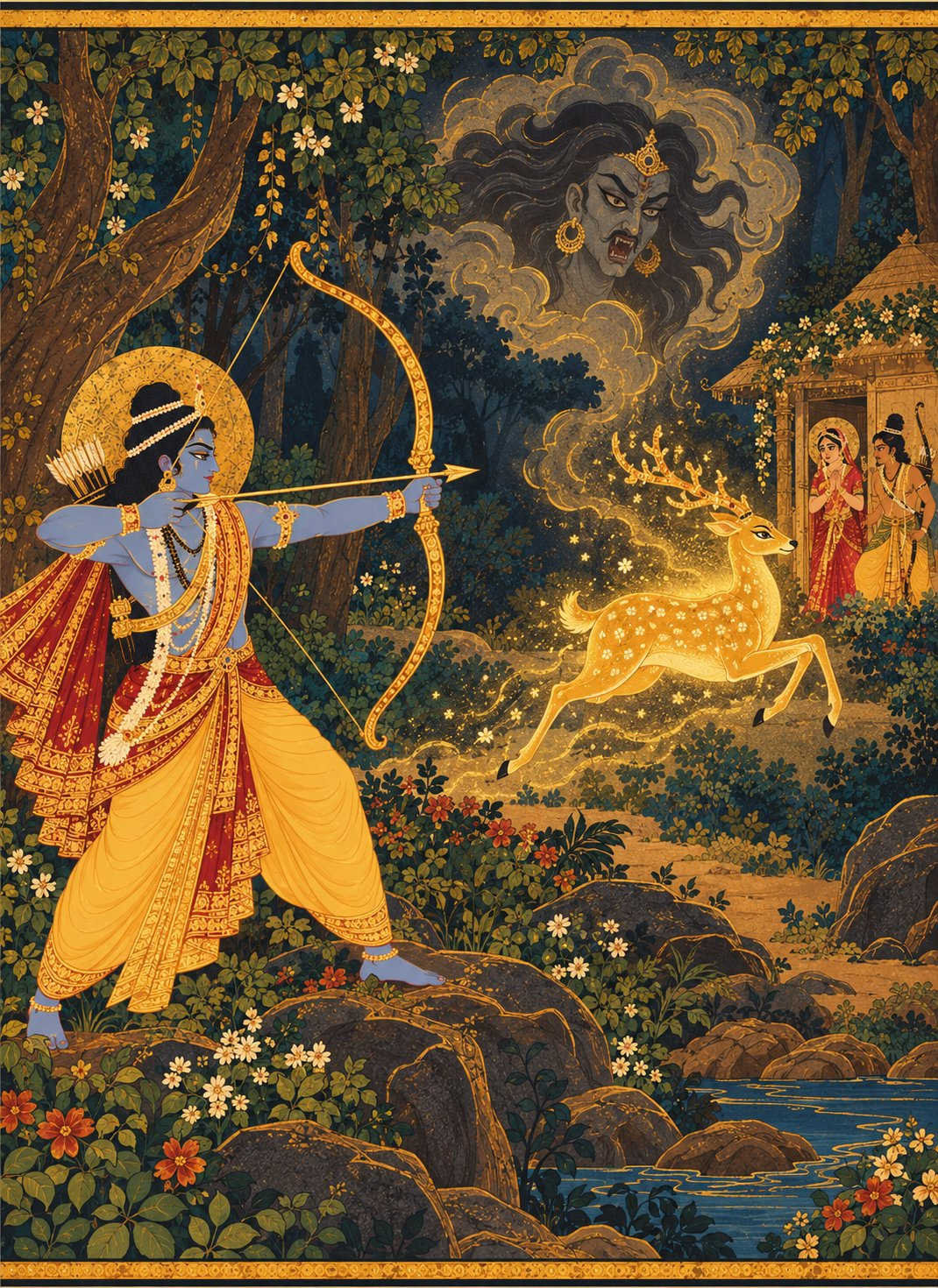
“A golden deer appeared near the hut, sparkling like a jewel. Sita was enchanted and asked Rama to catch it for her.”
Awondrous spectacle soon materialized among the flowering shrubs of Panchavati: an ethereal deer with skin like burnished gold, silver-dappled flanks, and antlers tipping with precious gems. Prancing playfully near the cottage threshold, the creature caught the sunlight, sparkling like an illusionary constellation.
Mata Sita was instantly captivated by its radiance and gently implored Sri Rama to capture the gentle creature alive as a forest companion, or bring its golden hide. While Lakshmana sensed demonic sorcery and cautioned against the unnatural apparition, Rama resolved to pursue it, instructing his vigilant brother never to leave Sita’s side.
मारीच माया नादः • कुटील आक्रन्दनम्
Chapter 7: The Golden Deer • Scene 6: The False Cry
“Rama told Lakshmana to guard Sita and went after the deer. Far in the forest, Rama’s arrow struck it, and in dying, Maricha cried out in Rama’s voice: ‘Lakshmana! Sita!’”
The evasive deer led Sri Rama deep into the thickets of Dandaka forest, perpetually vanishing and reappearing just beyond reach. Realizing at last that the creature was a cunning rakshasa in disguise, Rama fitted a flaming golden shaft to his bow and released it with pinpoint mastery, piercing the illusionary beast.
As the deer fell, the demonic spirit of Maricha burst from its form, expanding into a grey smoke-like mist. Using his final breath to fulfill Ravana’s sinister stratagem, Maricha mimicked Rama’s celestial voice and shrieked in agonizing tones through the silent woods: ‘Ha Lakshmana! Ha Sita!’—sending panic vibrating back toward the distant hut.
लक्ष्मण रेखा बन्धनम् • रक्षा मण्डलम्
Chapter 7: The Golden Deer • Scene 7: The Lakshman Rekha
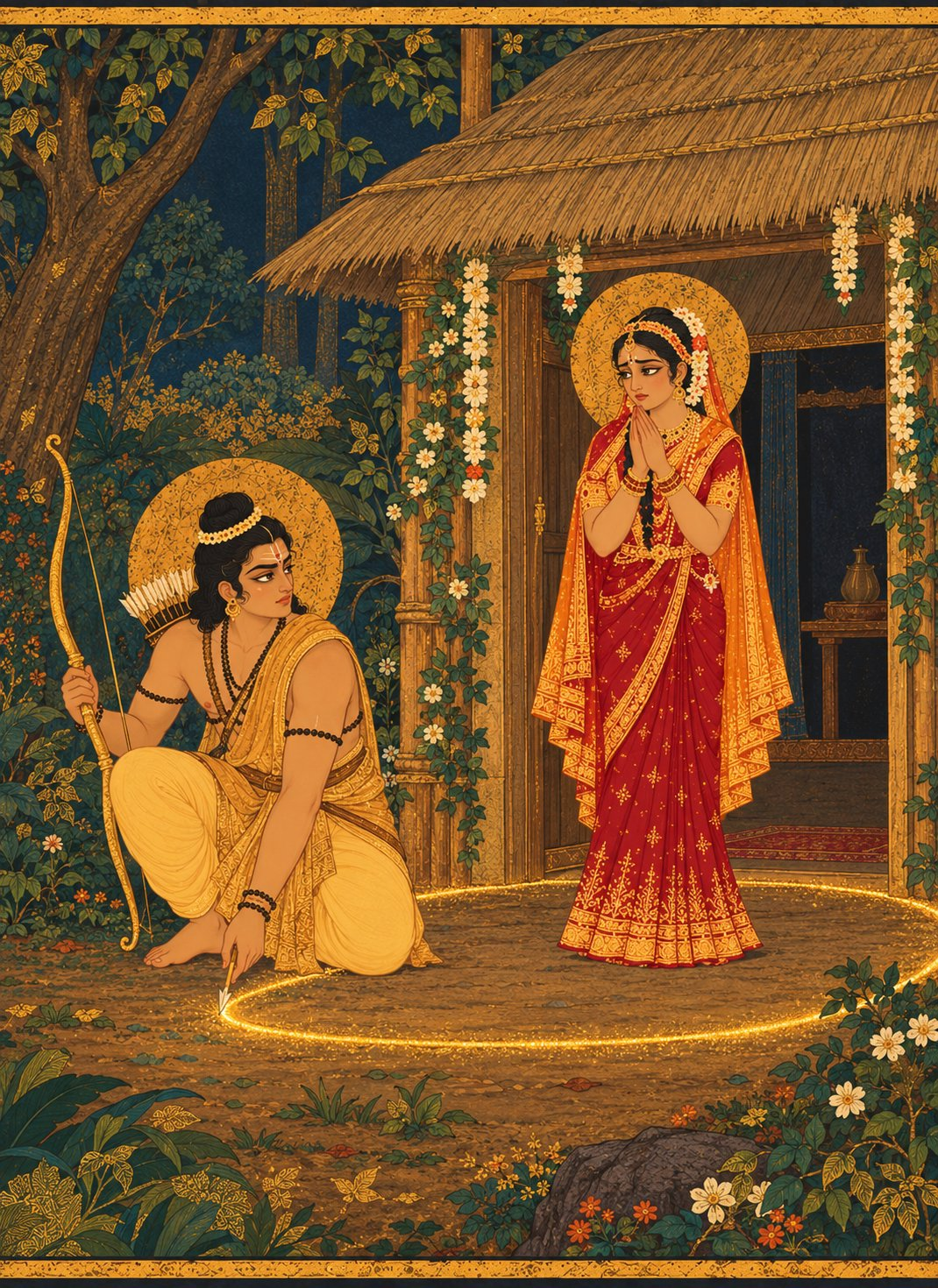
“Sita heard the cry and begged Lakshmana to run and help Rama. Lakshmana did not want to leave her, but she insisted. He drew a line around the hut and told her never to step beyond it.”
When the ominous cry for help echoed across Panchavati, Sita was convulsed with dread, convinced that Sri Rama was mortally wounded. She tearfully implored Lakshmana to rush to his brother's rescue. Though Lakshmana insisted that no power in the three worlds could ever harm Rama and that the voice was mere demonic deception, Sita’s desperate anguish compelled his departure.
Yielding to her unrelenting command with a heavy heart, Lakshmana knelt before the cottage and drew a consecrated circle upon the earth with the tip of his arrow—the legendary Lakshman Rekha. Blazing with golden mystical radiance, he solemnly pleaded with Mata Sita never to cross the sacred line under any circumstance before rushing into the forest.
कपट भिक्षुक रावणः • द्वार भिक्षाटनम्
Chapter 7: The Golden Deer • Scene 8: The Brahmin at the Door
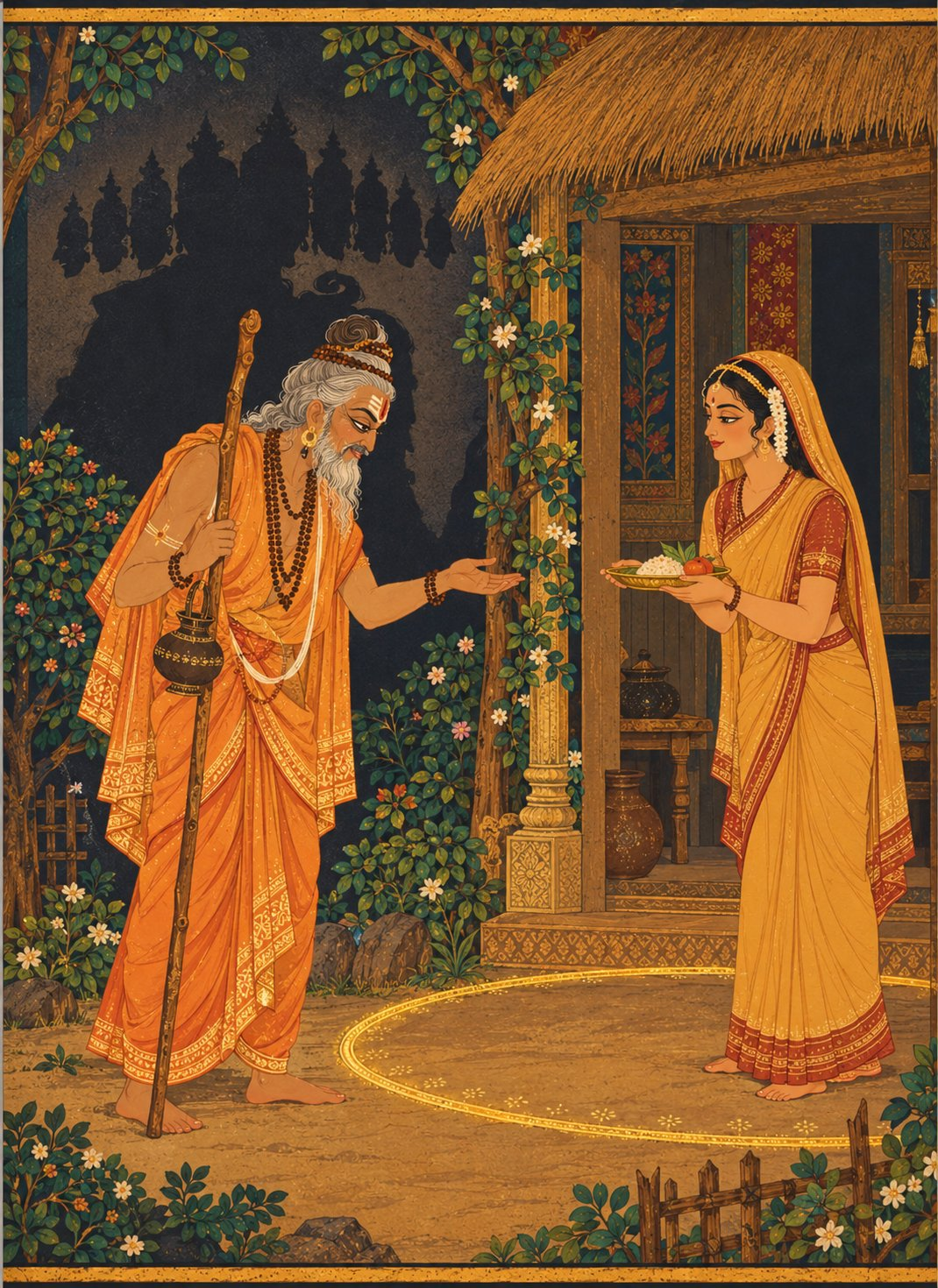
“As soon as Lakshmana left, an old Brahmin in saffron robes arrived at the hut and asked for alms. It was Ravana in disguise.”
Moments after Lakshmana vanished into the trees, an aged ascetic Brahmin clad in flowing saffron garments, adorned with sacred rudraksha beads and a white yajnopavita thread, appeared before the cottage steps. Leaning upon a wooden staff with a begging bowl outstretched, he chanted Vedic hymns, seeking hospitality and alms (bhiksha).
Honoring the inviolable duty of guest-worship (atithi-satkara), gentle Sita brought forth fruits and grain on a brass plate. Yet the disguised Ravana stood carefully beyond the blazing golden threshold, feigning frailty and coaxing her forward with deceptive humility. Unbeknownst to her, the towering shadow cast against the thatched wall revealed his monstrous ten-headed silhouette.
सीता हरणम् • पुष्पक प्रयाणम्
Chapter 7: The Golden Deer • Scene 9: The Abduction
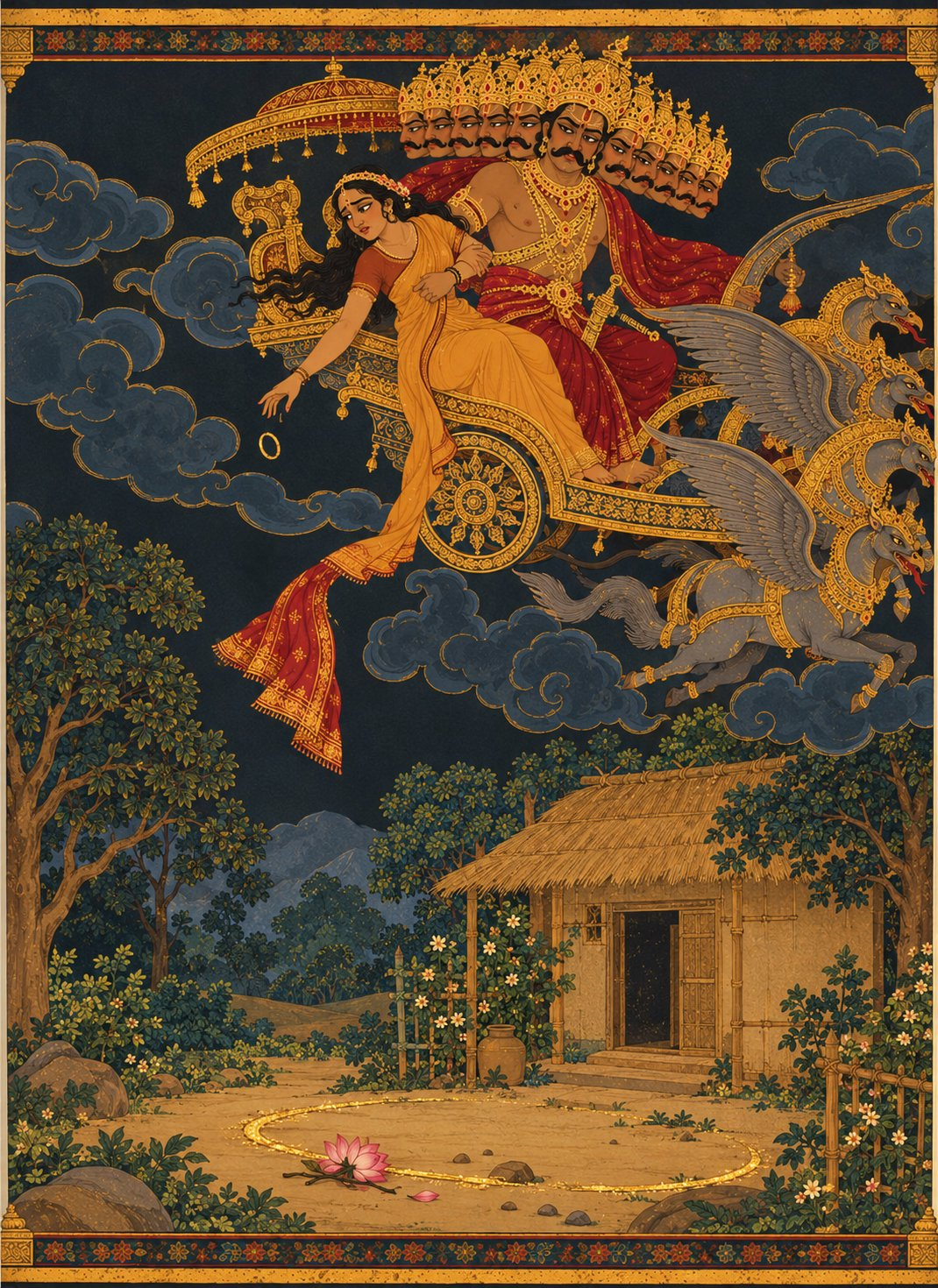
“When Sita stepped across the line to offer him food, Ravana showed his true form. He seized Sita and carried her away in his flying chariot. As she was carried across the sky, she dropped her ornaments to leave a trail.”
The instant Mata Sita stepped beyond the protective boundary to deliver the offerings, the mendicant dropped his disguise, expanding into the terrifying, ten-headed form of King Ravana. Gripping the screaming princess with brute force, he dragged her onto his celestial aerial chariot, drawn through the heavens by winged beasts.
As the flying chariot soared across the clouds, Sita cried aloud to the trees, river Godavari, and forest creatures to alert Sri Rama. With desperate presence of mind, she loosened her golden bangles, silken veil, and ornaments, dropping them along the aerial path so her beloved lord might trace her captive trail across the vast southern horizon.
जटायु महासंग्रामः • पक्षीराज शौर्यम्
Chapter 7: The Golden Deer • Scene 10: Jatayu Falls
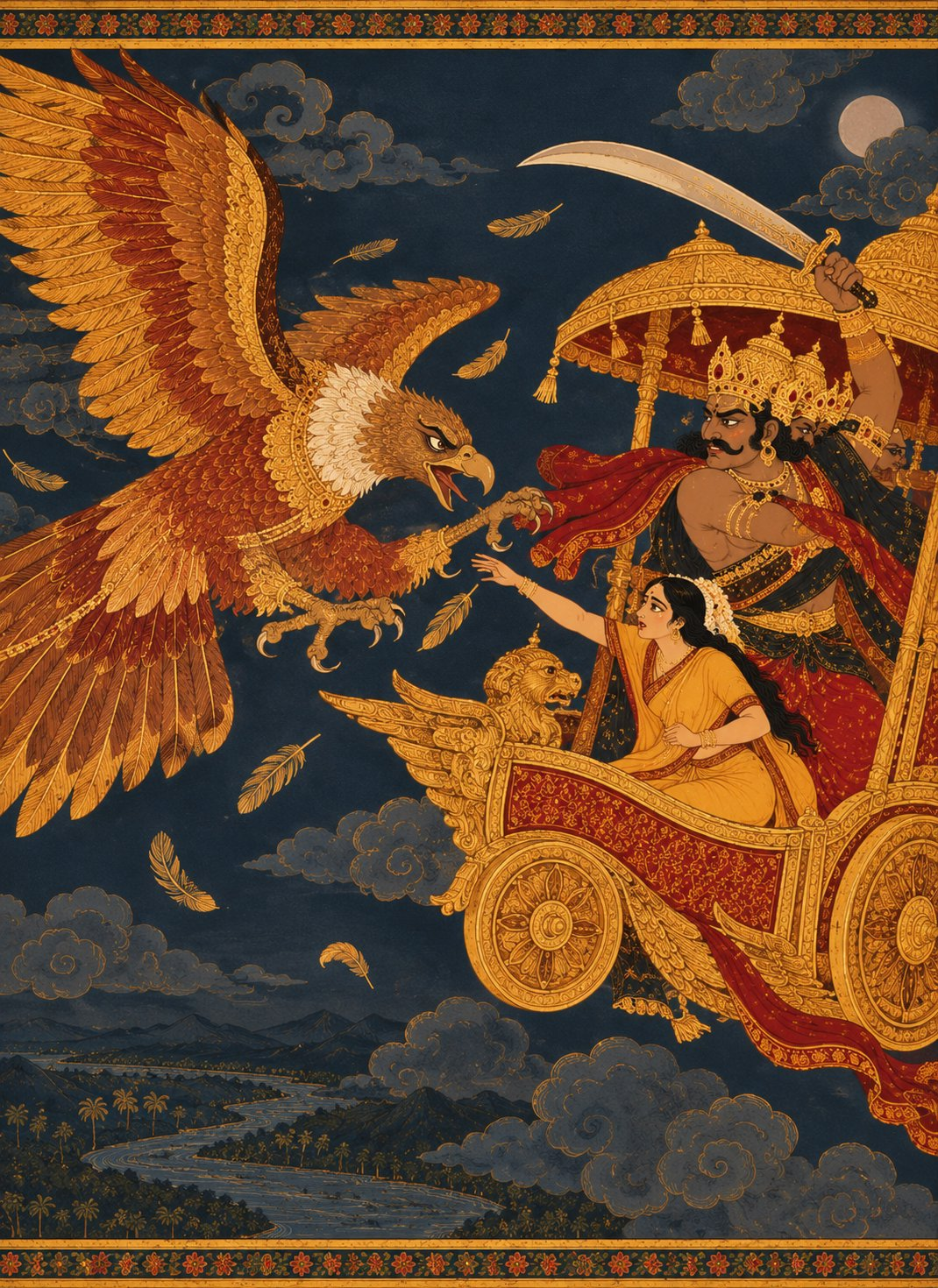
“The old vulture Jatayu heard Sita cry out and fought Ravana in the sky. Ravana cut his wings, and Jatayu fell. He stayed alive only to tell Rama what had happened.”
Hearing Sita’s agonizing lamentations resonating through the vault of heaven, the venerable vulture king Jatayu soared fearlessly into the skies to intercept the king of Lanka. Despite his ancient age, Jatayu attacked Ravana’s chariot with ferocious valor, shattering his golden bow, piercing his armor, and shredding his canopy with razor talons.
Enraged by the bird’s unyielding defiance, Ravana drew his curved Chandrahasa sword and severed Jatayu’s mighty wings. Spilling golden feathers into the azure sky, the noble creature plunged to the earth, mortally wounded. Holding onto his final breaths with supreme devotion, Jatayu resolved to cling to life until he could deliver the vital truth to Sri Rama.
अध्याय ८ आरम्भ भवति
द्रवहु सुदसरथ अजिर बिहारी ॥
सखा मिलन • सुग्रीव राज्य
Hanuman & Sugriva’s Alliance
Searching the southern wilderness in sorrow, Rama redeems dying Jatayu and accepts Shabari's sweet berries. At Lake Pampa, Hanuman introduces Rama to exiled King Sugriva. Sealing an eternal friendship before the sacred fire, Rama ends Vali’s tyranny, and the Vanara hosts search the earth.
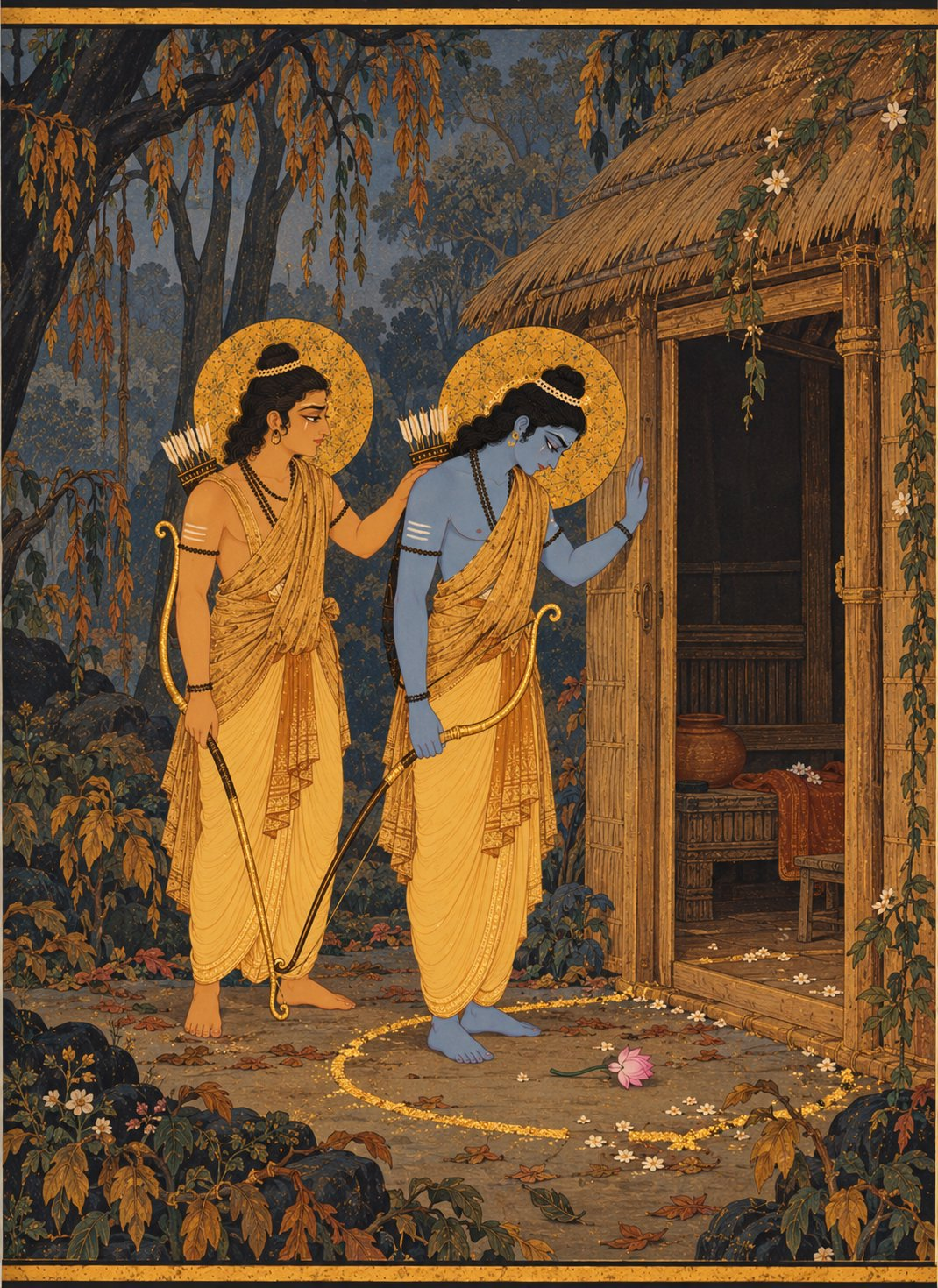
शून्य पर्णकुटीरः • राम विलापः
Chapter 8: Hanuman and Sugriva • Scene 1: The Empty Hut
“Rama returned with the deer’s body and found the hut empty. Sita was gone. He and Lakshmana searched the forest calling her name, but only silence replied.”
Returning to the clearing of Panchavati with the fallen body of the illusionary deer, Sri Rama met Lakshmana on the trail with a sinking heart. Hurrying to the cottage, they discovered the threshold deserted, the sacred protective circle breached, and a single pink lotus lying bruised in the dust.
Overwhelmed by boundless anguish, Rama leaned against the wooden doorway with bowed head, his golden bow hanging limp in his trembling hands. Weeping bitterly, the divine brothers searched every thicket and riverbank, questioning trees, deer, and flowering creepers, but only hollow echoes answered their cries.
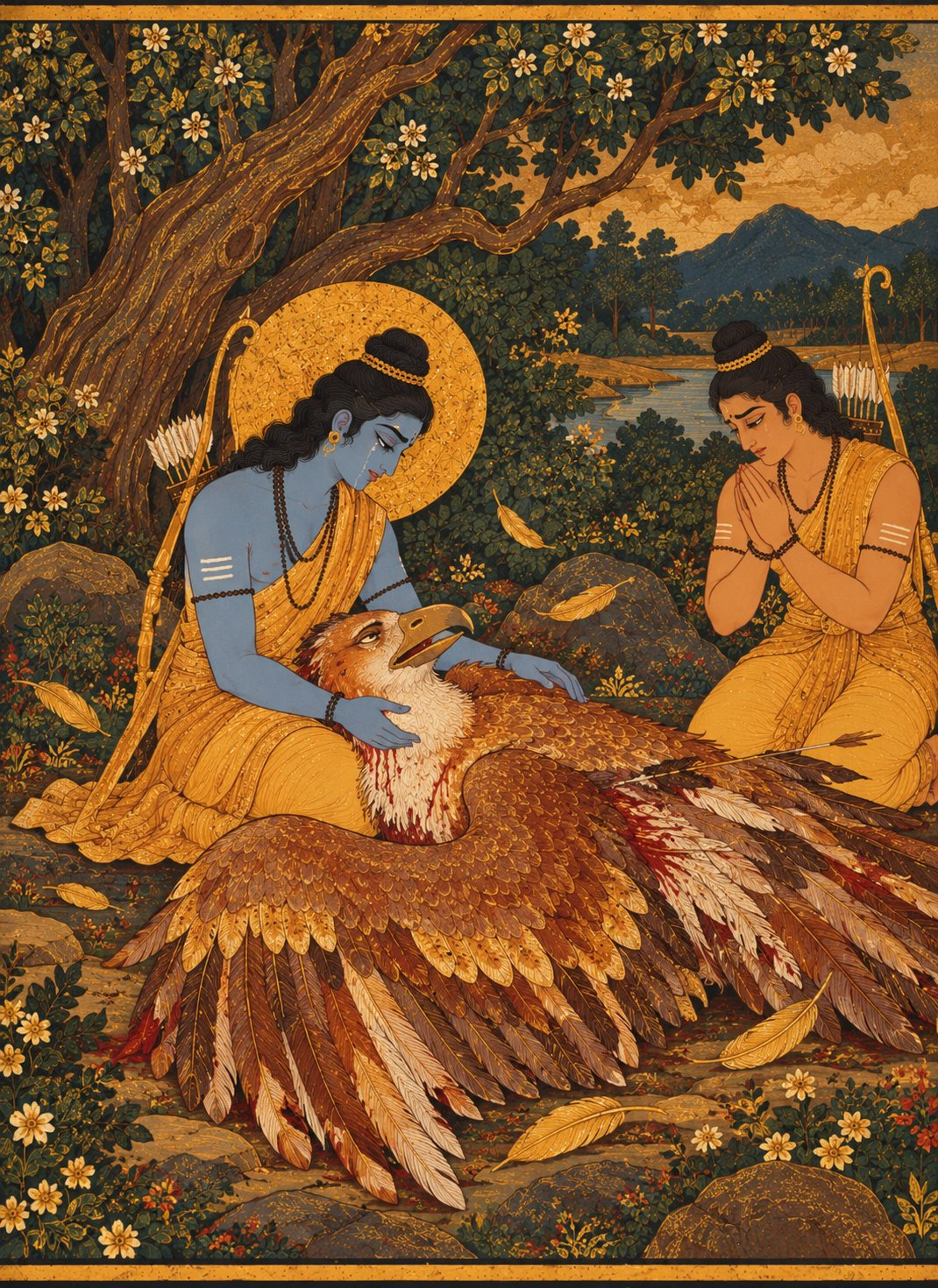
जटायोः मोक्षप्रदानम् • पितृवत् संस्कारः
Chapter 8: Hanuman and Sugriva • Scene 2: Jatayu’s Last Words
“In the forest they found Jatayu, who was barely alive. He told them that Ravana had carried Sita south. Rama held him and performed his last rites as if he were his own father.”
Deep in the forest glade, Rama and Lakshmana came upon the fallen king of birds, Jatayu, bleeding and gasping for breath upon the mossy earth. Gently cradling the vulture's head upon his lap, Sri Rama stroked his plumage with tears of tender gratitude and sorrow.
With his fading strength, Jatayu revealed that King Ravana of Lanka had carried Sita away toward the southern ocean. Having accomplished his sacred mission, Jatayu breathed his last in Rama’s embrace. Rama performed his funeral obsequies with sacred mantras, granting the valiant bird eternal salvation as he would for his own father Dasharatha.
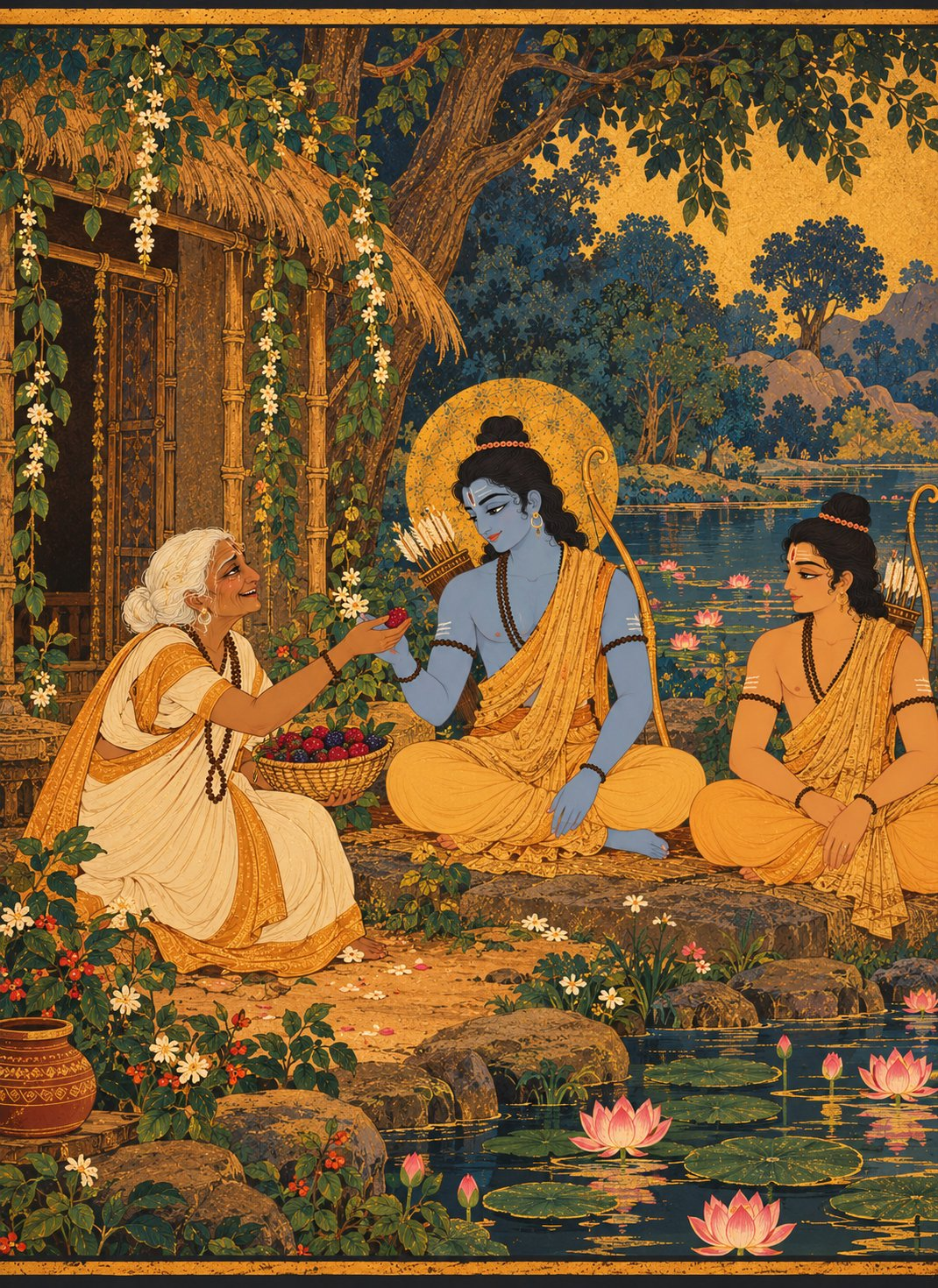
शबरी भक्ति परमानन्दः • नवधा भक्तिः
Chapter 8: Hanuman and Sugriva • Scene 3: Shabari’s Berries
“On the way, Rama and Lakshmana met the old Shabari, who had waited years for Rama to visit. She offered him berries, tasting each one first to make sure they were sweet. Rama ate them with love and blessed her.”
Journeying southward toward Lake Pampa, the brothers reached the secluded hermitage of the saintly ascetic Shabari, who had waited her entire lifetime for Sri Rama’s arrival upon the prophecy of her guru Matanga. Trembling with overjoyed tears, she washed Rama's lotus feet with water from the lake.
With simple, childlike innocence and devotion, Shabari presented a basket of wild berries, tasting each fruit beforehand to ensure that only the sweetest and ripest were offered to her Lord. Transcendental love dissolving all social rituals, Rama accepted every fruit with tender joy, blessing the noble devotee with supreme liberation.
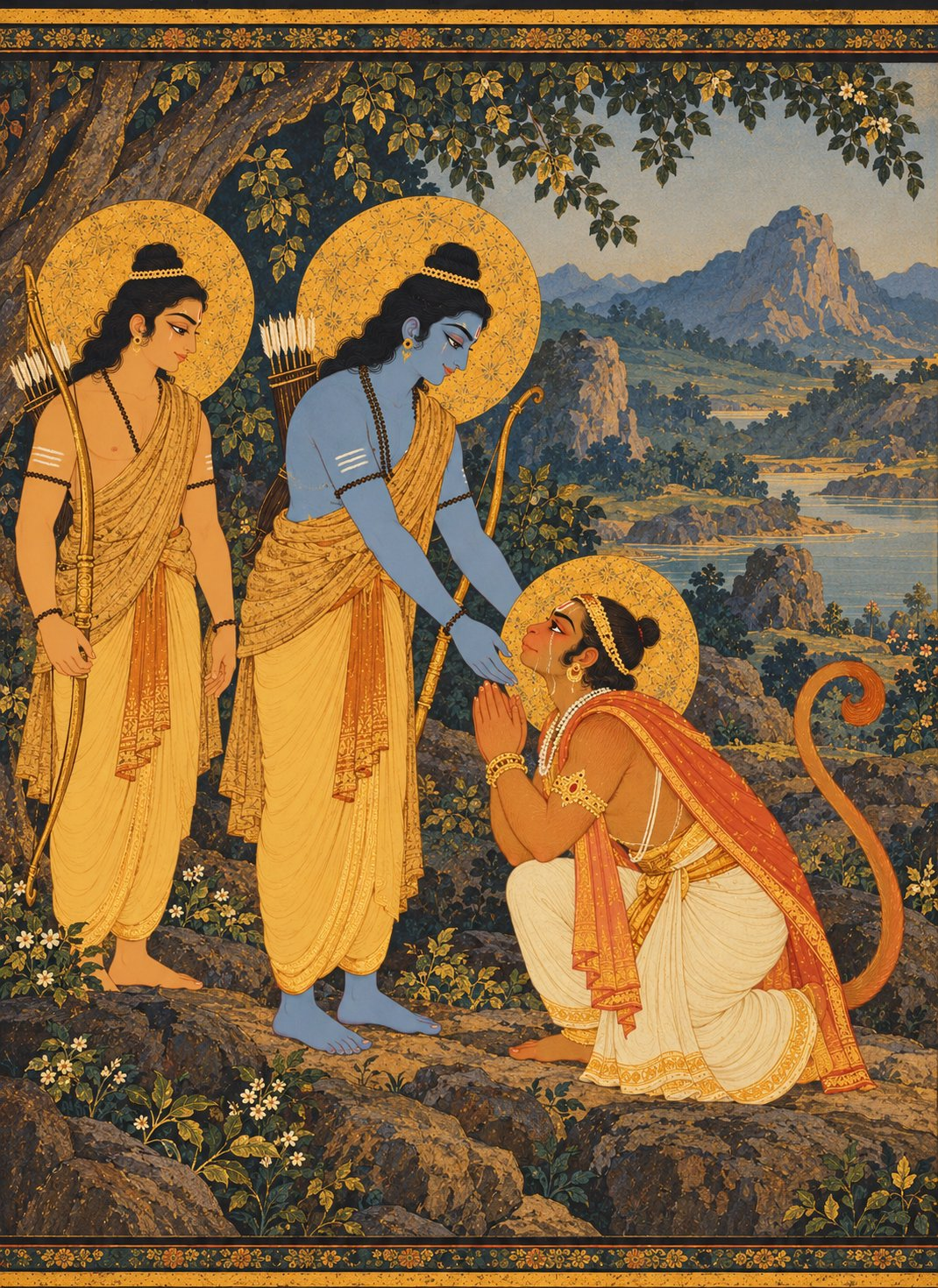
ऋष्यमूक पर्वते मिलनम् • पवनसुत वन्दनम्
Chapter 8: Hanuman and Sugriva • Scene 4: Hanuman Meets Rama
“At Mount Rishyamukha, Sugriva saw two warriors approaching and feared they were sent by his brother Vali. He sent his minister Hanuman, who disguised himself as a Brahmin. When Hanuman heard Rama’s voice, he knew who he was and fell at his feet.”
At Mount Rishyamukha, the exiled vanara prince Sugriva observed two bow-wielding warriors approaching and was stricken with dread, fearing they were assassins dispatched by his estranged brother Vali. He urgently sent his foremost minister and scholar, Hanuman, disguised as an ascetic Brahmin, to ascertain their intent.
Hanuman addressed the travellers with profound eloquence and Vedic erudition. Hearing Sri Rama’s gentle, resonant reply, the veil of illusion lifted; Hanuman recognized the Supreme Lord of his heart and fell prostrate at Rama’s feet with tears of ecstasy, as his true vanara form began to emerge from beneath his robes.
स्कन्धारोहणम् • मारुति पराक्रमः
Chapter 8: Hanuman and Sugriva • Scene 5: Carried on his Shoulders
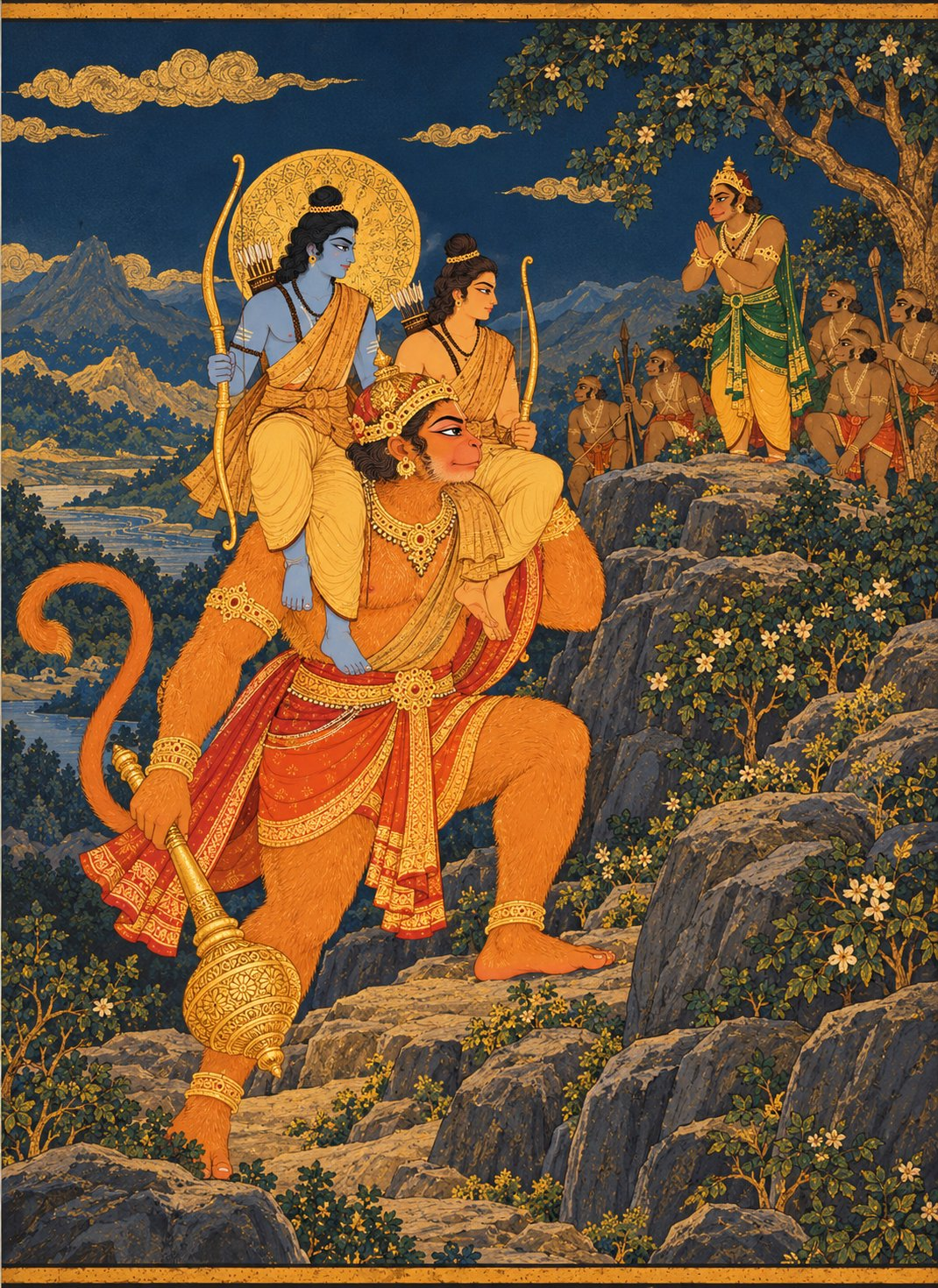
“Hanuman took his true form. He lifted Rama and Lakshmana on his shoulders and carried them up the mountain to meet Sugriva.”
Revealing his true divine form radiant like burnished gold with a sweeping tail, celestial armlets, and his golden mace, Hanuman bowed low before the divine brothers. With boundless reverence and love, he requested the supreme honour of carrying them up the steep crags of Rishyamukha.
Lifting Sri Rama upon his right shoulder and Lakshmana upon his left, the mighty son of the wind leaped effortlessly across chasms and scaled the jagged mountain peaks. At the summit, Sugriva and his vanara chieftains watched in awe as the supreme archers arrived upon the shoulders of their foremost counselor.
अग्निसाक्षिक सख्यम् • सीताभूषण दर्शनम्
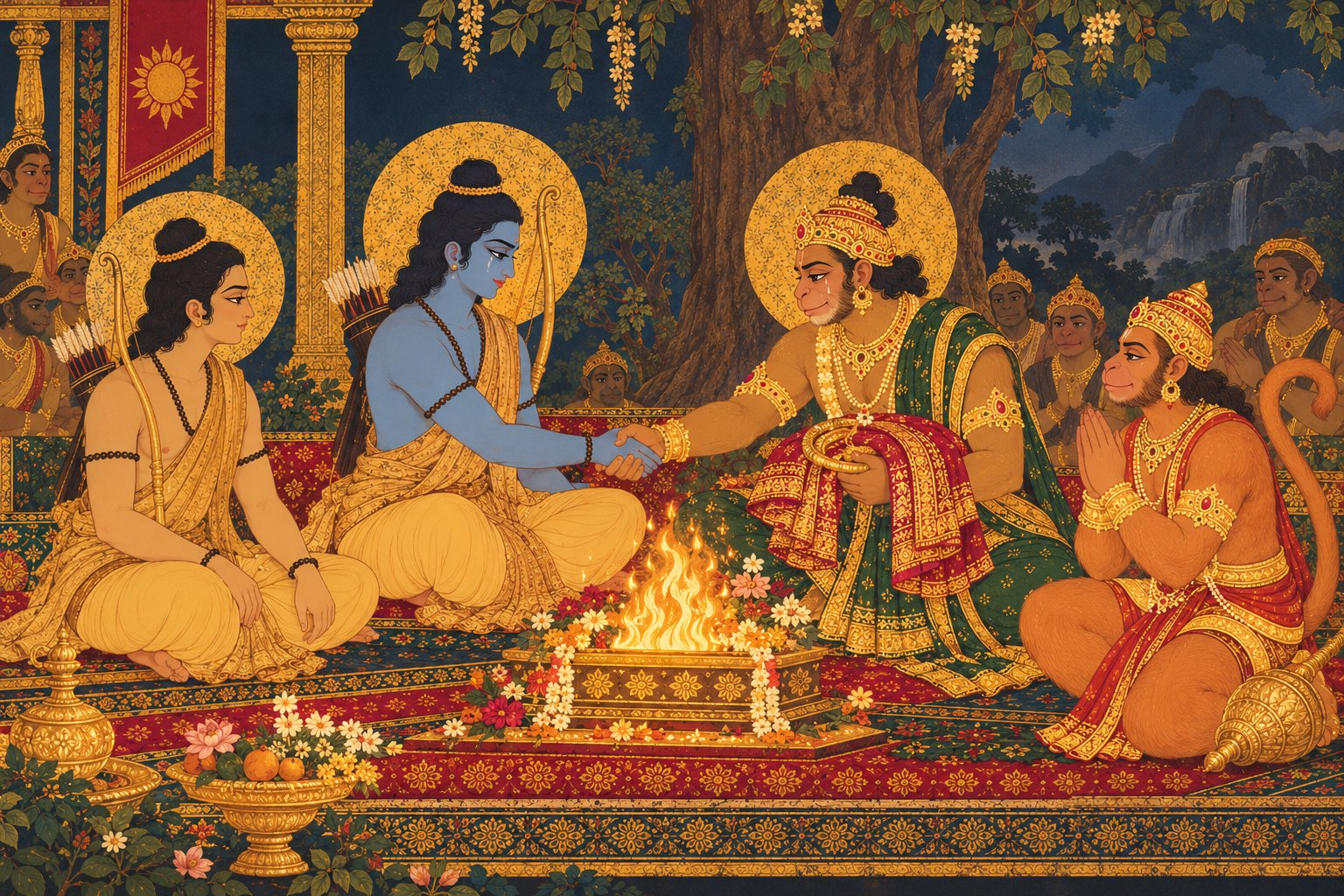
Chapter 8: Hanuman and Sugriva • Scene 6: Friendship by the Fire
“Rama and Sugriva became friends before a sacred fire. Sugriva showed them the ornaments Sita had dropped as she flew past, and Rama and Lakshmana knew they were on the right path.”
Before a sacred fire kindled by Hanuman upon the mountaintop, Sri Rama and Sugriva clasped hands and circled the blazing flames, forging an unbreakable bond of eternal brotherhood. Rama pledged to liberate Kishkindha from Vali's tyranny, while Sugriva vowed his vast vanara army to search all creation for Mata Sita.
Sugriva then brought forth a bundle wrapped in yellow silk, dropped from the sky by a captive princess. As Rama opened it, beholding Sita’s golden anklets and veil, tears bathed his cheeks; Lakshmana recognized her sacred anklets with reverent awe, confirming without doubt that Sita had been carried southward.
वालि वधः • धर्म संस्थापनम्
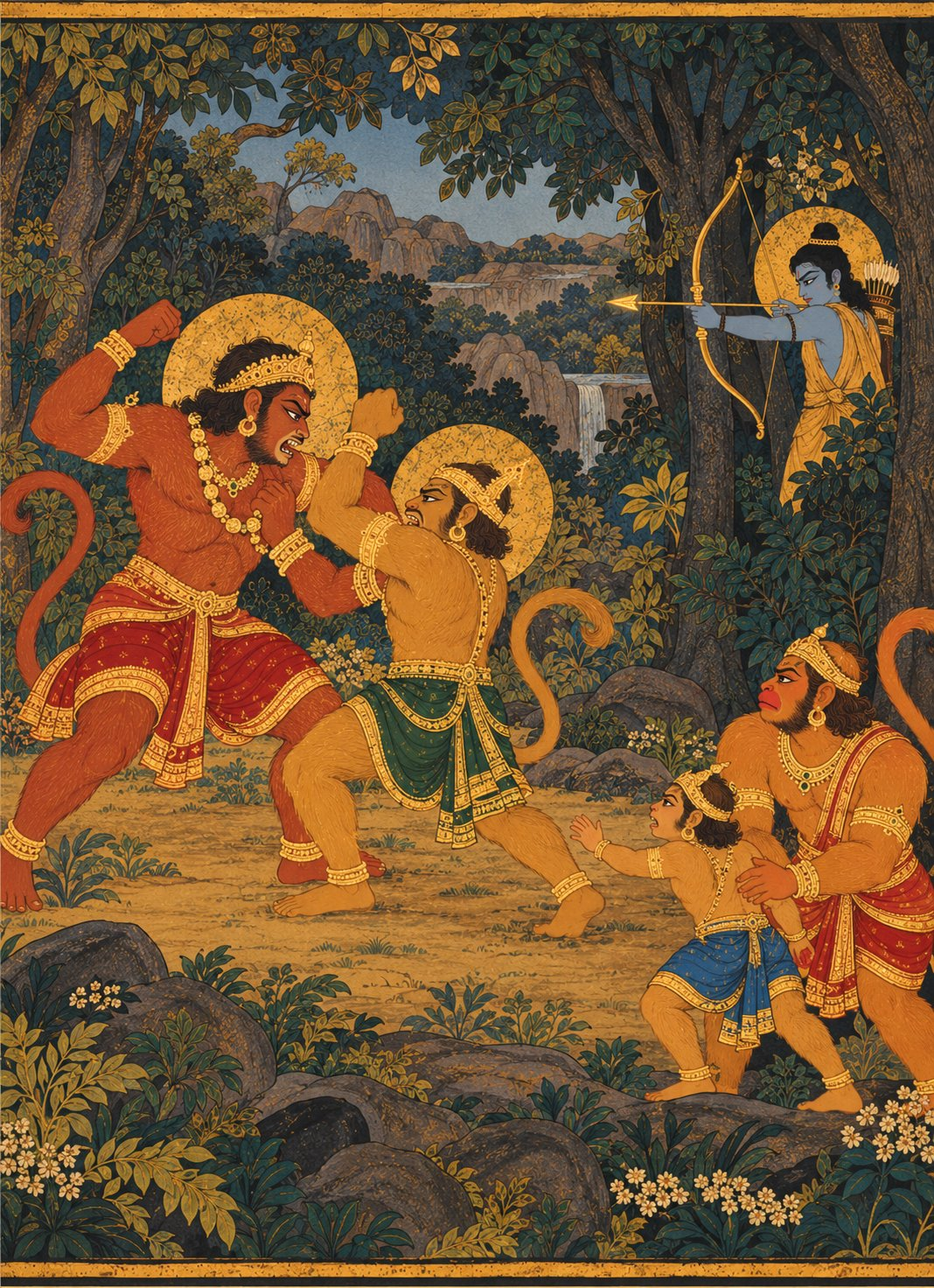
Chapter 8: Hanuman and Sugriva • Scene 7: Rama Ends Vali’s Rule
“Sugriva’s brother Vali had taken his kingdom and his wife. Sugriva challenged Vali to a fight, and Rama’s arrow struck from behind the trees. Vali fell. In his last moments, he made peace with Rama and asked him to protect his son Angada.”
According to the solemn pact, Sugriva marched to the gates of Kishkindha and roared a challenge to his invincible brother Vali. The two formidable vanara monarchs engaged in a colossal duel, their thunderous blows shaking the trees of the forest clearing.
Seeing Sugriva’s strength falter, Sri Rama, concealed among the Sala trees, released a golden arrow that struck Vali down, ending his unrighteous reign. In his final moments, Vali acknowledged the sanctity of Rama’s judgment, made peace with his brother Sugriva, and entrusted his young son Angada to Rama’s eternal protection.
सुग्रीव राज्याभिषेकः • वर्षर्तु प्रतीक्षा
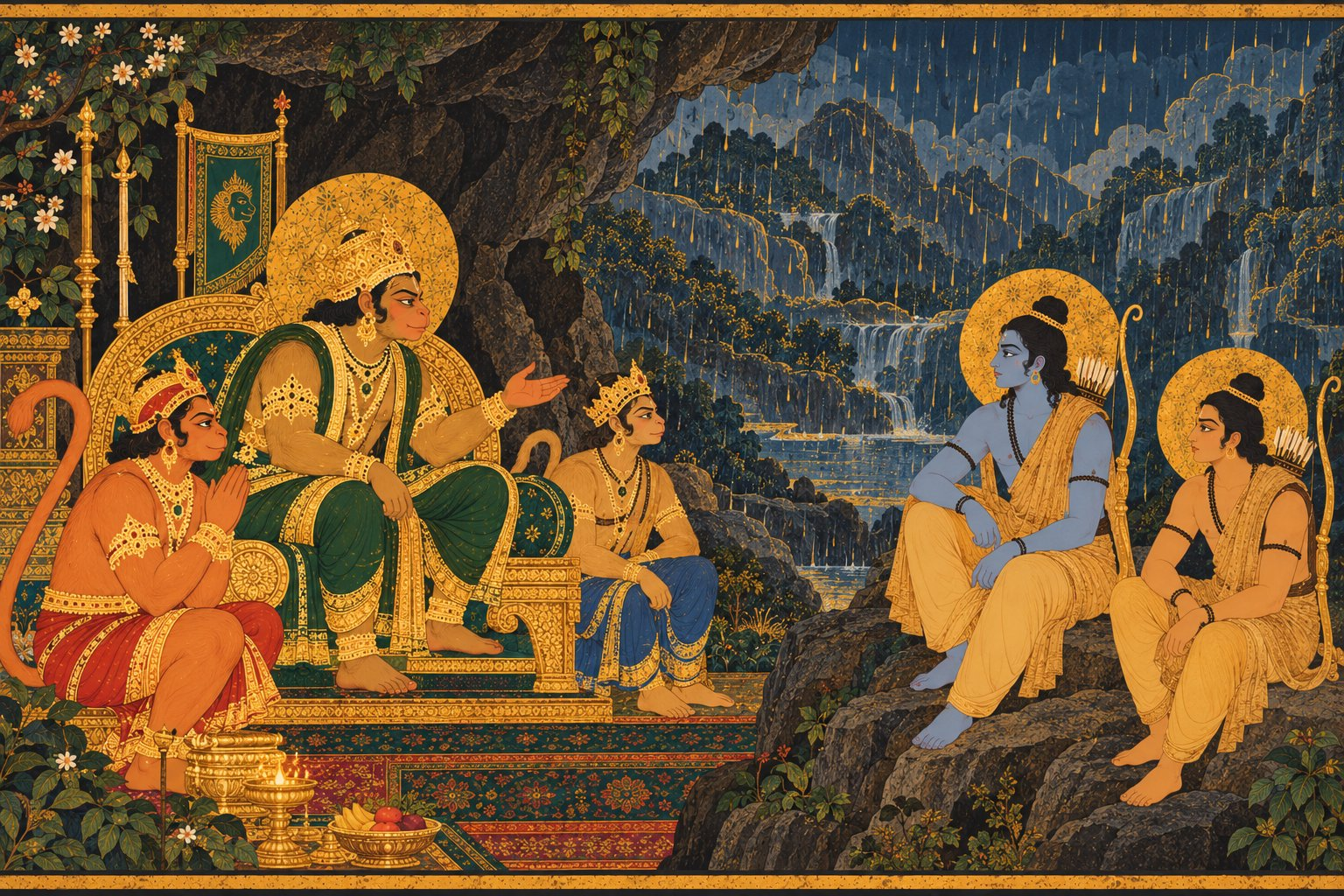
Chapter 8: Hanuman and Sugriva • Scene 8: Sugriva is Crowned
“Sugriva became king of Kishkindha. Rama waited through the monsoon rains until the roads were clear, and then Sugriva called the vanara armies to help find Sita.”
With sacred waters from the four seas poured by preceptors and ministers, Sugriva was formally crowned Maharaja of Kishkindha, and noble Angada was anointed crown prince. Abiding strictly by his fourteen-year ascetic vow, Sri Rama declined to enter the city gates.
Rama and Lakshmana established their dwelling in a natural cave atop Mount Prasravana, waiting out the torrential monsoon downpours as golden rain cascaded over waterfalls and lush valleys. When autumn cleared the skies and dried the forest tracks, King Sugriva summoned millions of vanaras from every corner of the earth to begin the search for Sita.
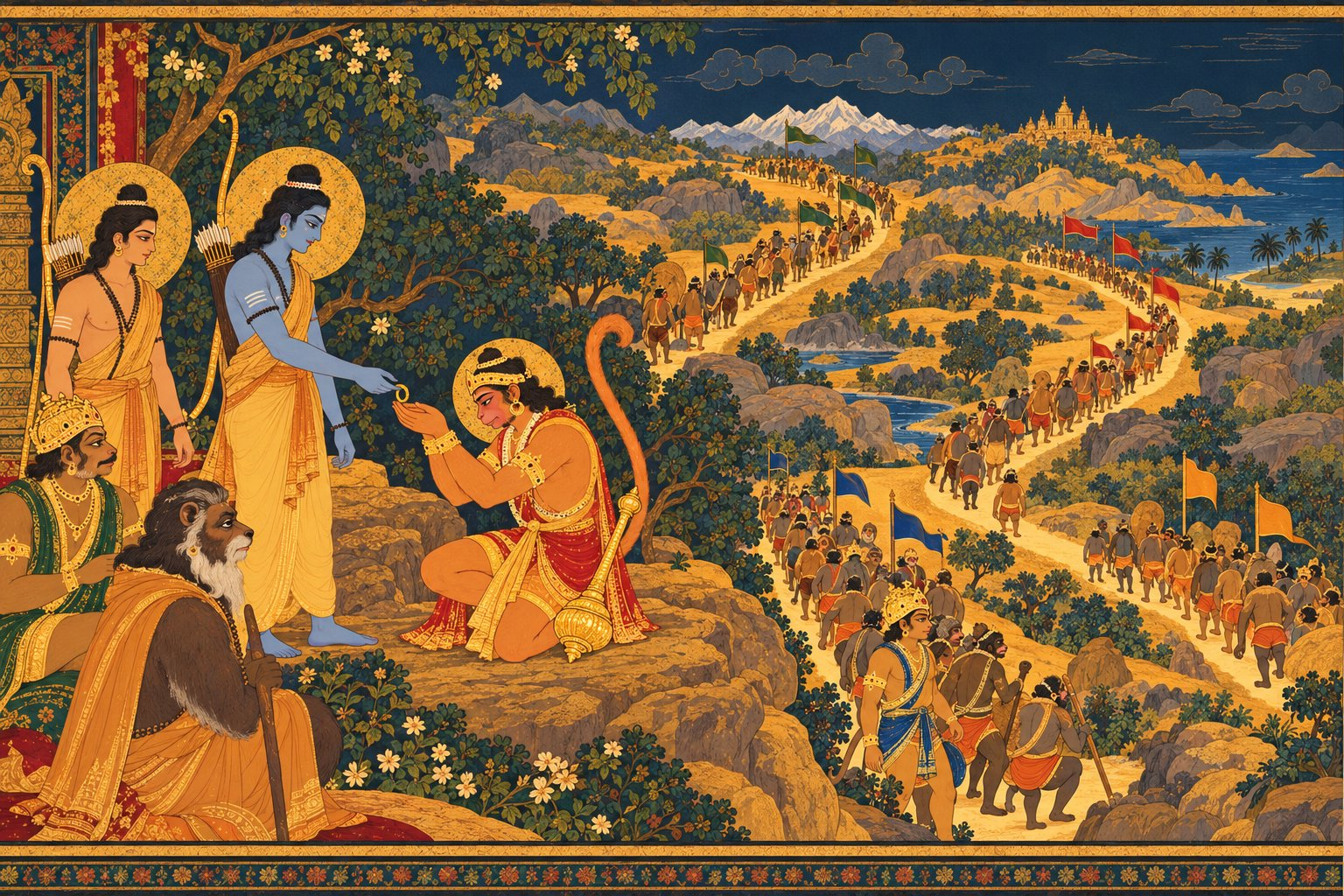
चतुर्द्दिक् प्रस्थानम् • राम मुद्रिका प्रदानम्
Chapter 8: Hanuman and Sugriva • Scene 9: Searching in Four Directions
“Sugriva sent search parties in all four directions. Rama gave Hanuman his own ring for Sita, saying, ‘She will know you came from me.’”
King Sugriva organized the massive vanara forces into four grand search divisions, dispatching legions to the north, east, west, and south under seasoned commanders. Placing his highest faith in the southern contingent led by prince Angada and elder Jambavan, Sri Rama summoned Hanuman.
Entrusting his sacred signet ring engraved with his divine name into Hanuman’s hands, Rama declared that when Sita beheld this gem, she would know without doubt that a true messenger had arrived. Hanuman bowed low, accepted the ring with both hands against his forehead, and set forth with resolute purpose.
सागर तीरे संपाति वाक्यम् • मारुति जागरणम्
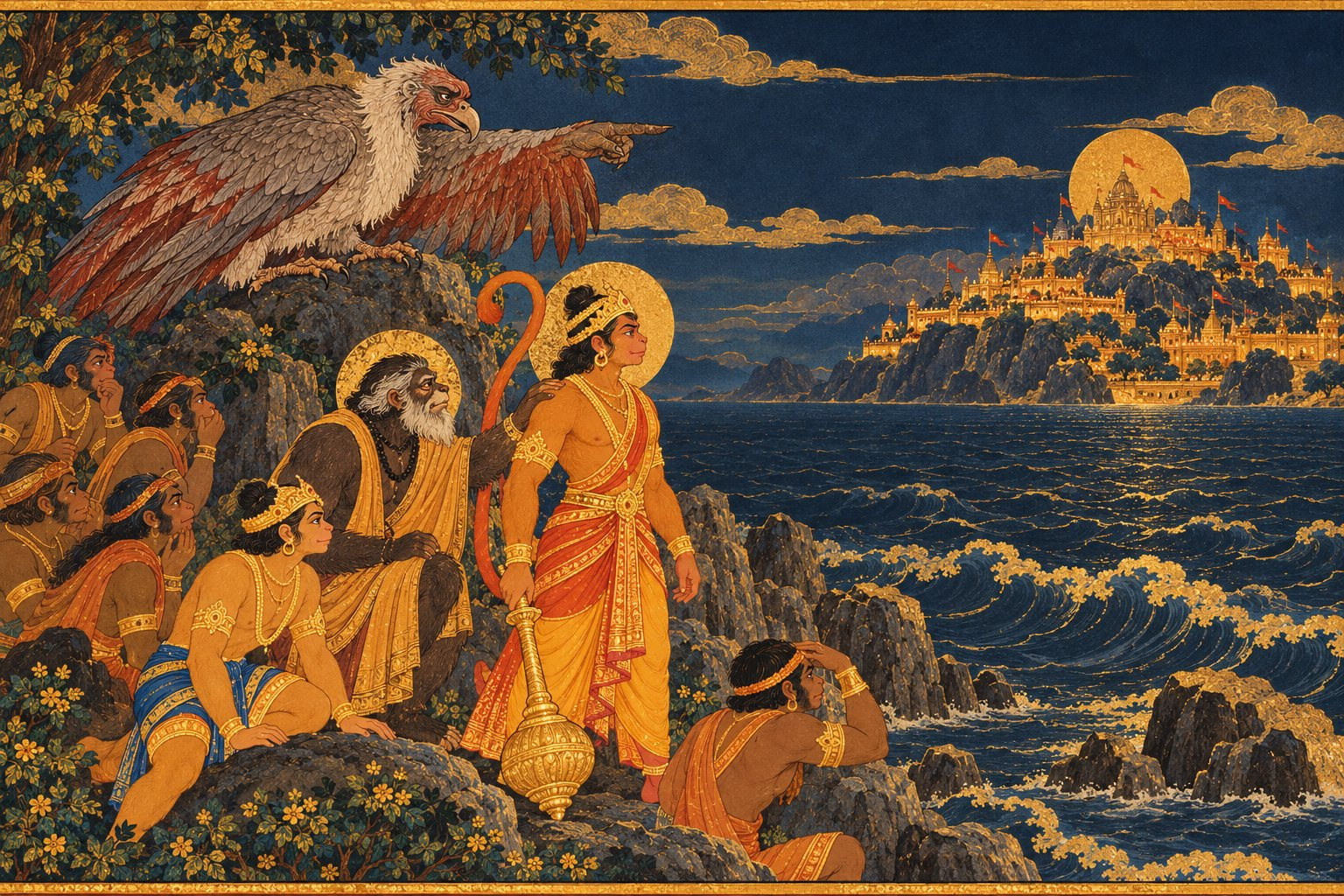
Chapter 8: Hanuman and Sugriva • Scene 10: The Edge of the Ocean
“The southern party searched for weeks. On the shore, the old vulture Sampati told them that he saw Sita in Lanka, across the sea. But the ocean was too wide for any of them. Then Jambavan reminded Hanuman of his own forgotten strength.”
After traversing dense jungles and barren mountain ranges, the southern search party arrived at the shores of the vast, roaring southern ocean. Despair gripped the vanaras as they gazed upon the endless surging waves, until the ancient vulture king Sampati, elder brother of Jatayu, appeared upon the coastal cliffs.
With his far-reaching eagle vision, Sampati confirmed that Mata Sita was held captive in the island fortress of Lanka, a hundred leagues across the deep. Seeing the vanaras despondent over how to cross the impassable expanse, the venerable bear-king Jambavan approached quiet Hanuman, chanting hymns of praise to awaken his forgotten cosmic power and prepare him for the legendary leap across the sea.
अध्याय ९ आरम्भ भवति
द्रवहु सुदसरथ अजिर बिहारी ॥
सुन्दरकाण्ड • लङ्का दर्शन एवं दहन
The Leap to Lanka & News of Sita
Hanuman leaps across the ocean from Mount Mahendra, overcoming sea trials to infiltrate golden Lanka. Discovering Sita in Ashoka Vatika, he delivers Rama’s signet ring and receives her Chudamani. After decimating the grove and defying Ravana, Hanuman sets Lanka ablaze with his burning tail and returns with the joyful cry: 'Drishta Sita!'
महेन्द्राग्र महाप्लवनम् • सिन्धुतरणम्
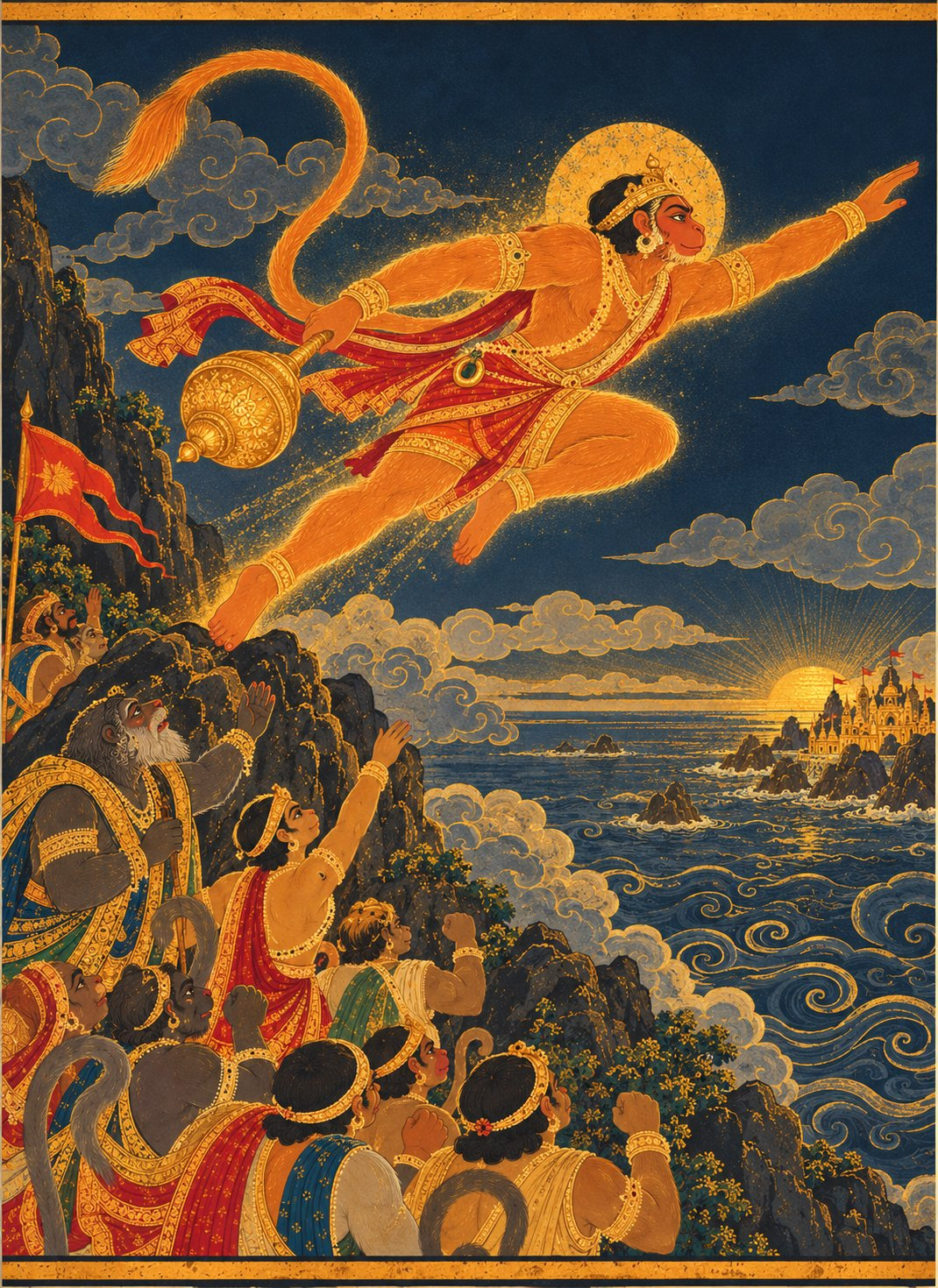
Chapter 9: The Leap to Lanka • Scene 1: The Mighty Leap
“Hanuman remembered his strength. He climbed Mount Mahendra, grew as tall as the clouds, and with a roar leapt across the ocean toward Lanka.”
Awakened to his boundless divine power by Jambavan, Sri Hanuman stood upon the towering crags of Mount Mahendra like a golden thunderbolt. Expanding his colossal celestial form until his crest scraped the clouds, he swung his radiant mace and let forth a cosmic roar that echoed across the southern horizon.
With unyielding devotion to Rama in his breast, Hanuman pressed down upon the mountain until its granite foundations groaned, and launched into the azure heavens over the rolling charcoal and gold waves toward Lanka as the vanaras cheered with raised hands.
सागर विघ्न निवारणम् • त्रिदिव्य विजयः
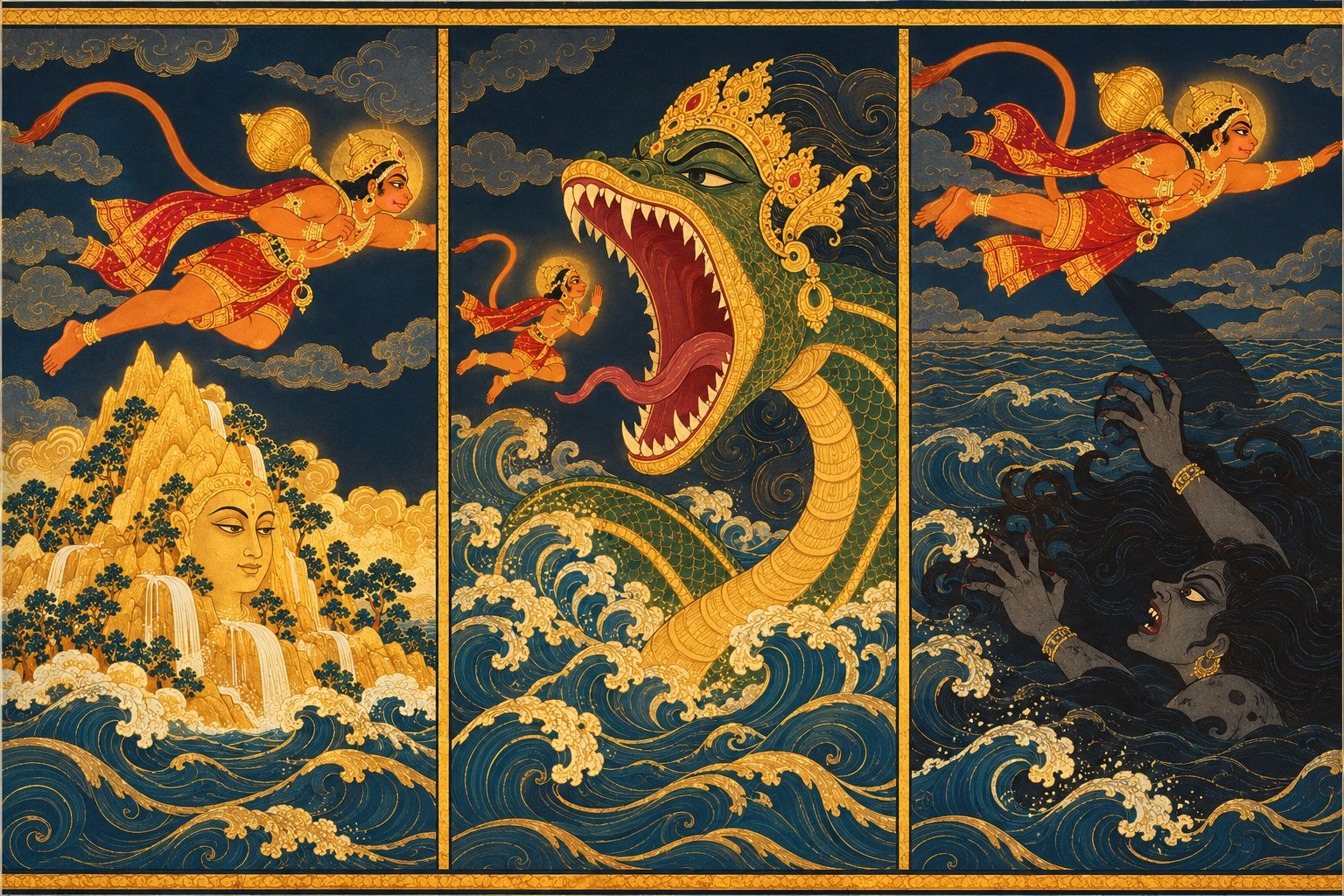
Scene 2: Three Trials at Sea • Double-Page Panorama
“On his way, the golden mountain Mainaka rose up to give him rest, but Hanuman only touched it and flew on. The sea-goddess Surasa opened a huge mouth to test him, and Hanuman shrank and slipped through. A shadow-demoness, Simhika, tried to pull him down, but he defeated her.”
As Maruti soared across the boundless waters, the golden winged mountain Mainaka emerged from the foam with folded hands, offering him nectar and rest. Touching its sunlit peak with reverence, Hanuman proclaimed his sacred vow: no rest until Rama's mission was accomplished.
Soon, Surasa, the Mother of Serpents, expanded her cavernous jaws to test his wit; Hanuman grew gigantic, then instantly shrank to the size of a thumb, darted through her mouth, and emerged triumphant. When shadow-demoness Simhika seized his shadow from beneath the dark ocean, Hanuman plunged into her maw, shattered her sinister heart, and bounded forth into the sky.
लङ्किणी विजयः • कनक लङ्का प्रवेशः
Chapter 9: The Leap to Lanka • Scene 3: The Gates of Lanka
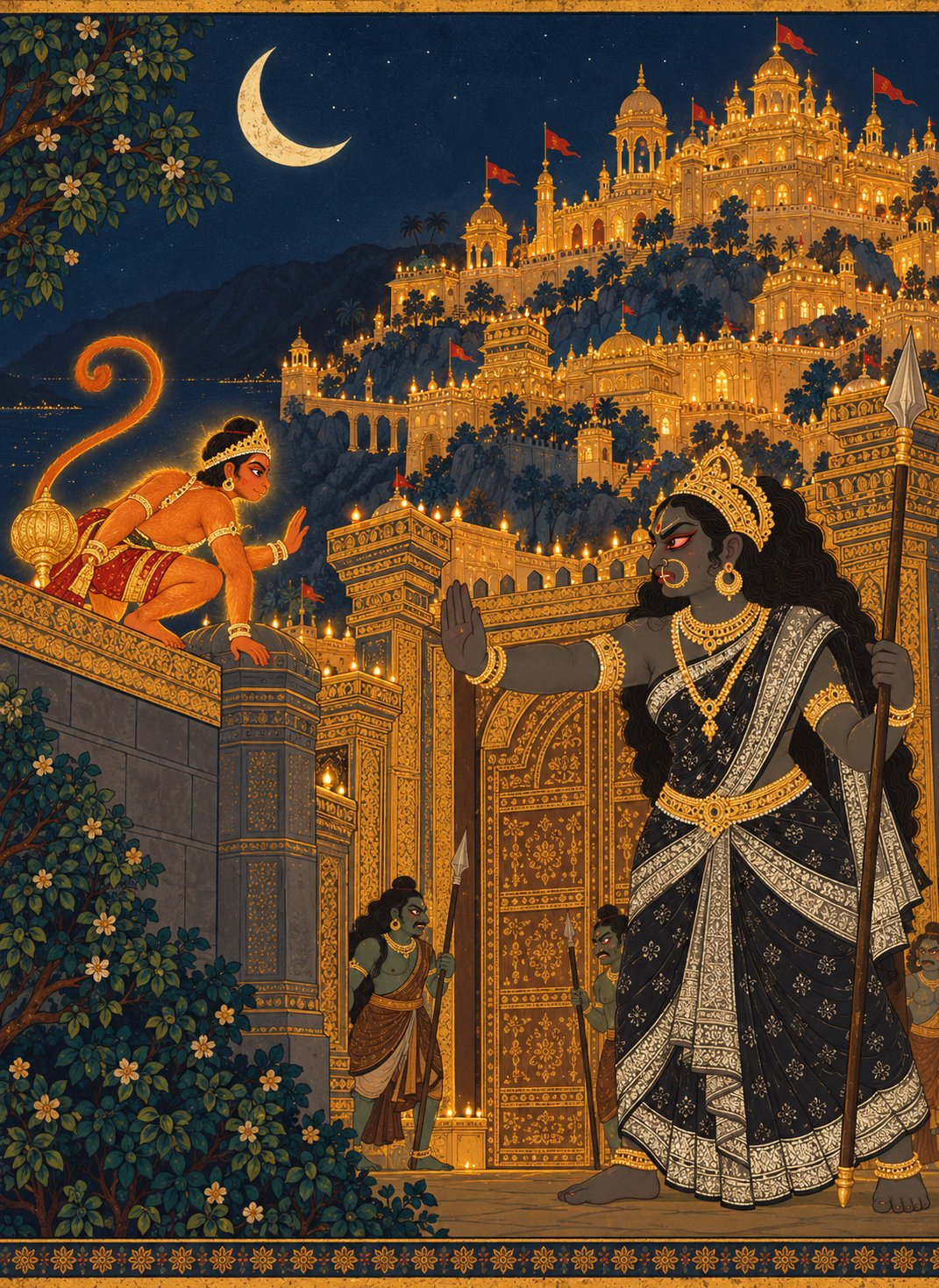
“Hanuman reached Lanka at night and saw a golden city. At the gate stood the demoness Lankini, who guarded the city. Hanuman struck her lightly, and she let him in, saying Ravana’s end was near.”
Under the silver gleam of a crescent moon, Hanuman descended upon Mount Trikuta, gazing upon the opulent golden ramparts, jewelled palaces, and formidable battlements of Lanka. Shrinking his colossal frame to the size of a gentle cat to avoid detection, he approached the ornate northern gates.
Suddenly, the fearsome demoness Lankini, the guardian deity of Lanka, loomed before him with a raised spear. With a single restrained blow from his left fist, Maruti felled the guardian. Remembering Brahma's prophecy that her defeat heralded the doom of the Rakshasa empire, Lankini bowed and bade him enter.
अन्तःपुर विमर्शः • रावण शयन दर्शनम्
Chapter 9: The Leap to Lanka • Scene 4: Searching the Palace
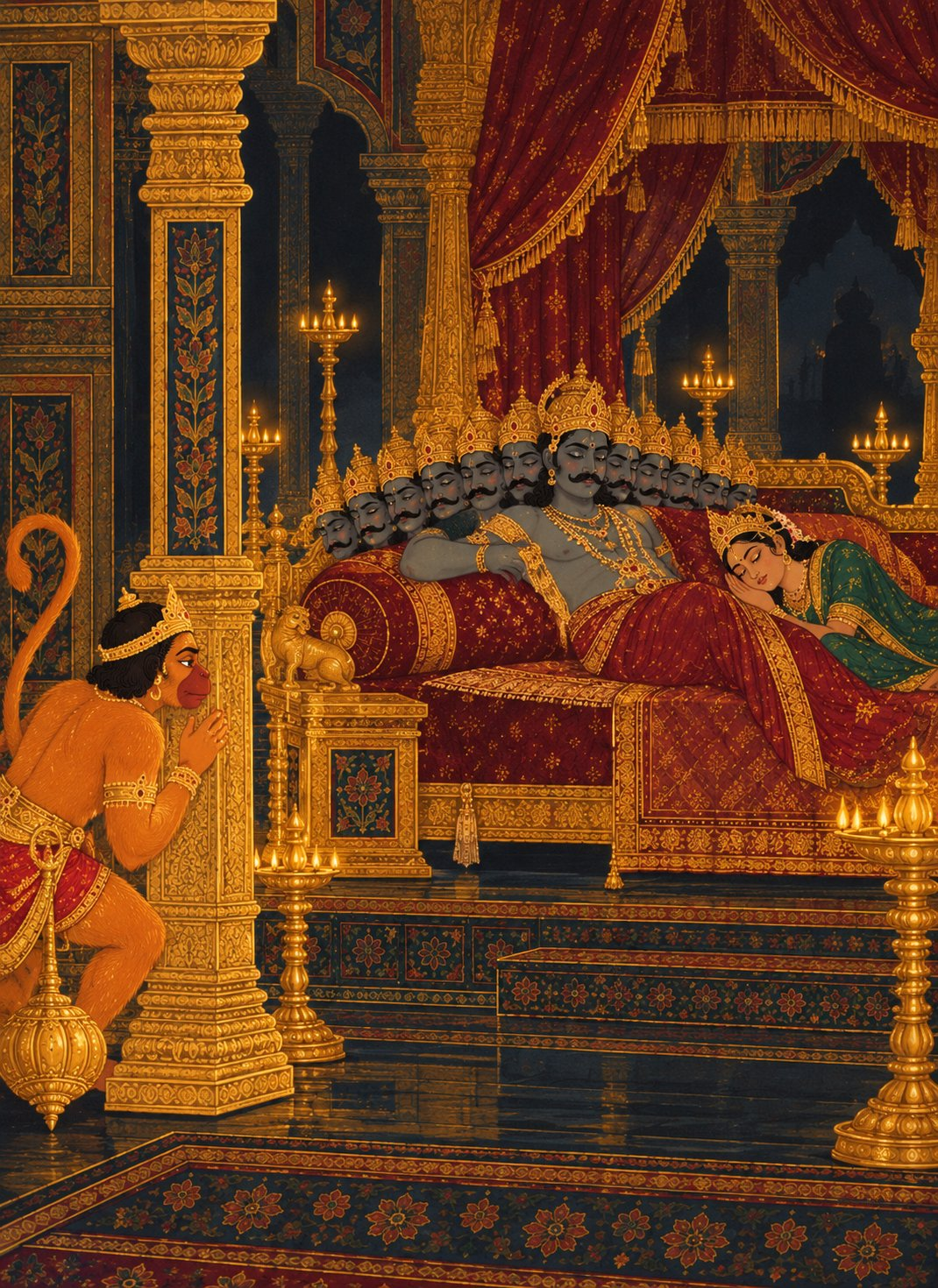
“Hanuman crept through the palace, searching every room. He saw Ravana asleep among his queens, and Ravana’s wife Mandodari, but he did not find Sita. He was worried and almost lost hope.”
Veiled by the shadows of midnight, Hanuman moved like a silent whisper through the grand halls of Ravana’s citadel. He peered through archways inlaid with pearls and sapphires into the opulent royal bedchamber, where King Ravana lay slumbering in wine-scented luxury, surrounded by ten golden crowns and his queens.
Sleeping peacefully beside him was Mandodari, adorned in emerald silk. Maruti observed the court with pure eyes, but nowhere was the chaste, weeping daughter of Janaka. Grief and anxiety gripped his heart as he feared she might be lost forever.
अशोकवनिका दर्शनम् • विदेहराजनन्दिनी
Chapter 9: The Leap to Lanka • Scene 5: Sita in Ashoka Vatika
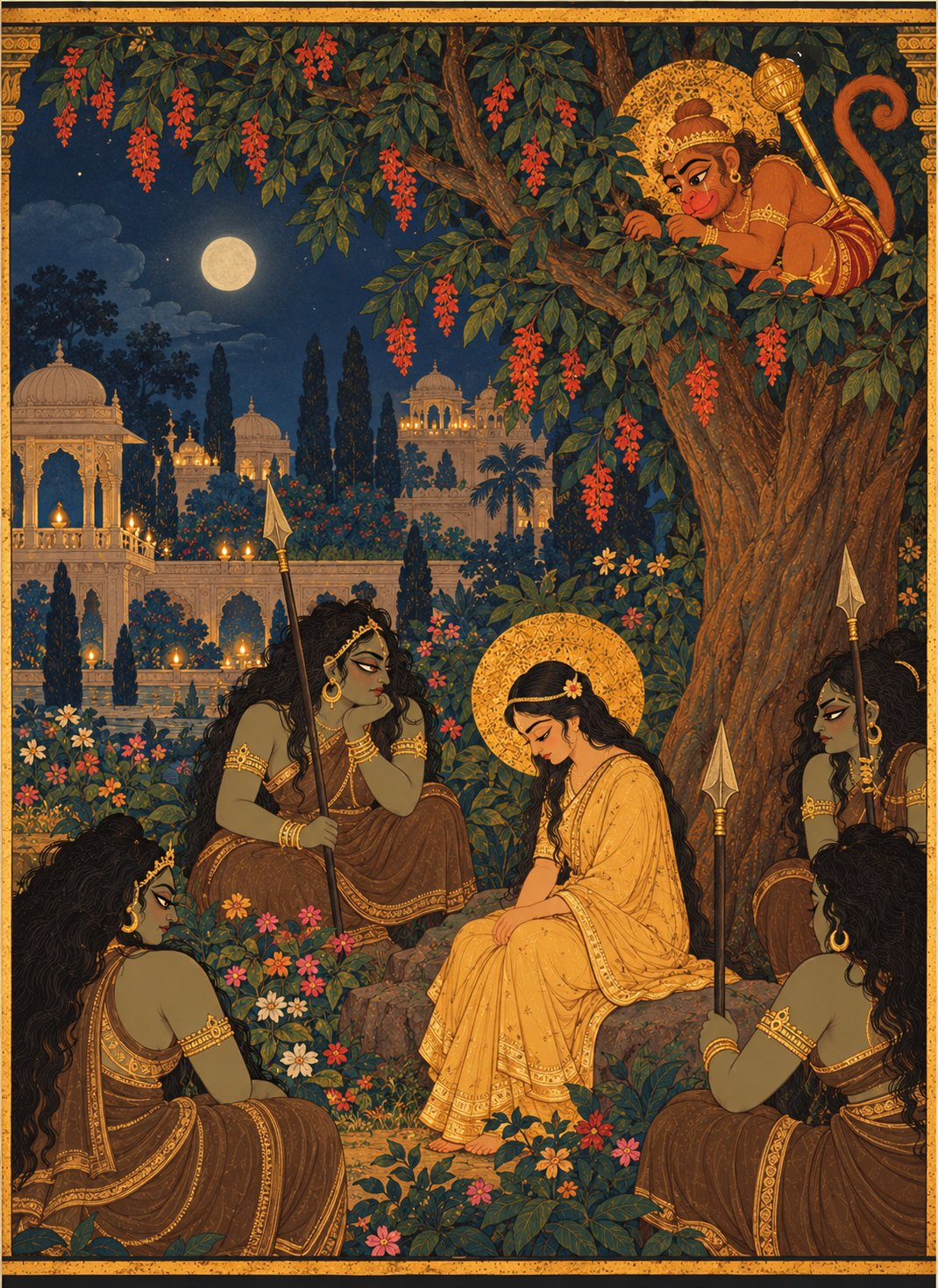
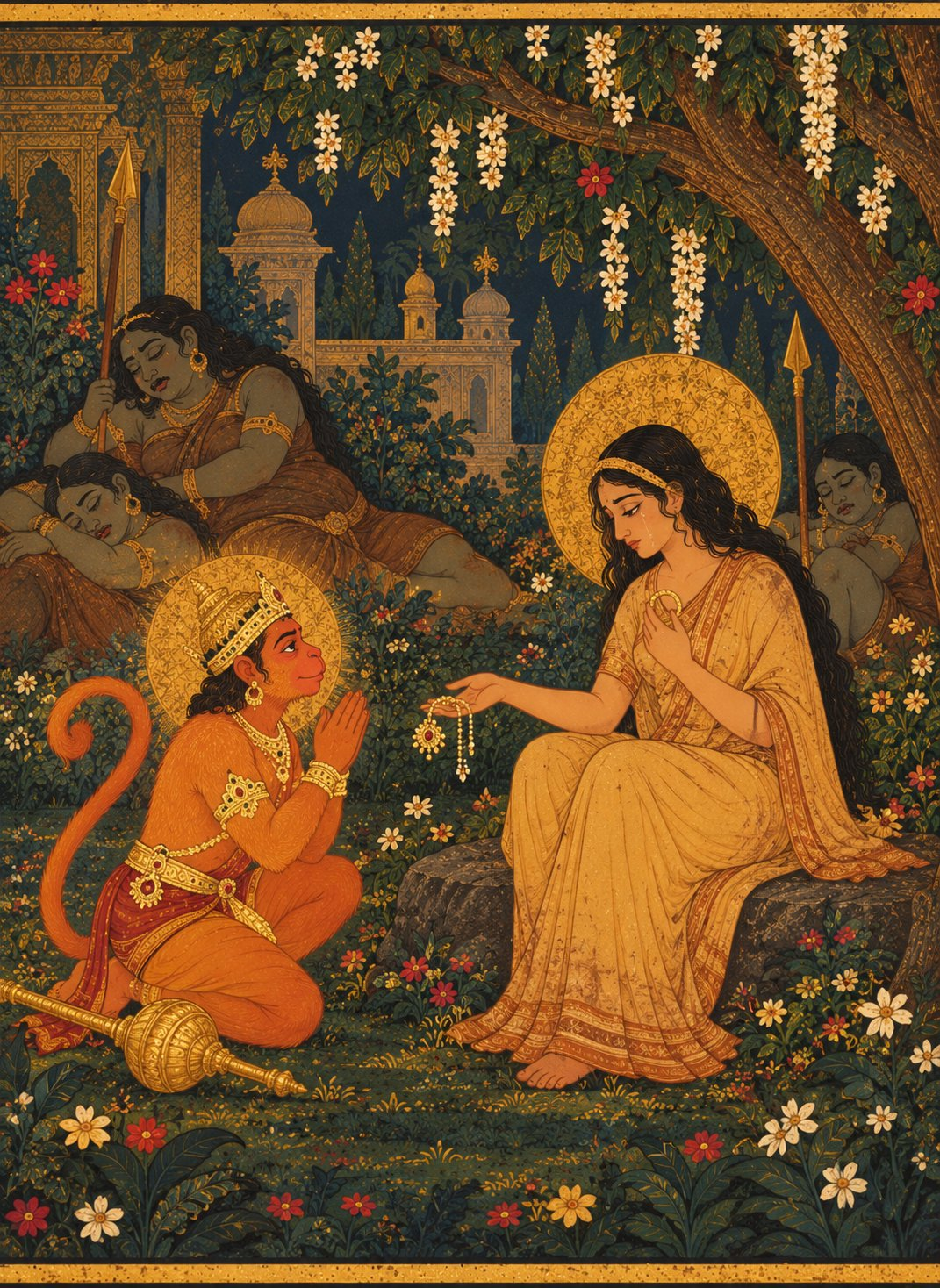
“At last Hanuman found a grove called Ashoka Vatika. Under a tree sat Sita, thin and sad, guarded by fierce rakshasis. She was still faithful and waiting for Rama.”
Leaping into the moonlit Ashoka Vatika, a fragrant grove of sacred flowering trees, Hanuman’s search reached its divine destination. Beneath the dense foliage of a weeping Shimshapa tree sat Devi Sita, frail, unadorned, and clad in a faded yellow-ochre sari, her hands clasped in prayer as tears streamed down her cheeks.
Surrounded by monstrous rakshasis bearing iron tridents and spiked clubs, she remained immovable in her unswerving devotion to Rama. High amidst the blossoming boughs, tiny Hanuman wept silent tears of veneration and joy.
तृणान्तर सम्भाषणम् • रावण तर्जनम्
Chapter 9: The Leap to Lanka • Scene 6: Ravana’s Threat
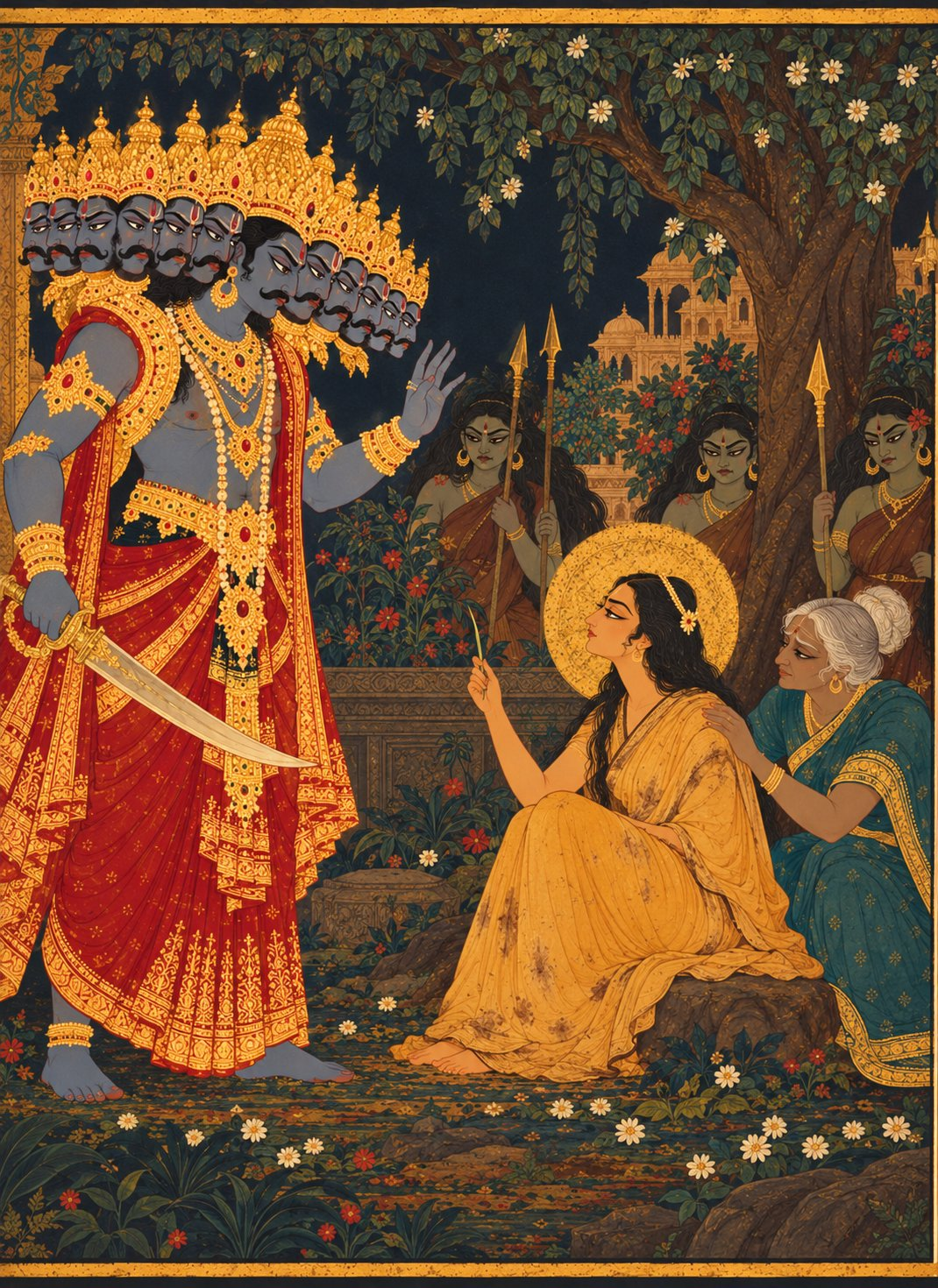
“Ravana came to the garden and told Sita to marry him. Sita placed a blade of grass between them and refused. Ravana gave her two months to change her mind. Kind old Trijata comforted her.”
At dawn, King Ravana entered the Ashoka grove in regal fury, brandishing his gold-hilted Chandrahasa blade and demanding Sita’s surrender. Unshakable as Mount Meru, Devi Sita placed a single blade of grass upon the earth between them—refusing to look directly upon the abductor—and declared that Rama’s celestial shafts would reduce Lanka to ashes.
Enraged, Ravana granted her a final ultimatum of two months before his sword fell. When the fierce demonesses threatened her, only the venerable Trijata intervened, recounting her prophetic dream of Rama’s victory and comforting Sita.
मुद्रिका प्रदानम् • चूडामणि समर्पणम्
Chapter 9: The Leap to Lanka • Scene 7: The Ring and the Jewel
“When the guards slept, Hanuman dropped Rama’s ring into Sita’s lap and spoke softly. Sita wept with joy. She gave him her hair jewel, the Chudamani, to take to Rama as a sign.”
When a divine slumber overcame the rakshasi guards, Hanuman descended softly through the branches and began reciting the auspicious deeds of Sri Rama. Dropping Rama’s golden signet ring gently into her cupped hands, Maruti revealed himself with folded palms.
Recognizing the divine seal of her lord, Sita wept tears of boundless relief, honoring Hanuman as a son and true messenger of God. From her woven tresses, she untied her radiant hair crest—the sacred Chudamani—and blessed Hanuman, urging him to bring Rama swiftly to her rescue.
अशोकवनिका भङ्गः • ब्रह्मास्त्र बन्धनम्
Chapter 9: The Leap to Lanka • Scene 8: The Garden Falls & Hanuman is Caught
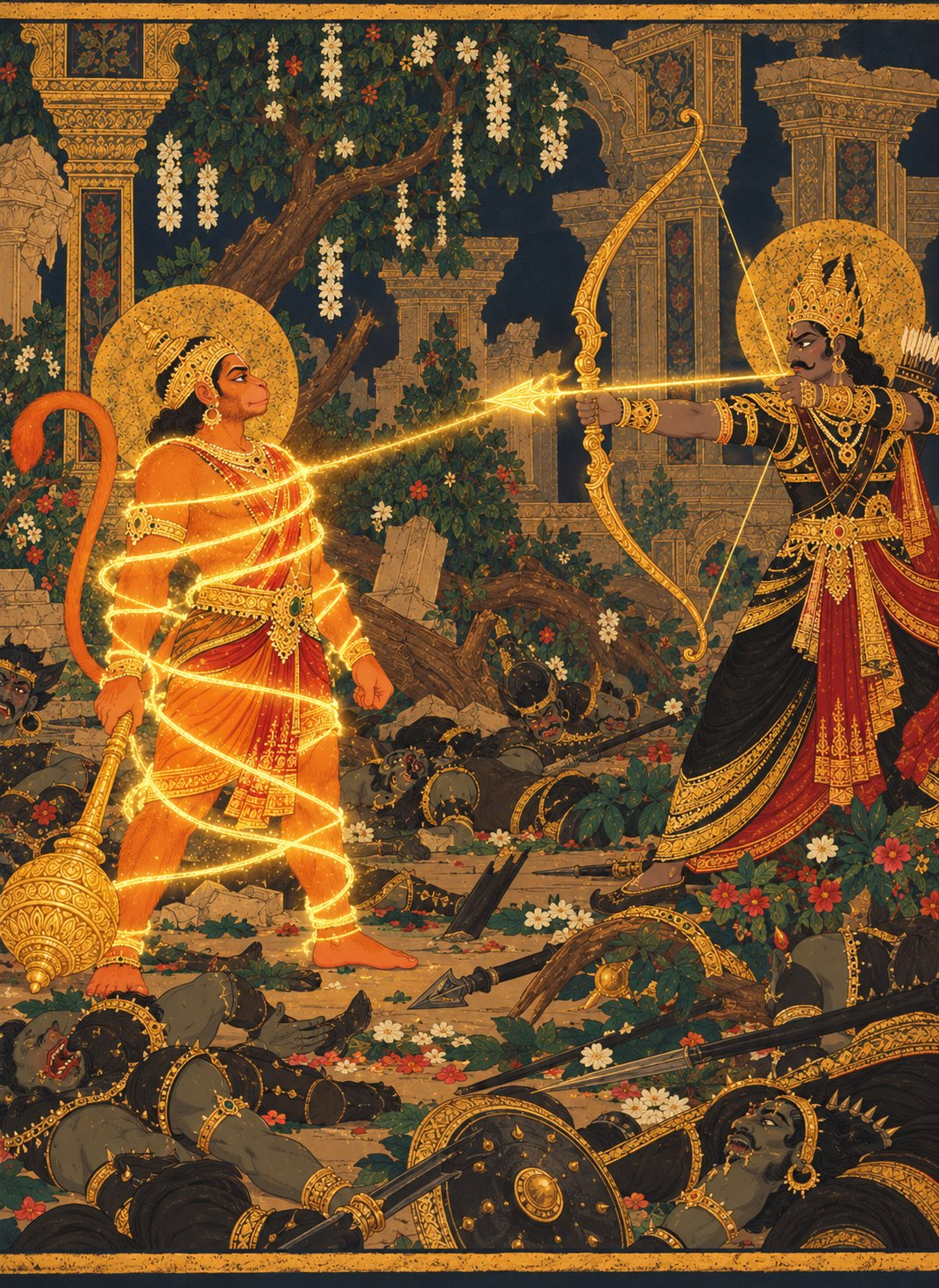
“Before leaving, Hanuman broke the garden and fought Ravana’s soldiers. At last Ravana’s son Indrajit used a divine weapon, and Hanuman allowed himself to be taken, so that he could see Ravana’s court.”
Resolved to test Lanka's military strength and deliver Rama’s warning face-to-face to Ravana, Hanuman uprooted the trees, tore down the golden pavilions, and decimated the ranks of demons sent to apprehend him. At last, Prince Indrajit took the field, releasing the invincible golden cords of the Brahmastra.
Though possessing the celestial boons to instantly dissolve the divine shackle, Hanuman willingly surrendered to the sacred bonds so that he would be brought directly before the ten-headed sovereign.
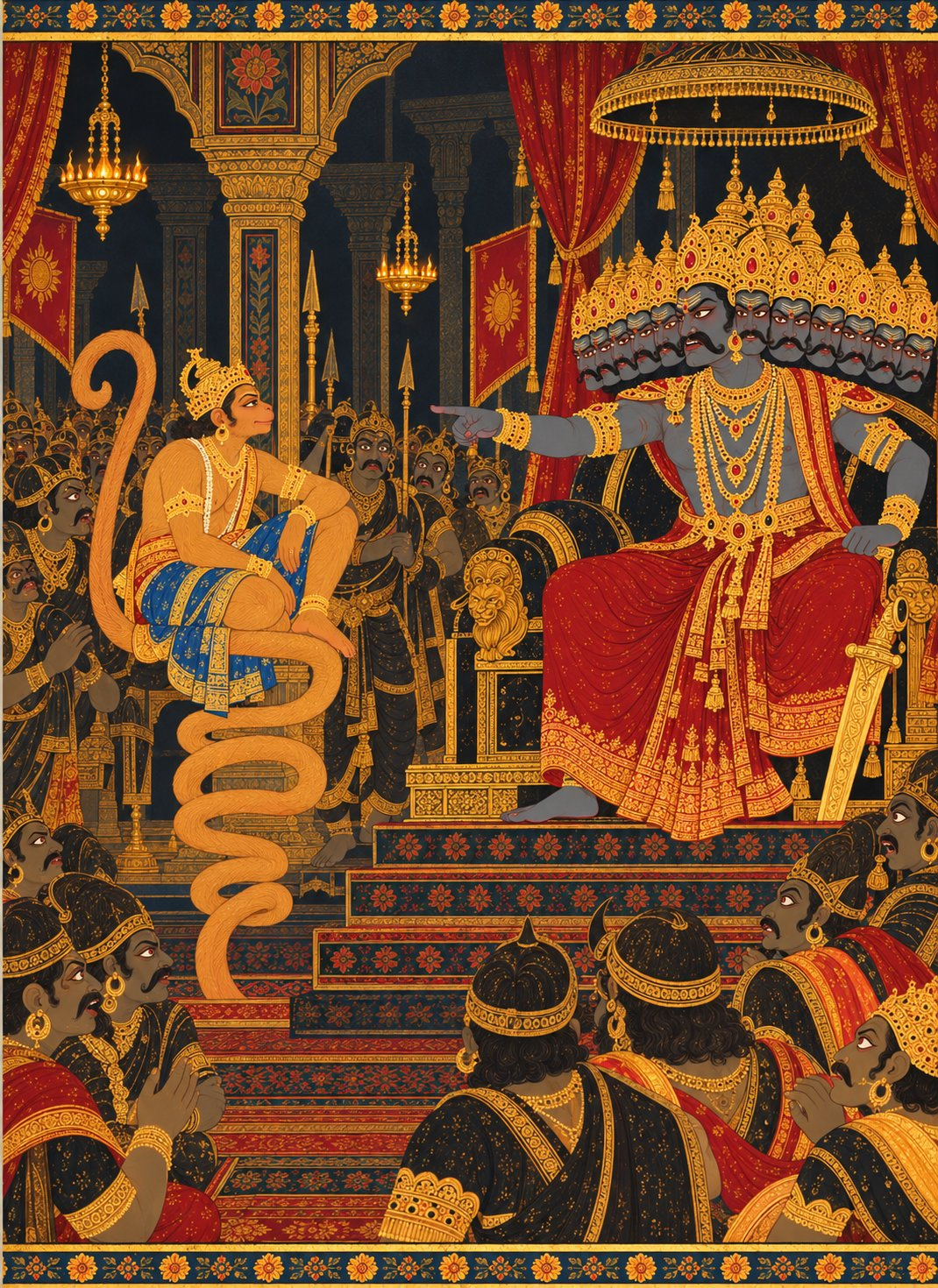
रावण सभा सम्भाषणम् • पुच्छ प्रज्वलनम्
Scene 9: Ravana’s Court & Burning Tail • Double-Page Panorama
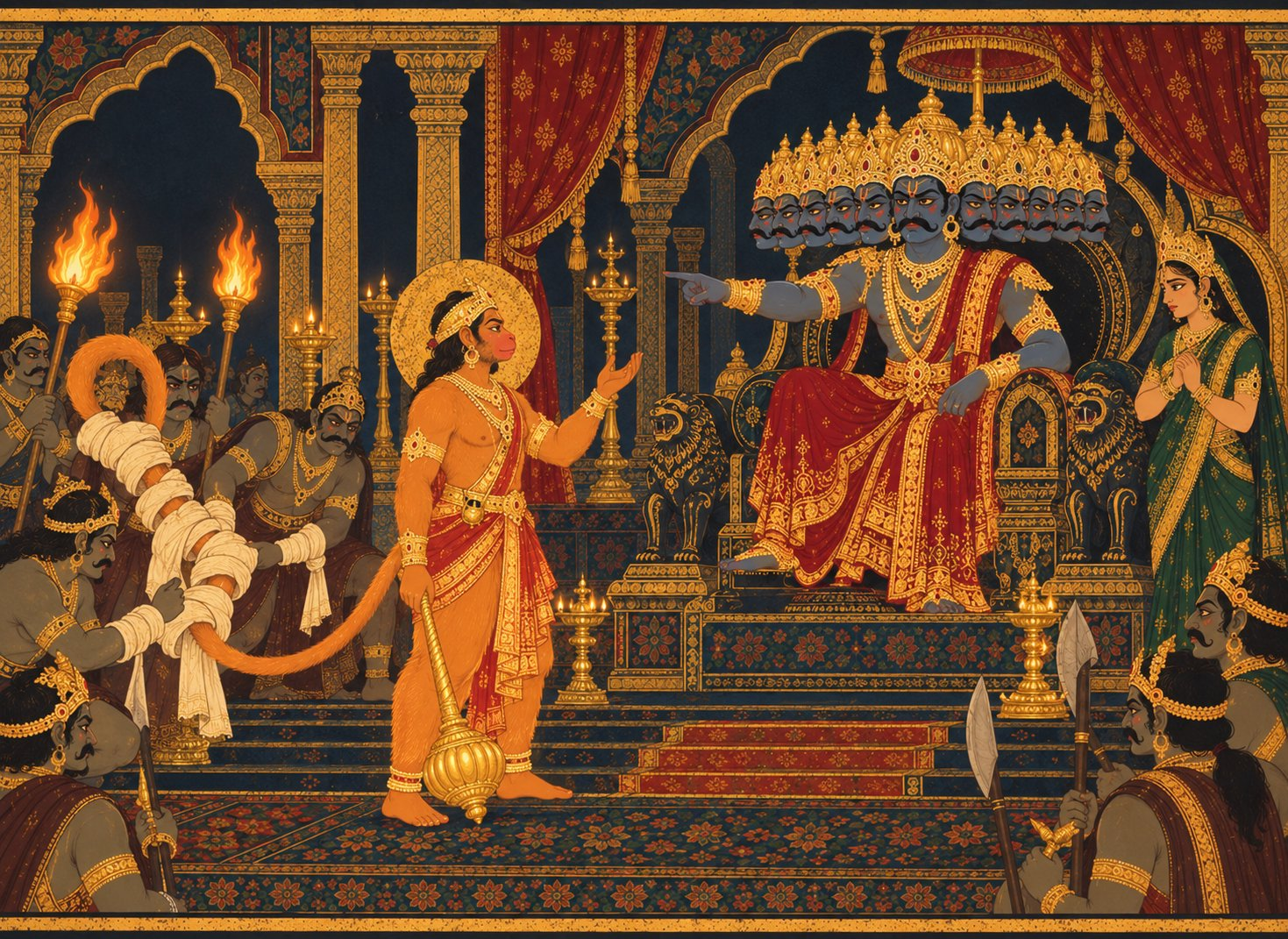
“In Ravana’s court, Hanuman told Ravana to return Sita, or Rama would destroy Lanka. Ravana laughed and ordered his tail to be set on fire.”
Brought before the diamond-studded throne of Ravana, Hanuman coiled his extended tail into a lofty seat rising equal to the monarch’s grandeur. Fearlessly, the monkey envoy proclaimed Sri Rama’s righteousness and demanded the immediate release of Sita, warning that Lanka’s golden palaces would turn to ash.
Mocking the emissary, Ravana spared his life but commanded that his beloved tail be wrapped in cotton cloth, soaked in oil, and set ablaze with flaming torches to parade him through the streets. Mandodari watched in dread as Maruti smiled, feeling no heat through Agni’s blessings.
लङ्का दहनम् • चूडामणि समर्पणम्
Chapter 9: The Leap to Lanka • Scene 10: Lanka Burns & News Reaches Rama
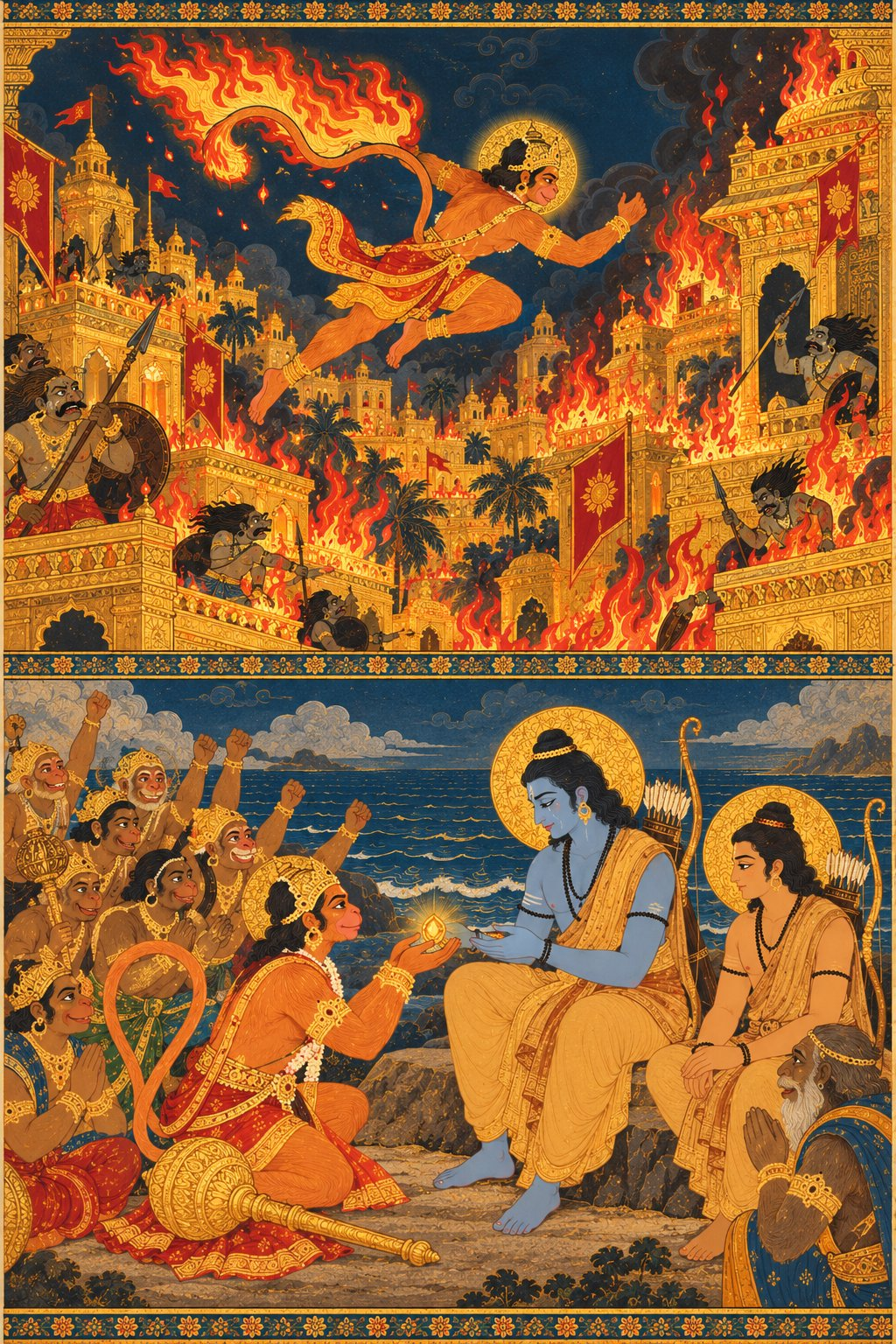
“With his tail aflame, Hanuman leapt from roof to roof and set the golden city on fire. Sita was untouched. Then he flew back across the sea, and at the shore he placed the Chudamani in Rama’s hands and told him, ‘I have seen Sita.’”
Expanding to gargantuan size, Maruti slipped from his chains and bounded across the gilded spires of Lanka, sweeping his fiery tail across the mansions, arsenals, and barracks until the city burned like a mountain of red and gold flame, leaving the Ashoka grove untouched.
Quenching his tail in the southern sea, Hanuman flew back like a shooting star to Mount Mahendra. Kneeling at the lotus feet of Sri Rama on the ocean shore, Hanuman placed Devi Sita’s shining Chudamani jewel into his master’s hands, uttering the immortal words: “Drishta Sita—I have seen Sita!” Tears of divine love filled Rama’s eyes as the vanara hosts cheered in thunderous celebration.
अध्याय १० आरम्भ भवति
द्रवहु सुदसरथ अजिर बिहारी ॥
नल-नील रामसेतु निर्माण
Building the Miraculous Ocean Bridge
At the edge of the southern sea, Sri Rama grants unconditional refuge to Vibhishana. Vanara architects Nala and Neela construct the floating stone bridge across the roaring waves, allowing Rama's colossal army to cross into Lanka.
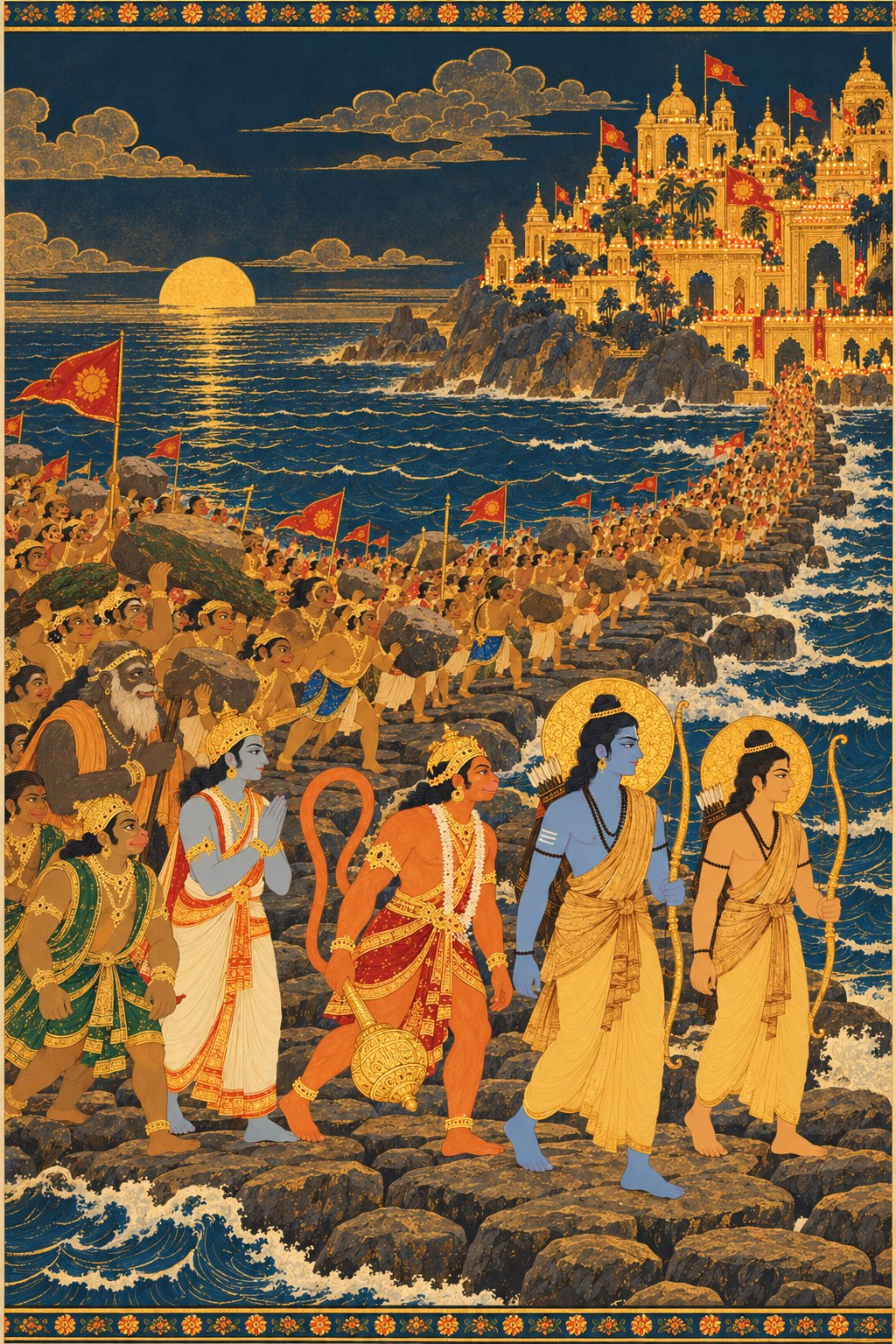
दक्षिण प्रयाणम् • सिन्धुतीर गमनम्
Chapter 10: The Bridge • Scene 1: The Army Marches South
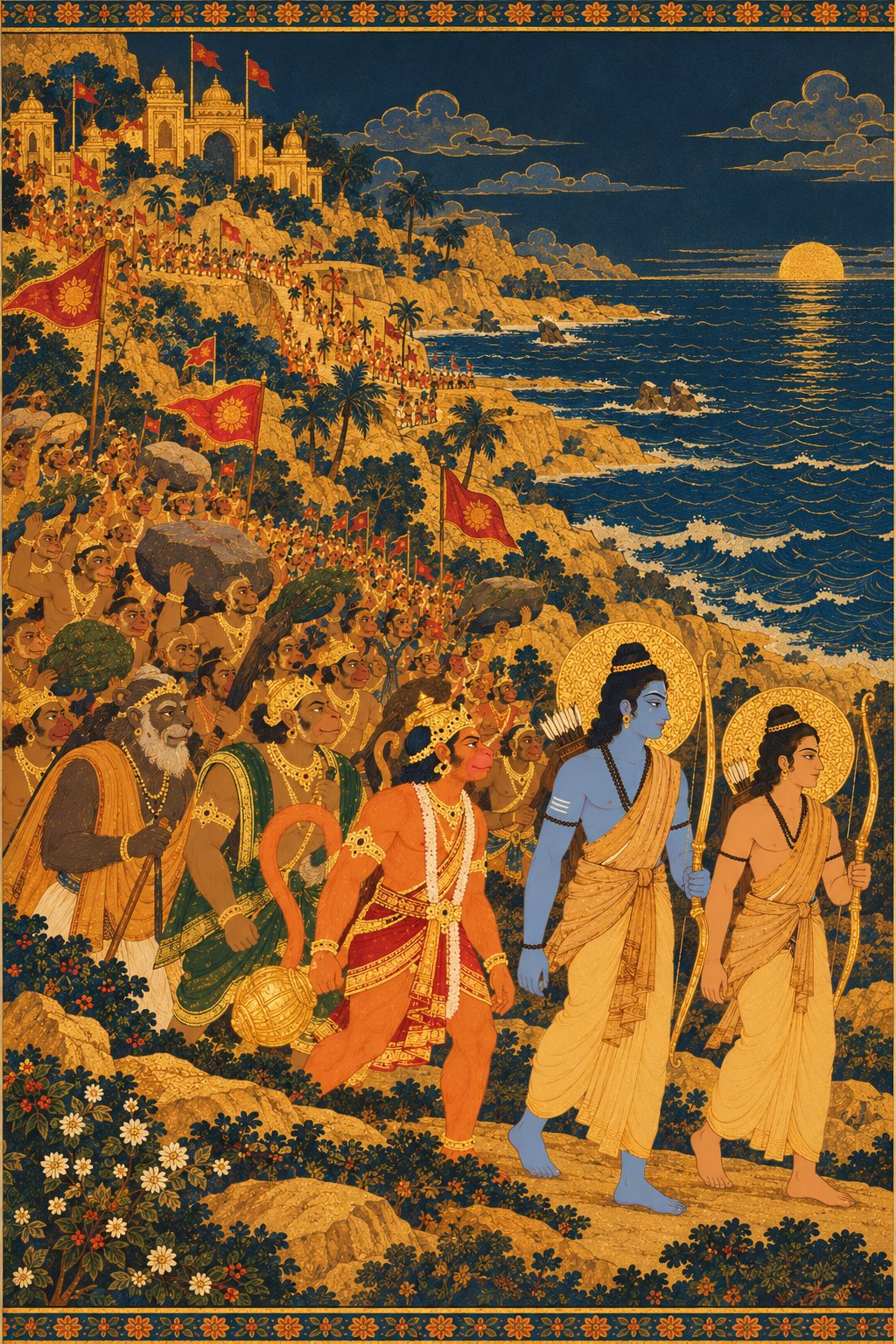
“The vanara army, thousands strong, marched south with Rama at the front. Hills shook, and the sound of their roars rose like a storm. At last, they reached the shore of the great ocean.”
Led by Sri Rama and Lakshmana in ascetic bark robes, the colossal vanara army advanced southward like a golden tempest. Valiant generals Sugriva, Hanuman, Jambavan, and Angada marshaled countless legions carrying aloft vibrant flags emblazoned with the blazing golden sun. The mountains trembled beneath their thunderous footsteps, and the skies resonated with their mighty battle roars.
Across rugged crags and golden hills, through lush forests and rolling wilderness, the great host marched with unflagging devotion and speed. At long last, the earth sloped downward, and before their astonished gaze stretched the vast expanse of the southern ocean, its dark indigo waves glistening under the golden sun and foaming against ancient cliffs.
विभीषण हितोपदेशः • धर्मसंभाषणम्
Chapter 10: The Bridge • Scene 2: Vibhishana’s Advice
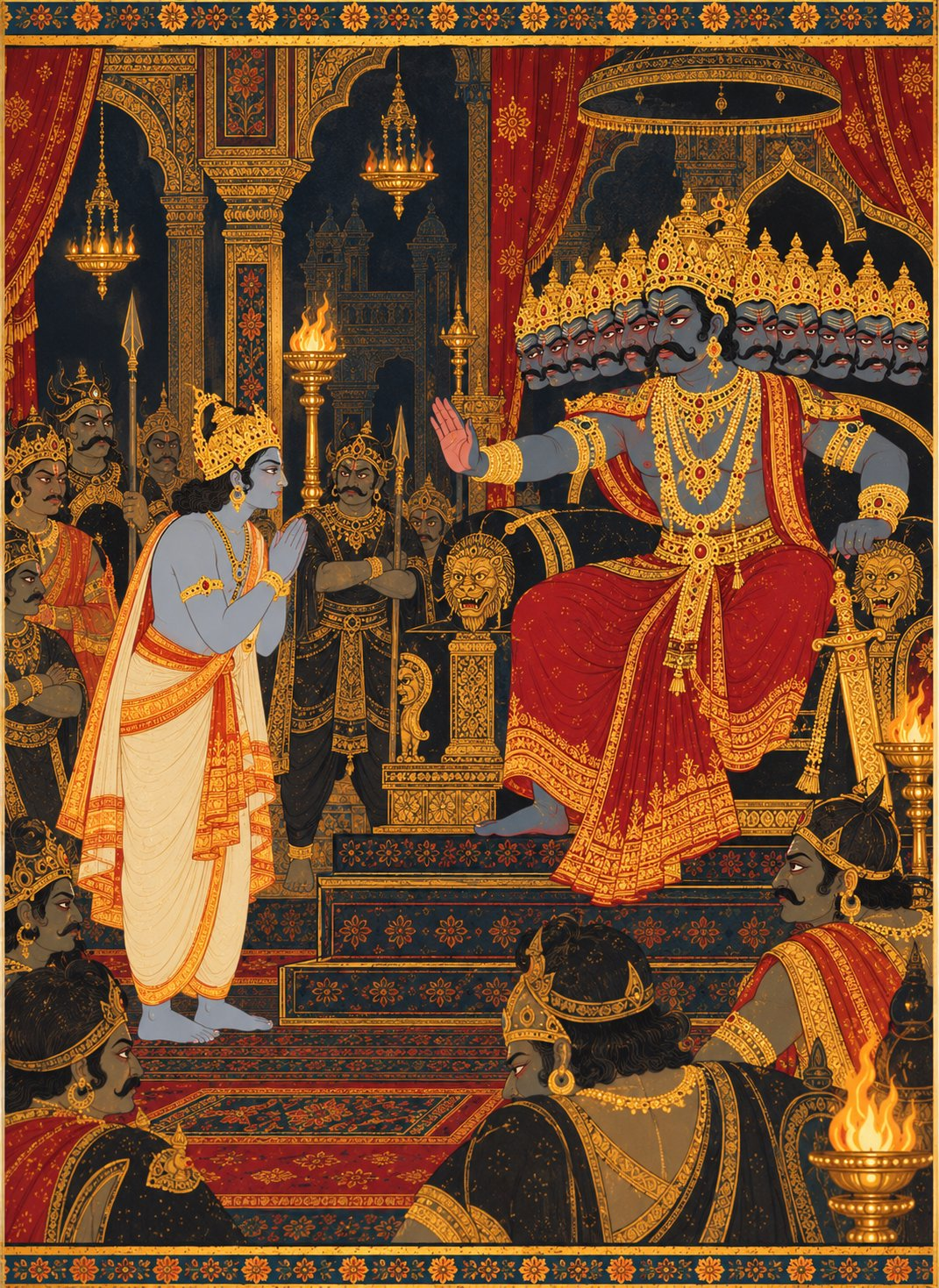
“In Lanka, Ravana’s younger brother Vibhishana begged him: ‘Return Sita to Rama, and avoid this war.’ But Ravana would not listen.”
Within the shadowy grandeur of Lanka’s royal assembly, amidst looming obsidian pillars and courtiers clad in spiked black armor, a voice of moral clarity dared to rise. Vibhishana, younger brother to the demon king, stepped forward in an unadorned white and saffron dhoti, his palms folded in humble reverence and his face pleading for truth and preservation.
Knowing the divine might of Sri Rama and the absolute sanctity of righteousness, Vibhishana implored the ten-headed sovereign to restore Sita to her rightful lord and avert inevitable ruin. But blinded by pride and intoxication of power, Ravana waved his hand in fury, spurning the sacred wisdom of dharma with mockery and wrath.
लङ्का त्यागः • धर्मपथ गमनम्
Chapter 10: The Bridge • Scene 3: Vibhishana Leaves Lanka
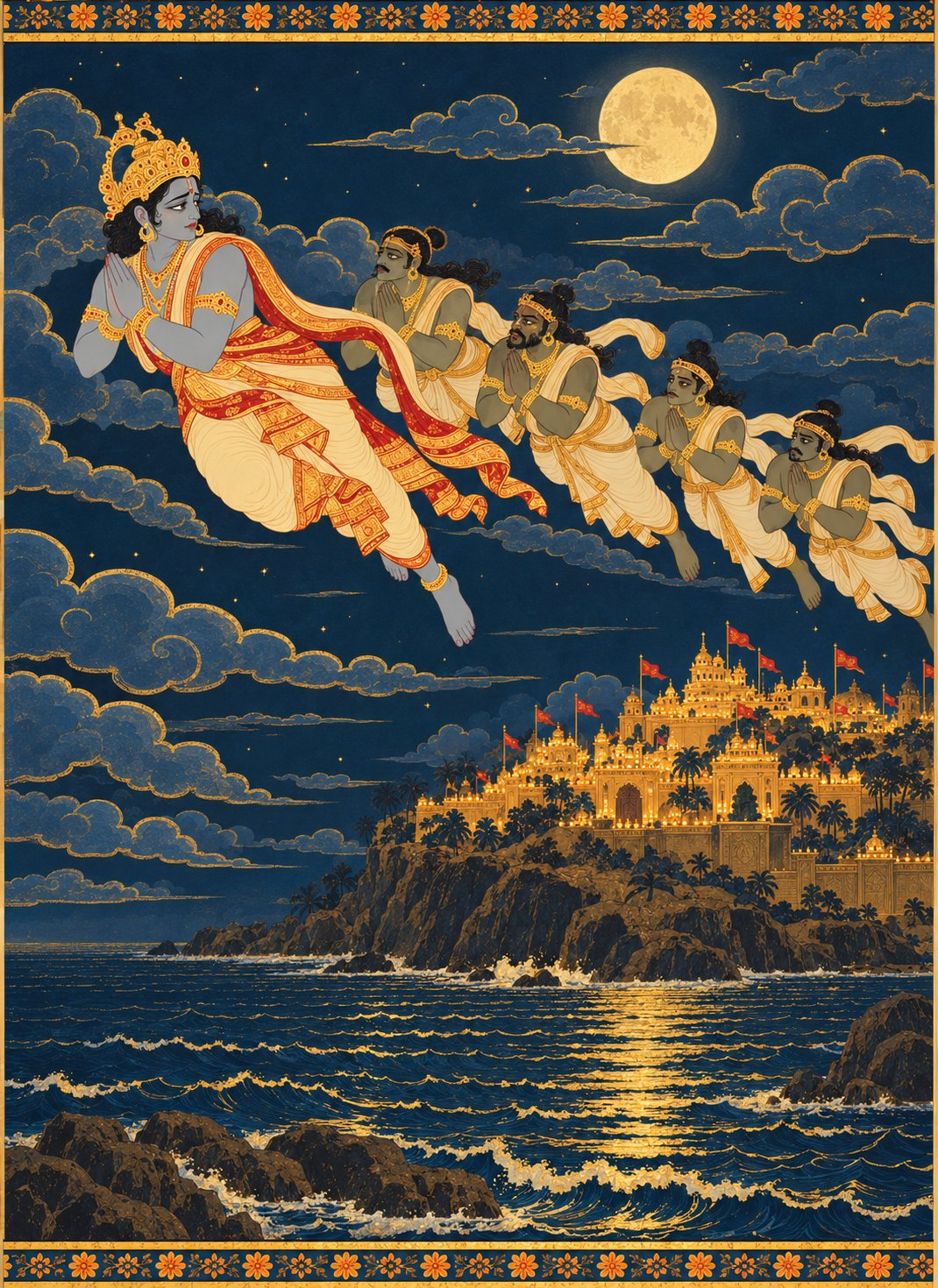
“Ravana insulted him and ordered him to leave. Vibhishana left the golden city with his four loyal ministers, choosing dharma over family.”
Ravana’s bitter scorn and insults severed the last ties of fraternity. Recognizing that to dwell with unrelenting evil was to forsake one’s own soul, Vibhishana made the eternal choice of righteousness above kinship. Accompanied by his four faithful ministers—Anala, Sharabha, Sampati, and Praghasa—he rose into the cool night air.
Flying high across the star-strewn firmament under the luminous moon, Vibhishana gazed back one last time at the shimmering spires and golden battlements of doomed Lanka with sorrow in his eyes. Turning his heart unconditionally toward Sri Rama, they soared across the glittering sea where golden ripples whispered of eternal grace.
विभीषण शरणागतिः • अभयदानम्
Chapter 10: The Bridge • Scene 4: Rama Welcomes Vibhishana
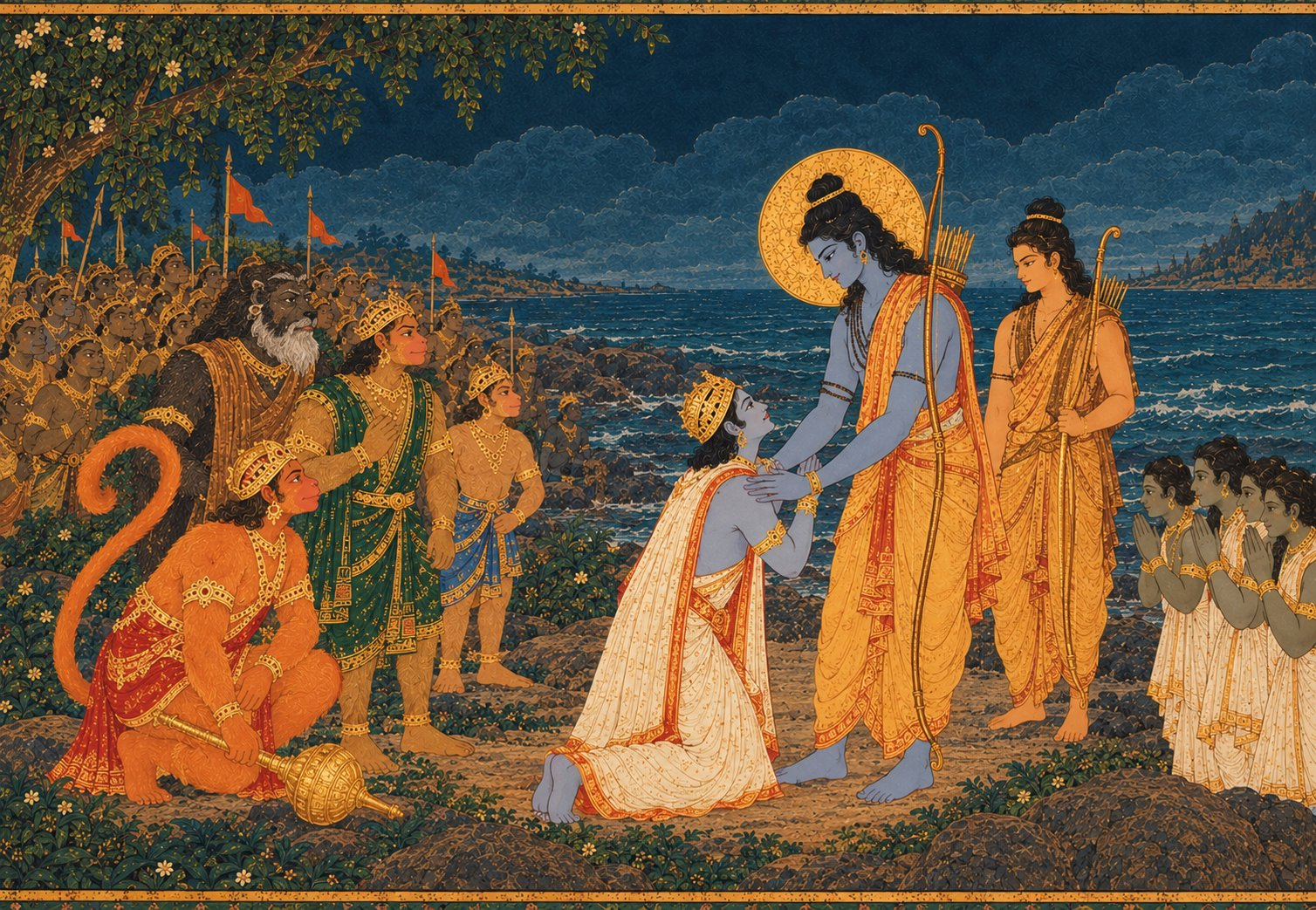
“Vibhishana landed on the shore and asked Rama for shelter. Some vanaras were suspicious, but Rama welcomed him with open arms, and promised that he would be king of Lanka after the war.”
Descending upon the sandy shore where the vanara legions stood guard, Vibhishana fell to his knees with folded hands, prostrating before Lord Rama in utter surrender. Though Sugriva and other chieftains urged caution against a spy from the enemy camp, Sri Rama radiated serene compassion, declaring his sacred vow: whoever comes seeking refuge with a pure heart shall never be turned away.
With a gentle, radiant smile, Sri Rama raised Vibhishana up with his own hands, embracing him as a beloved brother. Bestowing supreme fearlessness upon him, Rama summoned Lakshmana to fetch sacred seawater in a golden vessel, anointing Vibhishana as the future, rightful king of Lanka before the entire cheering host.
समुद्रोपवेशनम् • दर्भशय्या तपस्या
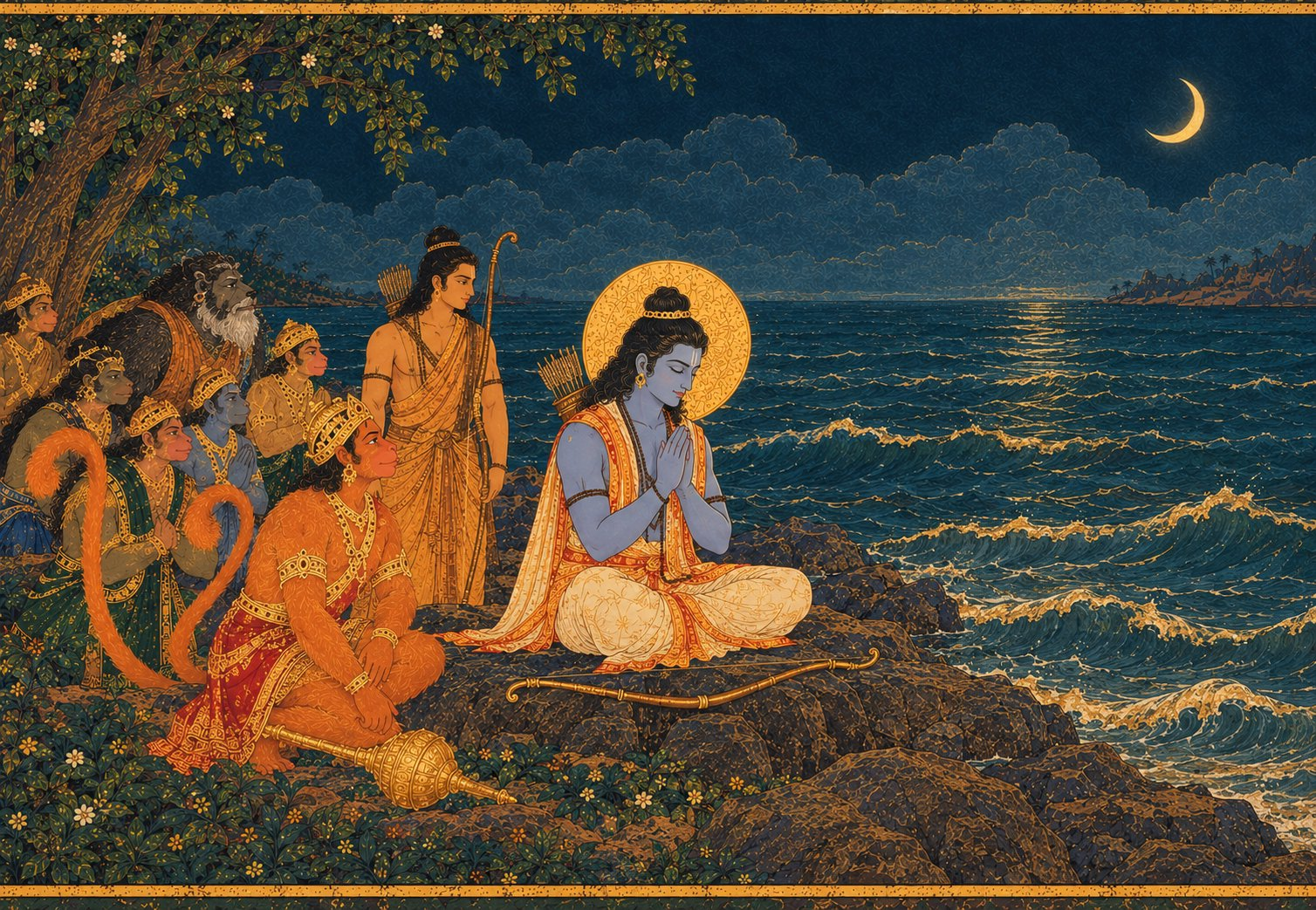
Chapter 10: The Bridge • Scene 5: Three Days of Prayer
“The ocean was too wide to cross. Rama sat on the shore and prayed to the Sea God for three days, asking for a path. The sea did not answer.”
The boundless southern ocean roared with insurmountable surges, blocking the vanara vanguard from reaching Lanka. Seeking a peaceful passage with consummate humility and honor, Sri Rama spread a sacred bed of darbha grass upon the rocky sands. Placing his golden bow beside him, he sat in motionless, deep meditation, fasting and offering reverent prayers to Samudra, the Lord of Oceans.
For three continuous days and nights, Lord Rama observed his solemn vigil while the crescent moon rose, stars traversed the dark gold heavens, and charcoal waves rolled against the shore. Lakshmana, Hanuman, Sugriva, and the vanaras sat in hushed, reverent stillness behind their lord, awaiting the ocean's response. Yet deafened by pride, the sea remained silent.
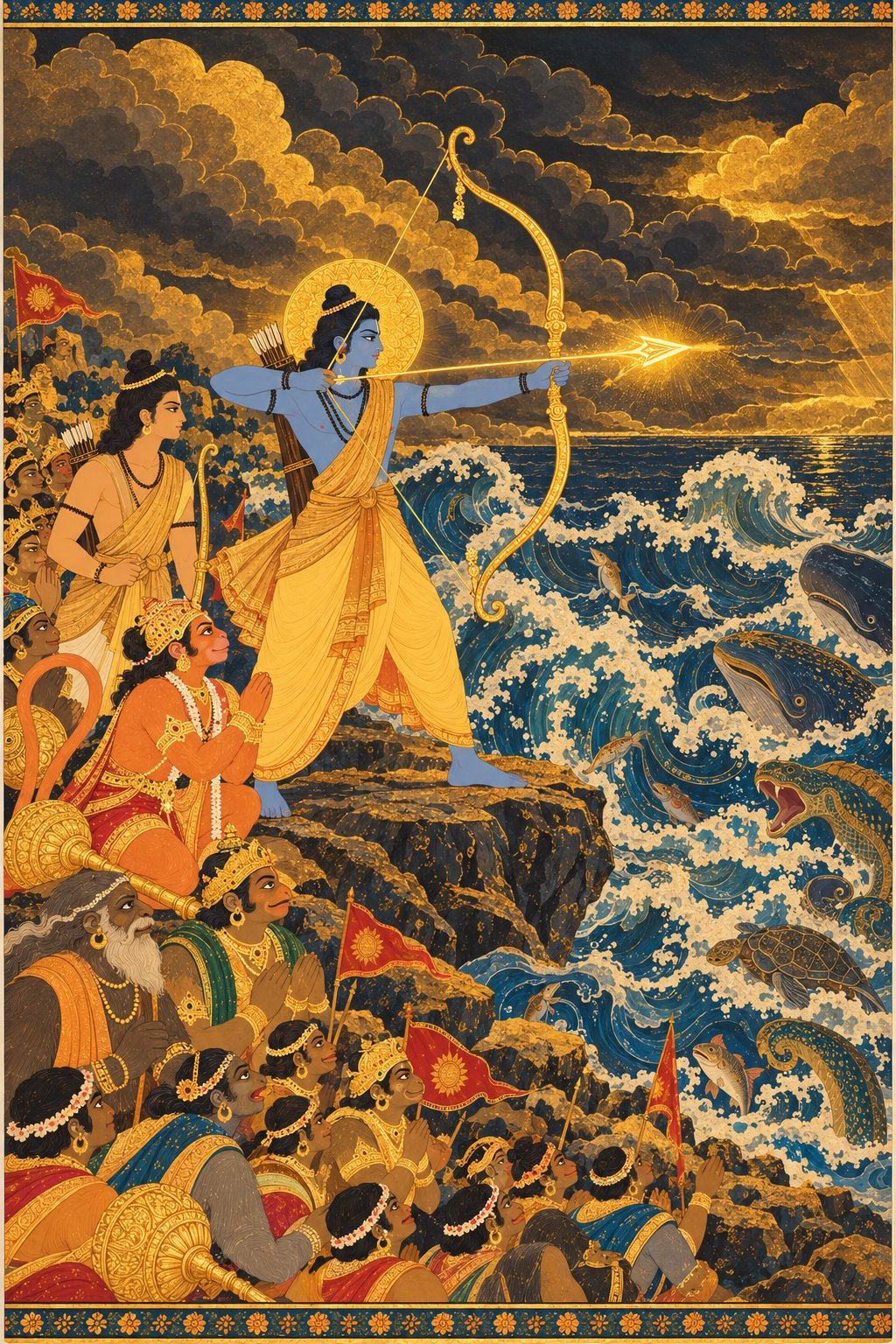
श्रीराम कोपः • ब्रह्मास्त्र संधानम्
Chapter 10: The Bridge • Scene 6: Rama’s Arrow
“On the third day, Rama’s patience ran out. He lifted his bow and aimed a powerful divine arrow at the sea, ready to dry it up. The oceans trembled.”
When three days of righteous patience met only cold arrogance, Sri Rama’s gentle countenance transformed into cosmic wrath. Rising like a blazing sun upon the shoreline, his lotus eyes flashing with righteous fire, he lifted his glorious golden bow, Kodanda. Fitting a celestial Brahmastra to the golden cord, he pulled the bowstring taut with awe-inspiring majesty.
As the divine shaft blazed with blinding golden luminescence, the heavens grew dark with crimson embers and the ocean trembled to its deepest subterranean foundations. Titanic waves leaped violently into the air, whirlpools swirled in terror, and great serpents, makaras, and sea creatures darted frantically for salvation. The entire vanara army stepped back in trembling veneration.
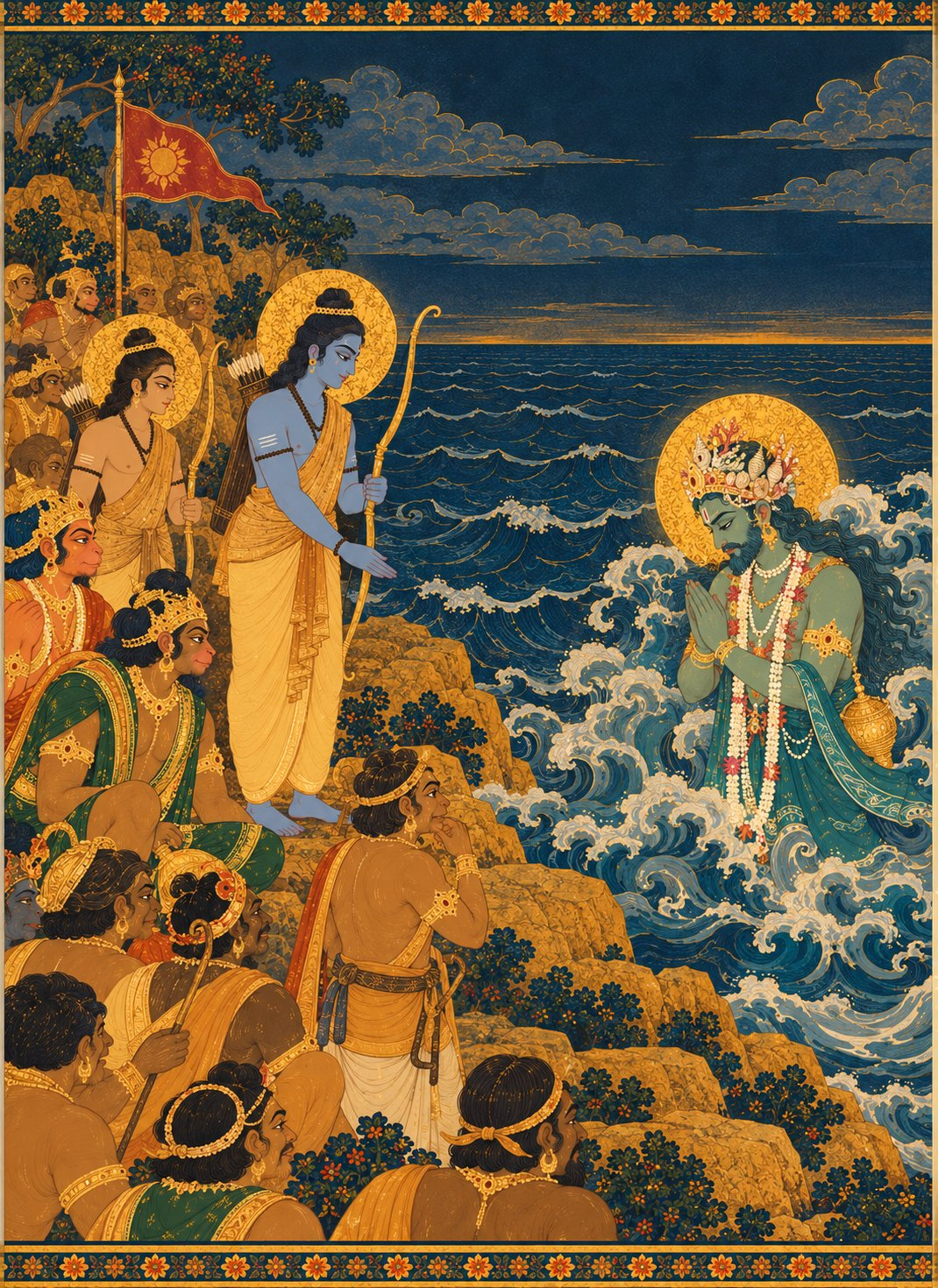
समुद्र प्राकट्यम् • सेतुमार्ग वरदानम्
Chapter 10: The Bridge • Scene 7: Samudra Appears
“Samudra, the Sea God, rose from the waves with folded hands and asked Rama to forgive him. He said: ‘Let Nala, who is the son of the divine builder Vishwakarma, build a bridge, and I will carry its weight.’”
Terrified by the imminent vaporization of all waters, Samudra, the majestic Sea God, emerged from the foaming surges like a mountain of sapphire and beryl. Adorned with crowns of conch shells, lustrous pearls, and coral garlands, he bowed his head with folded hands before Sri Rama, begging forgiveness for yielding only to natural law until awakened by divine power.
Samudra then revealed the divine secret: among the vanaras stood Nala, the blessed son of celestial architect Vishwakarma, endowed with the boons of engineering and construction. "Command Nala to build the causeway," Samudra promised, "and I shall bear every boulder upon my waves without sinking." Hearing this, Rama relaxed his bowstring, and peace returned to the gleaming sea.
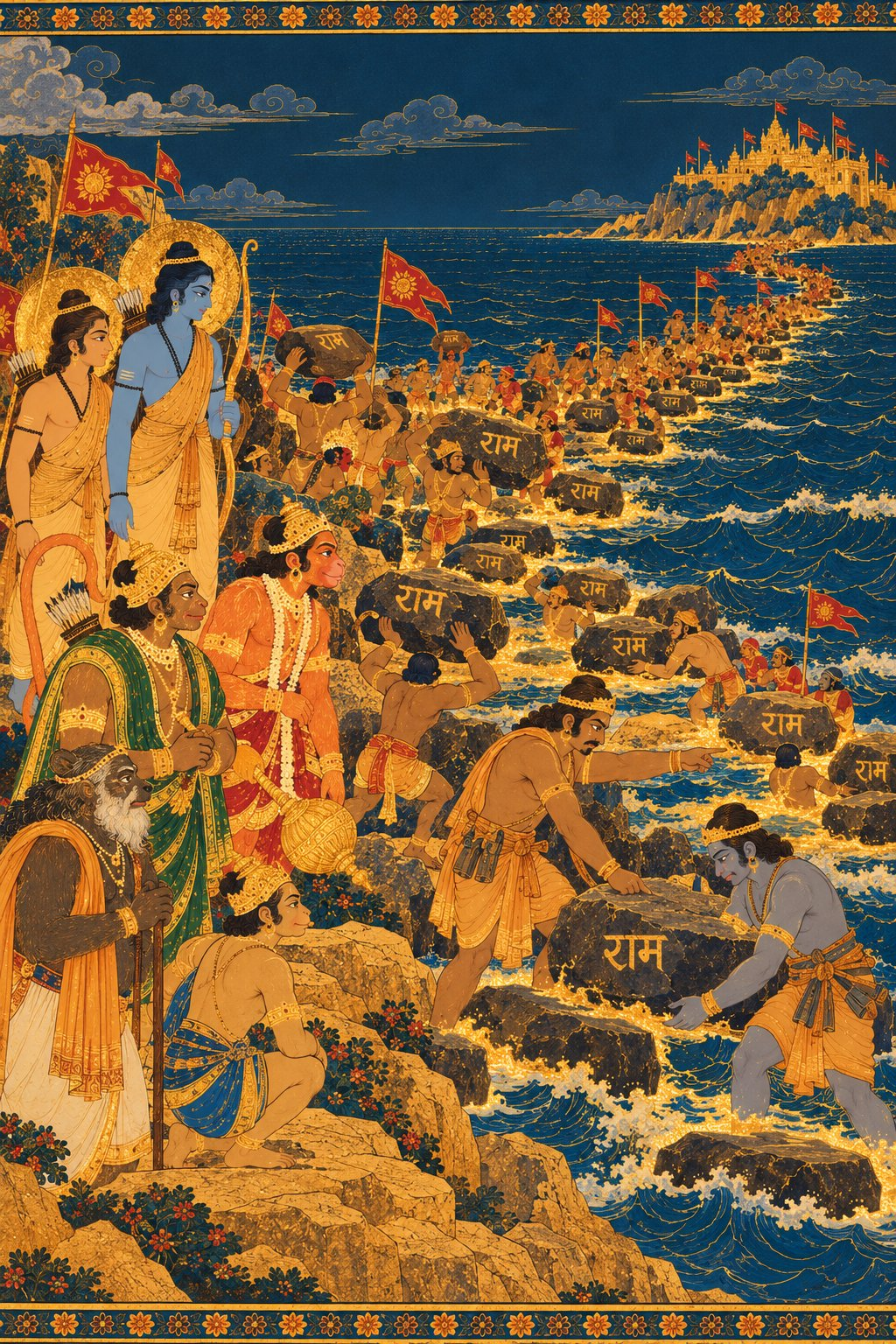
रामसेतु निर्माणम् • प्लवमान शिला
Chapter 10: The Bridge • Scene 8: Stones that Float
“The vanaras brought huge rocks and trees. Writing Rama’s name on each stone, they placed them on the water, and the stones floated. Nala and Nila directed the work, and the bridge grew day by day.”
With joyful cries of victory, the millions of vanaras leaped into action. Uprooting colossal sala, teak, and palm trees, and quarrying massive granite boulders from mountain summits, they carried heavy crags upon their shoulders. Upon each stone, loving hands inscribed the sacred syllables "राम" in radiant Devanagari, transforming sheer matter into instruments of divine grace.
Led by architect generals Nala and Nila standing at the surging wavefront, the stones were placed into the waters—and miraculously, each stone floated upon the sea like a flower, surrounded by shimmering rings of golden light. Spanning fourteen leagues on the first day and expanding daily, the wonder of Ram Setu rose above the roaring foam.
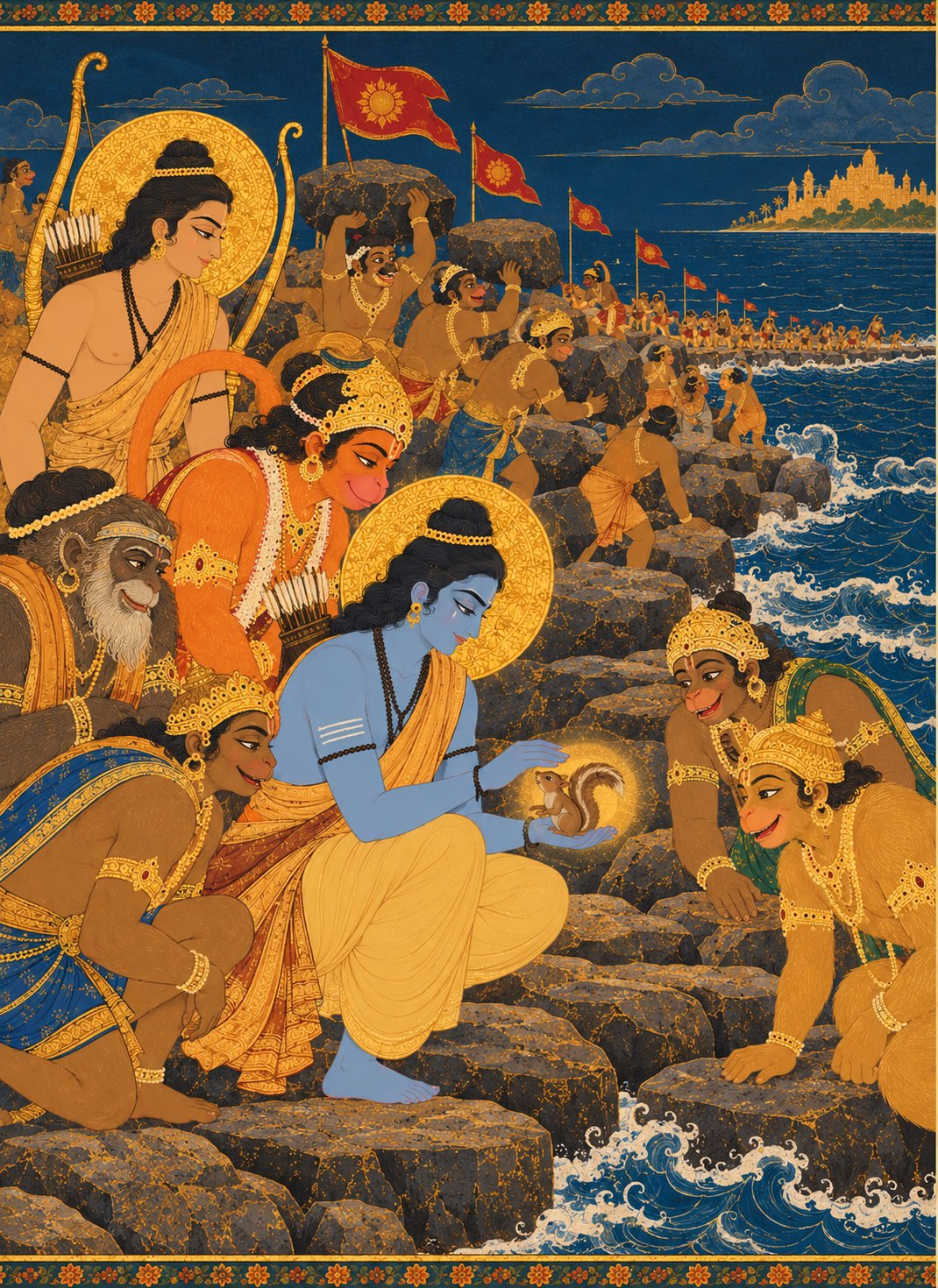
गिलहरी भक्ति • श्रीराम कृपाशीर्वादः
Chapter 10: The Bridge • Scene 9: The Little Squirrel
“Even a tiny squirrel wanted to help. It rolled in the sand and shook it into the gaps between the stones. The vanaras laughed, but Rama gently picked it up and stroked its back, and it is said that his three fingers left the stripes that squirrels have to this day.”
As mighty vanara titans hauled massive boulders, a tiny squirrel observed the great labor with ardent love for Sri Rama. Scampering down to the water’s edge, it rolled its small furry body in the sand, ran onto the causeway, and shook the tiny grains into the crevices between the floating stones. Seeing its earnest efforts, several vanaras laughed heartily at such miniature assistance.
But Lord Rama saw only the purity of boundless devotion. Bending down with infinite tender love, he scooped the tiny creature into his gentle palm, holding it close to his chest. As he stroked its soft back with three divine fingers, radiant light touched its fur, leaving behind the three sacred stripes of Sri Rama’s eternal blessing to be carried by all squirrels for all eternity.
सेतु तरणम् • सुवेल शैल गमनम्
Chapter 10: The Bridge • Scene 10: Crossing to Lanka
“In five days, the bridge was ready. The great army crossed the sea. Across the water, the golden towers of Lanka shone. The time for the great battle had come.”
Completed within five glorious days, the hundred-league bridge stretched like a gleaming garland of gold and granite across the blue main. With banners unfurled and trumpets blaring, Sri Rama and Lakshmana marched at the vanguard, flanked by Hanuman, Vibhishana, Sugriva, Jambavan, and Angada. Behind them crossed the millions of roaring vanara and bear warriors, their discipline as unwavering as their faith.
Across the southern waters, the steep crags of Mount Suvela rose into view, crowned by the opulent golden towers and formidable bastions of Ravana’s Lanka shining beneath a dramatic twilight sky. The ocean had been conquered; dharma had crossed the abyss, and the fateful hour for the liberation of Mata Sita had arrived.
अध्याय ११ आरम्भ भवति
द्रवहु सुदसरथ अजिर बिहारी ॥
महासंग्राम • रावण वध
The Great War & Victory of Dharma
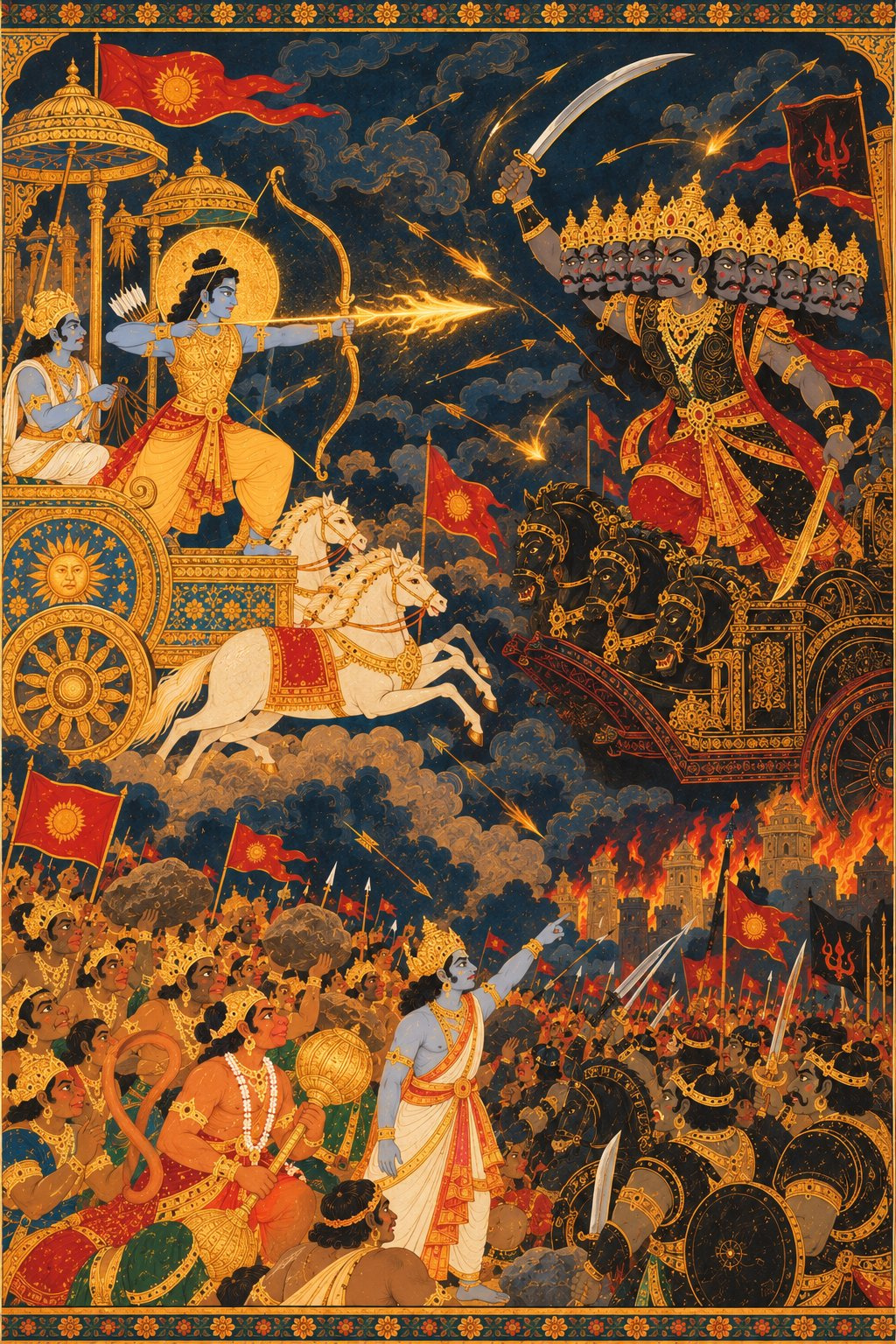
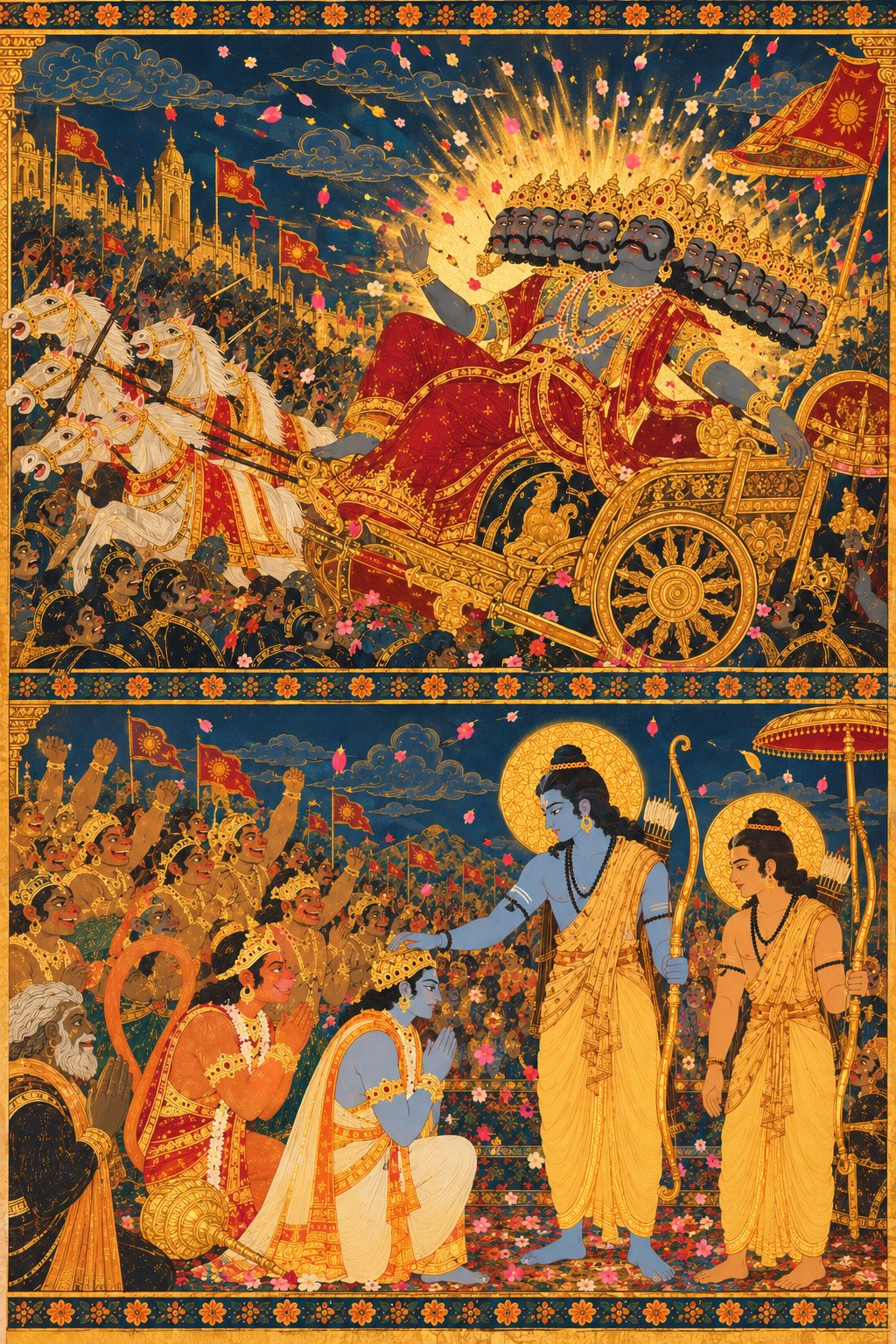
A monumental battle rages outside the ramparts of Lanka. Kumbhakarna falls, Lakshmana slays Indrajit, and Sri Rama, chanting the sacred Aditya Hridaya Stotra, releases the celestial Brahmastra to vanquish ten-headed Ravana, crowning Vibhishana as righteous king.
अङ्गद दौत्यम् • सभा प्रवेश
Chapter 11: The Great War • Scene 1: Angada’s Embassy
“Before the war, Rama sent young Angada to Ravana with one last offer of peace. Ravana gave him no seat, so Angada coiled his tail into a high seat, level with the throne. Ravana refused to return Sita.”
Before unleashing the righteous fury of war upon the golden citadel, Sri Rama dispatched youthful Prince Angada to Lanka’s imperial hall with one final offer of peace and repentance. Denied an honorable seat by the haughty demon sovereign, Angada calmly extended his own golden tail, coiling it into a towering spiral seat that rose majestic and proud, lifting him level with Ravana’s obsidian throne.
Speaking with fearless dignity and eloquence, Angada urged the ten-headed monarch to renounce unrighteousness, return Mata Sita with honor, and avert total devastation. But blinded by pride and stubborn rage, Ravana pointed an angry finger, spurning Rama’s peaceful embassy and sealing the doom of his empire.
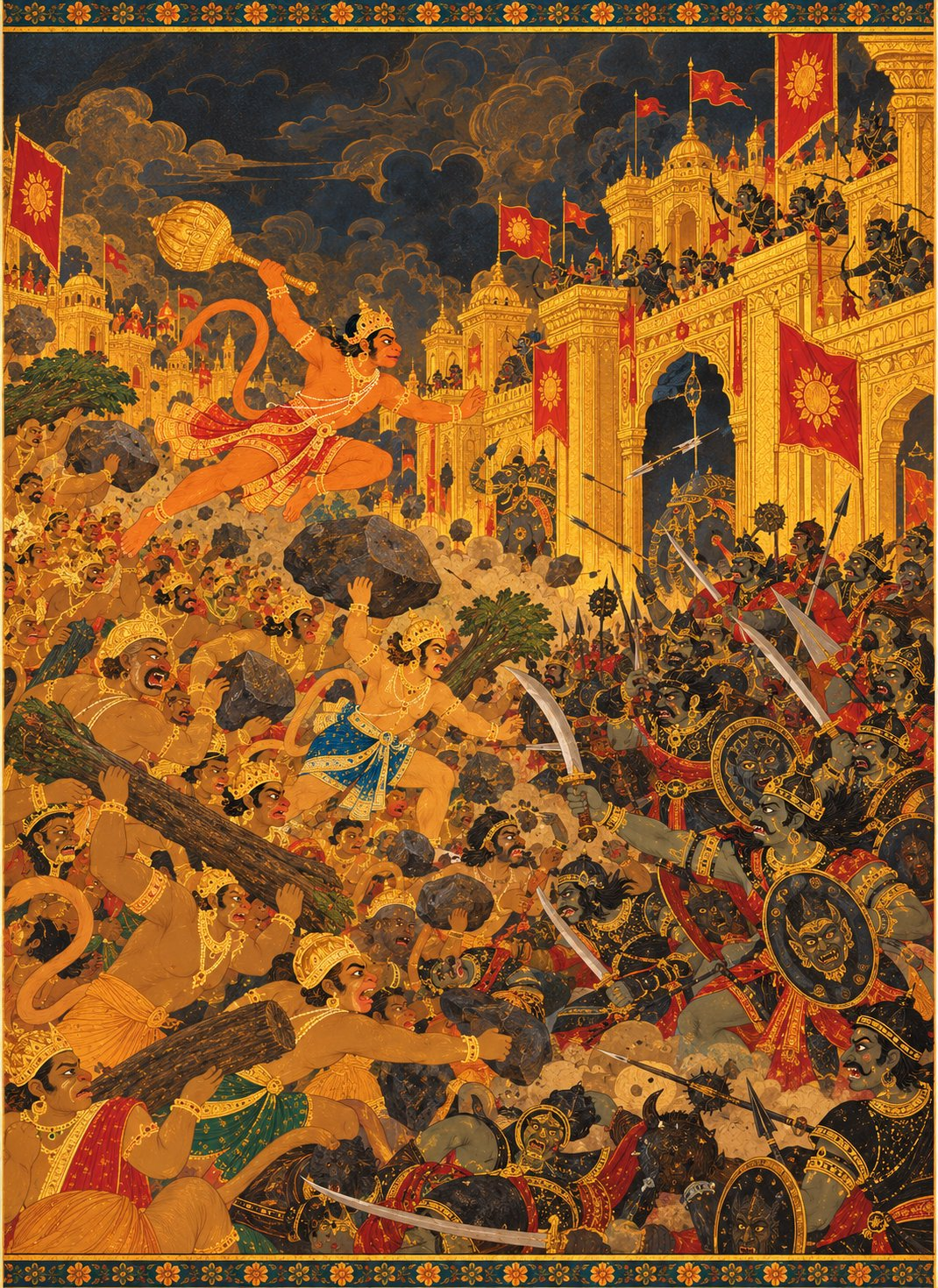
महासमर प्रारम्भः • लङ्काद्वार युद्ध
Chapter 11: The Great War • Scene 2: The Armies Meet
“The war began at the gates of Lanka. Vanaras threw rocks and uprooted trees, and the demons answered with arrows and swords. The sky filled with dust and gold fire.”
At the towering golden gateways of Lanka, the titanic clash of arms commenced with the roar of a thousand thunders. On the left vanguard, legions of heroic vanaras with fur of golden bronze leaped forward under fluttering sun banners, hurling colossal mountain boulders and massive uprooted trees against the fortress walls.
From the right, battalions of demon warriors in black spiked armor charged forth with gleaming scimitars, tridents, and raining volleys of flaming arrows. Sri Hanuman leaped high with swinging golden mace while Prince Angada led the assault, turning the twilight sky into a raging tempest of dust, sparks, and golden embers.
नागपाश बन्धनम् • गरुड आगमनम्
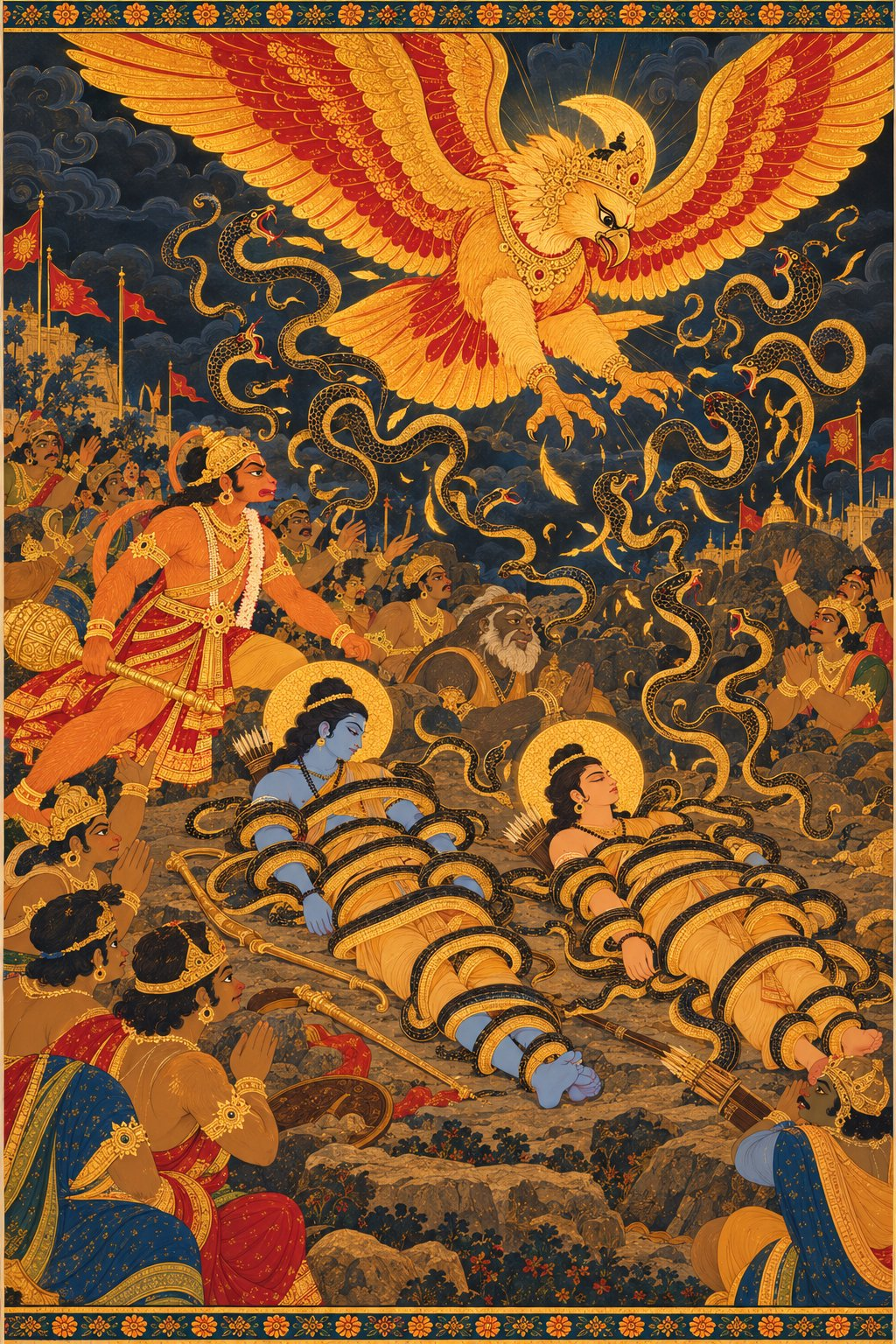
Chapter 11: The Great War • Scene 3: The Serpent Arrows
“Ravana’s son Indrajit, hidden in clouds, shot serpent arrows that bound Rama and Lakshmana. The vanaras cried out in fear. Then the great eagle Garuda swooped down, and the snakes fled, setting them free.”
Concealed within illusory storm clouds by dark sorcery, Ravana’s son Indrajit loosed his venomous Nagapasha astras, which transformed into hissing serpents of black and gold light. Ensnaring Sri Rama and Lakshmana in an inescapable coil, the poisonous bonds felled the two brothers motionless upon the dusty field, plunging the vanara host into weeping despair.
Suddenly, the celestial skies blazed with golden splendor as Lord Garuda, the divine golden eagle, descended with wings of crimson and fire. At the mere scent and sight of the celestial king of birds, the venomous serpents scattered in panic into the abyss, freeing Rama and Lakshmana with restored vitality and boundless divine luster.
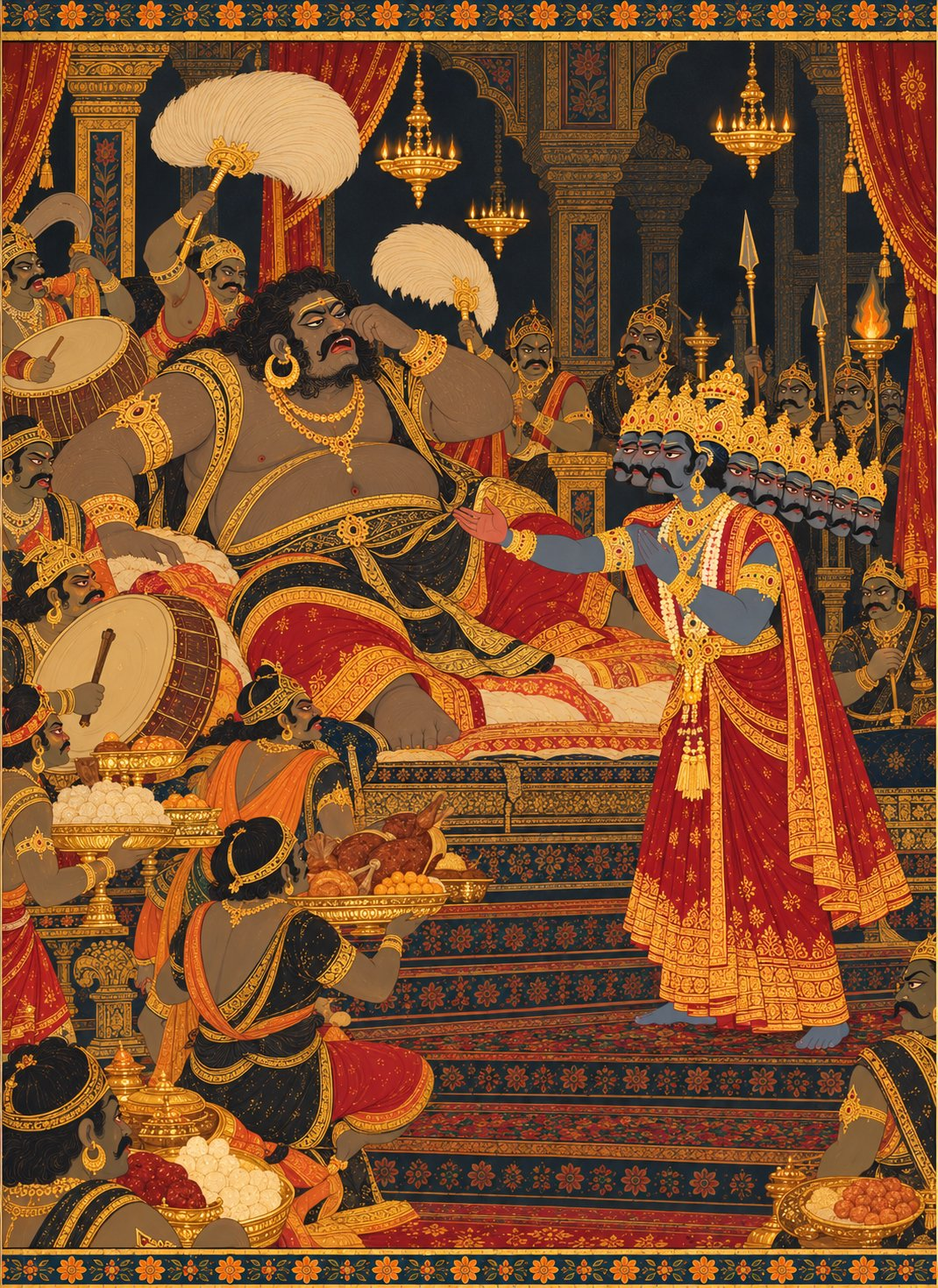
कुम्भकर्ण प्रबोधनम् • भ्रातृ संवाद
Chapter 11: The Great War • Scene 4: Kumbhakarna Awakes
“Ravana woke his giant brother Kumbhakarna, who slept for months at a time. Drums and elephants were needed to wake him. When he heard the news, he told Ravana that he was wrong, but he said, ‘I am your brother, and I will fight for you.’”
Shaken by mounting losses, Ravana sent his commanders into the subterranean cavern to awaken his titanic brother Kumbhakarna, cursed to sleep six months at a stretch. Only after armies of attendants beat thunderous war drums, brought charging elephants, and set forth mountainous platters of roasted meats and sweetmeats did the giant slowly open his heavy, fiery eyes.
Rising upon his vast bed with colossal gold earrings glinting in the torchlight, Kumbhakarna rubbed his brow and listened to Ravana’s desperate plea. Frank and righteous in spirit, he sternly rebuked Ravana for abducting Sita, yet bound by unswerving fraternal loyalty, he pledged: "Though your path is unjust, you are my elder brother; I shall step onto the field and fight for you to the death."
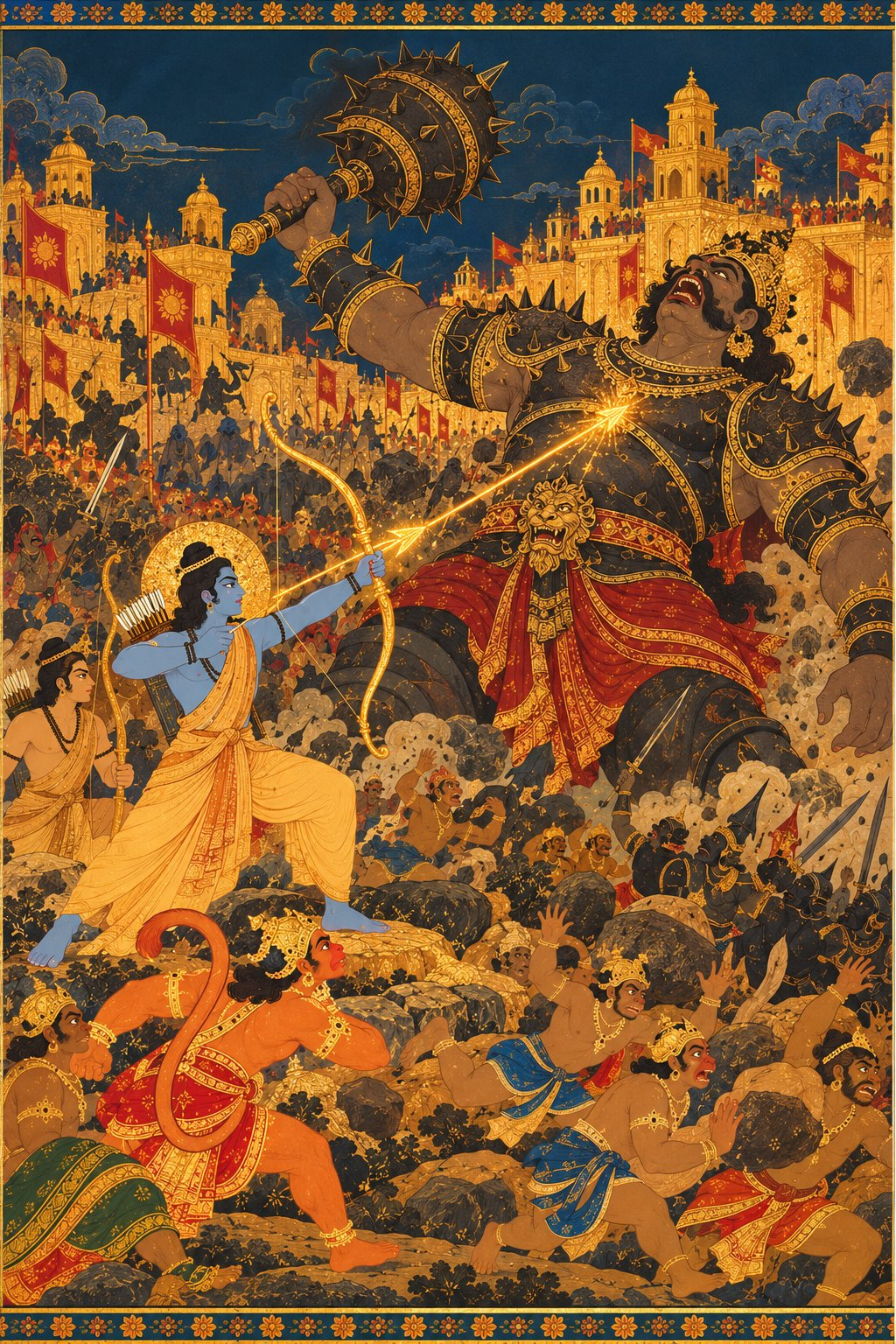
कुम्भकर्ण वध • वीर मोक्ष
Chapter 11: The Great War • Scene 5: Kumbhakarna Falls
“Kumbhakarna was as tall as a mountain, and the vanaras scattered. But Rama stood firm and fired his arrows. Kumbhakarna fell, and even Rama bowed his head for his honour.”
Like a walking mountain encased in spiked iron armor, Kumbhakarna strode onto the battlefield swinging a massive barbed mace that crushed earth and stone. Vanara warriors broke ranks and scattered in terror before the giant’s deafening footsteps and sweeping blows. But Sri Rama stepped forward with tranquil majesty, standing steadfast as a golden pillar against the tempest.
Drawing his golden Kodanda bow to his ear, Sri Rama loosed radiant sun-blazing arrows that struck the titan’s limbs and shattered his mace. As Kumbhakarna toppled like a severed cliff amidst swirls of golden aura and dust, Lord Rama lowered his bow and bowed his head in solemn reverence, honoring the giant’s valour and selfless fraternal sacrifice.
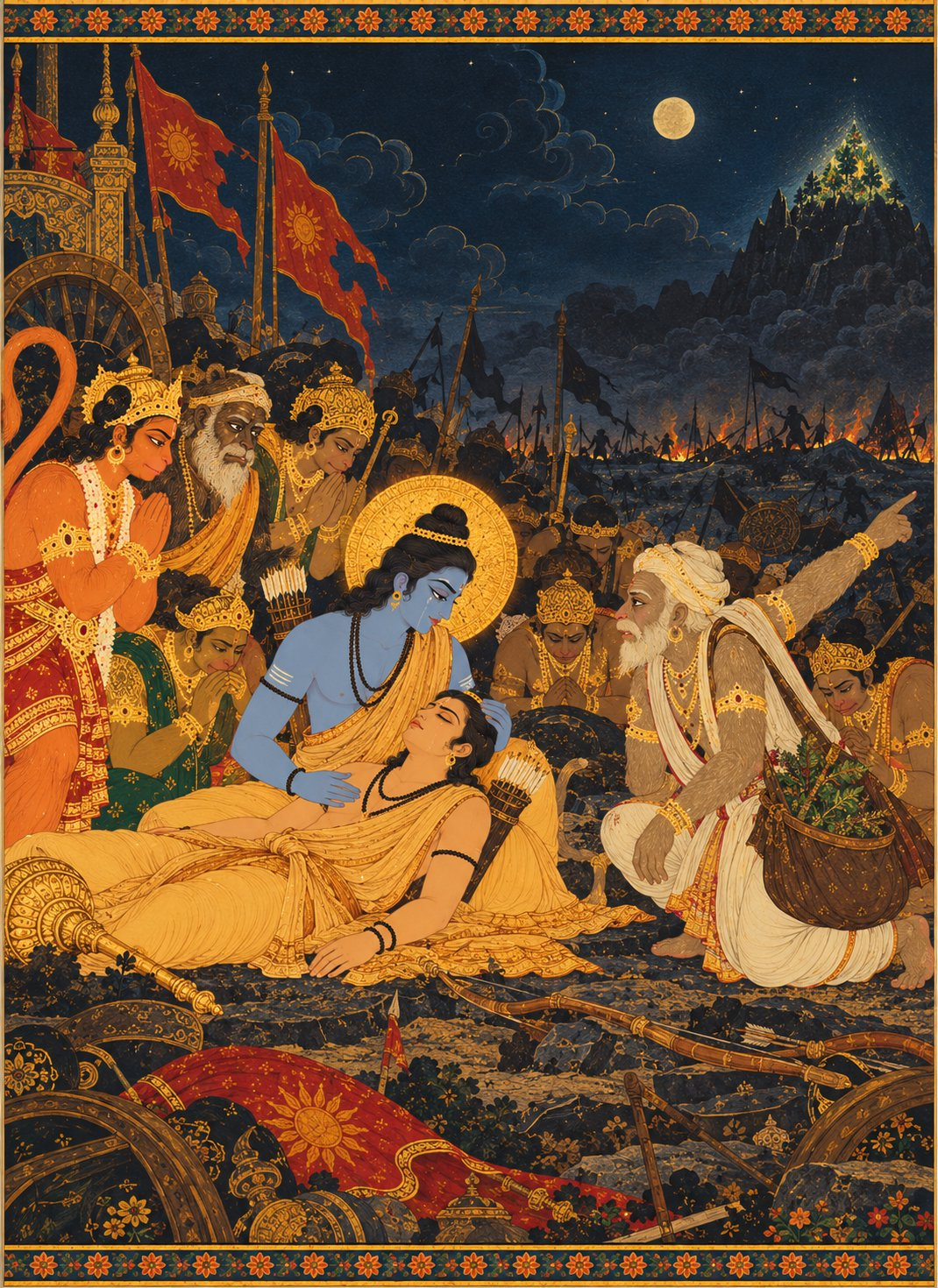
लक्ष्मण शक्ति भेद • श्रीराम विलाप
Chapter 11: The Great War • Scene 6: Lakshmana Falls
“Indrajit struck again with a divine weapon, and Lakshmana fell. Rama held him in his arms and wept. The healer Sushena said only the Sanjeevani herb on a far Himalayan mountain could save him before dawn.”
In a fierce nocturnal skirmish, Indrajit hurled a dread divine Shakti javelin forged with dark enchantments, striking brave Lakshmana directly in the chest. As the faithful prince collapsed lifeless to the ground, Lord Rama rushed forward, gathering his brother into his lap, weeping copiously and kissing his cold brow as the entire vanara assembly stood in grief-stricken silence.
The venerable physician Sushena examined the fallen prince and delivered urgent solace: Lakshmana still retained the fragile breath of life, but only the miraculous Sanjeevani herb from the celestial Dronagiri peak in the far northern Himalayas could revive him before the break of dawn. Hearing this, all eyes turned to mighty Hanuman.
द्रोणाचल आनयनम् • संजीवनी प्रादुर्भाव
Chapter 11: The Great War • Scene 7: Hanuman Brings the Mountain
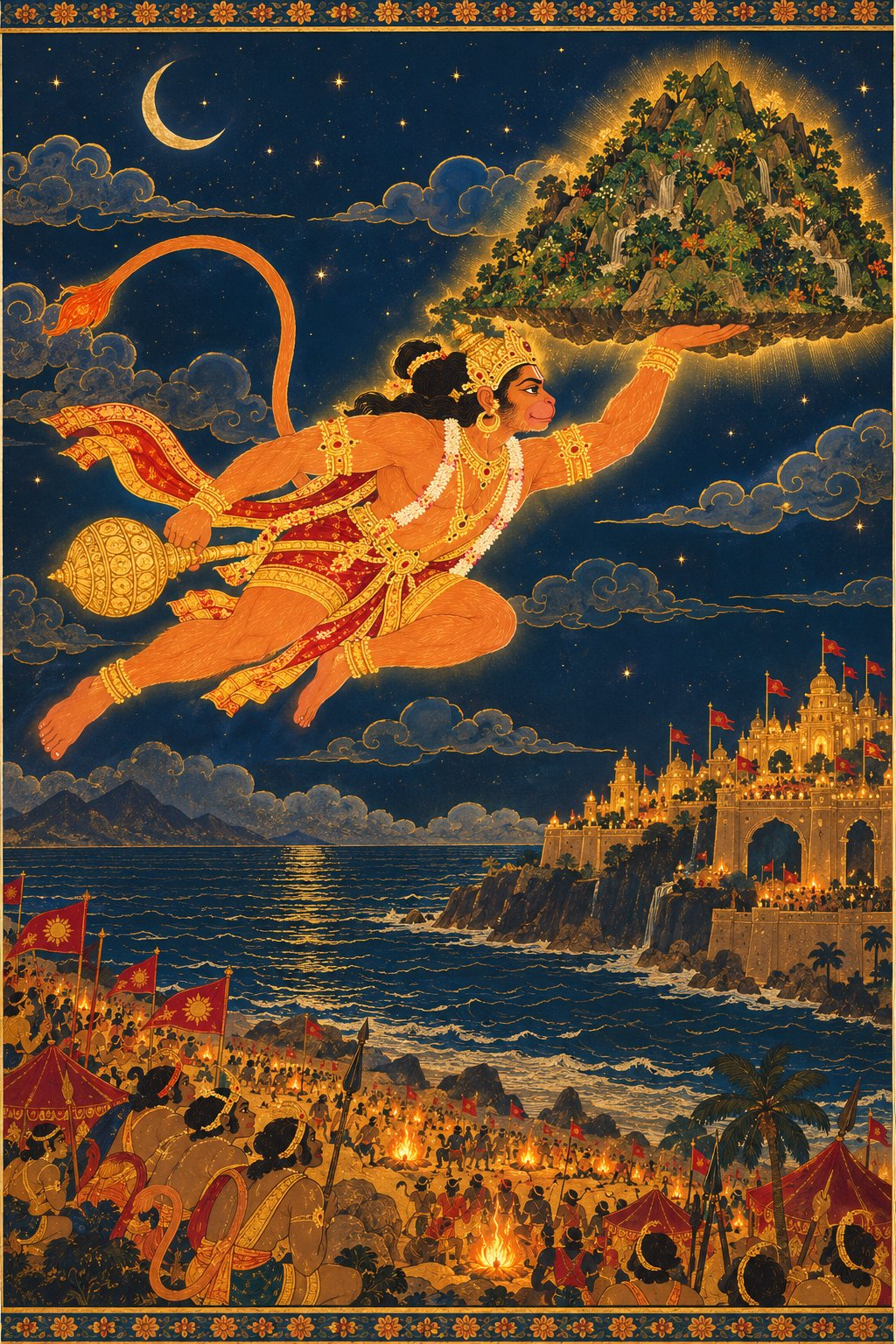
“Hanuman flew to the Himalayas through the night. He could not recognise the herb, so he lifted the whole mountain and carried it back before sunrise. Sushena found the herb, and Lakshmana woke up healed.”
Expanding his celestial form into a golden titan, Sri Hanuman traversed thousands of leagues across northern skies within the blink of an eye. Reaching the snowcapped Himalayan peaks, the glowing herbs hid themselves from sight. Unwilling to delay an instant while his master's brother lay in mortal danger, Hanuman dug his mighty arms beneath Mount Dronagiri and effortlessly hoisted the entire emerald mountain atop his single palm.
Soaring back across the starlit heavens like a second sun with his golden tail streaming behind, Hanuman touched down at Lanka’s shore before the first glimmer of dawn. Sushena extracted the glowing Sanjeevani herb, its divine fragrance filling the air; Lakshmana opened his eyes, smiled, and rose up fully healed to the ecstatic cheers of the vanara host.
निकुम्भिला यज्ञ भङ्ग • इन्द्रजित् वध
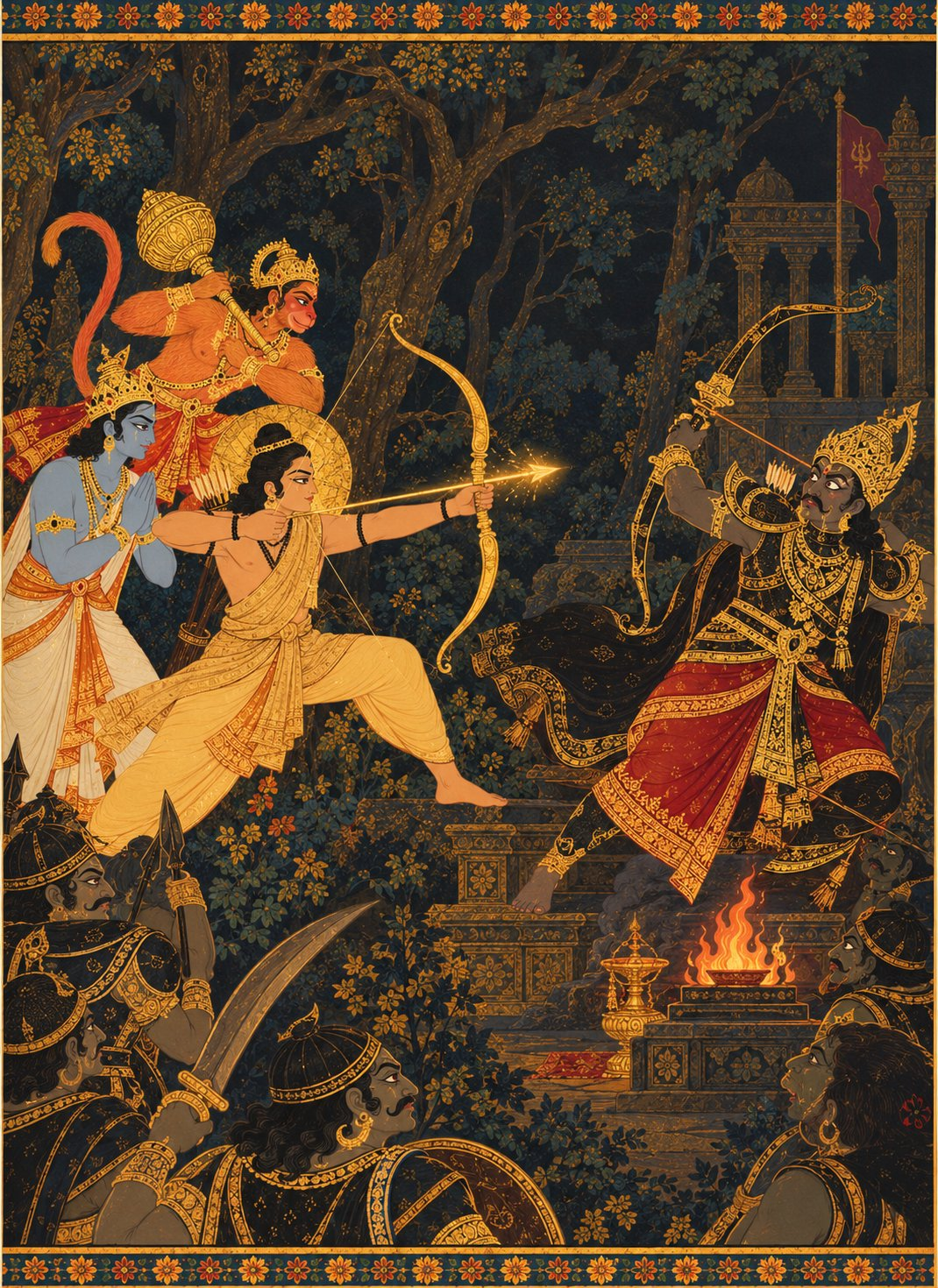
Chapter 11: The Great War • Scene 8: Indrajit Falls
“Indrajit went to a hidden grove to perform a ritual that would make him unbeatable. Vibhishana told Lakshmana where to find him. Lakshmana attacked him before the ritual was done, and Indrajit fell.”
Seeking invincibility, Indrajit retreated to the sequestered grove of Nikumbhila to perform a dark, forbidden sacrifice. Alerted by Vibhishana that completing the ritual would render the demon invincible, Lakshmana, accompanied by Hanuman and Vibhishana, breached the sacred grove before the oblations could conclude, challenging Indrajit to open combat.
Caught off guard amidst the flickering altar flames, Indrajit seized his bow in desperation. Uttering a sacred vow dedicating his arrow to Sri Rama’s righteousness and truth, Lakshmana loosed a blazing golden shaft that severed Indrajit’s crown and head, breaking Lanka’s greatest shield and filling the citadel with wails of mournful despair.
राघव-रावण महायुद्ध • मातलि रथ
Chapter 11: The Great War • Scene 9: Rama and Ravana
“Ravana, blind with grief and rage, rode out himself. Indra sent his chariot with the charioteer Matali. Every time Rama cut off one of Ravana’s heads, a new one grew. Vibhishana whispered that the secret lay in Ravana’s navel.”
Crazed with inconsolable wrath after the loss of his son and brother, Ravana mounted his grand obsidian war chariot, charging into the fray like a cosmic storm. Beholding the demon king riding a celestial chariot while Rama fought on foot, King Indra sent down his own solar chariot driven by the divine charioteer Matali, enabling the supreme duel of the ages to commence.
Raining cosmic astras upon each other, the sky filled with blazing sunbursts. Yet whenever Sri Rama severed one of Ravana’s crowned heads with golden arrows, another instantly sprouted in its place. Noticing Rama’s contemplation, Vibhishana stepped forward, whispering the divine secret: Lord Brahma had placed the immortal nectar of life within Ravana's navel, which must first be dried by the sacred arrow.
रावण संहार • विभीषण पट्टाभिषेक
Chapter 11: The Great War • Scene 10: Dussehra and Ravana’s End
“Rama fired the divine Brahmastra, and it struck Ravana. Ravana fell, and gold light spread through the sky. This day is remembered as Dussehra. Rama had Vibhishana crowned as king of Lanka. Sita was free, and the war was over.”
Chanting the sacred Aditya Hridaya and invoking the primal energies of creation, Sri Rama loosed the celestial Brahmastra. Piercing Ravana’s navel, the arrow consumed the nectar of immortality and shattered his chest; the ten-headed tyrant collapsed from his chariot into golden light as divine flower showers descended from heaven to celebrate Vijayadashami (Dussehra).
With the great conflict concluded and dharma restored across the earth, Sri Rama gently placed his blessing upon kneeling Vibhishana, crowning him as the righteous sovereign of Lanka. The chains of captivity fell away from Mata Sita, peace embraced the three worlds, and the jubilant cries of victory rang out to the ends of the universe.
“Truth and courage win over pride and power.”
अध्याय १२ आरम्भ भवति
द्रवहु सुदसरथ अजिर बिहारी ॥
दीपोत्सव • अयोध्या वापसी
Return to Ayodhya & Grand Diwali
Reunited with Mata Sita, Sri Rama, Lakshmana, and their allies return to Ayodhya aboard the celestial Pushpaka Vimana. Welcomed by ecstatic citizens lighting millions of earthen oil lamps, Sri Rama is crowned emperor, ushering in the glorious golden age of Ramrajya.
सीता-राम समागम • अशोकाश्रु विमोचन
Chapter 12: The Return to Ayodhya • Scene 1: Sita and Rama Meet Again
“After the war, Vibhishana brought Sita to Rama. After many months in Lanka, Sita stood before him with a calm face. Rama’s eyes filled with tears, and the Ashoka garden’s long sorrow ended.”
Escorted by King Vibhishana from the sequestered confines of Lanka, Mata Sita walked slowly toward Lord Rama in her humble faded ochre sari, her hands joined in reverent salutation and her visage bathed in serene equanimity. Beholding his devoted queen after agonizing months of separation, Sri Rama stood with his golden bow lowered, tears of boundless love and relief glistening upon his cheeks.
Around them in the golden pavilion, Lakshmana, Hanuman, Sugriva, and the entire vanara host watched with tearful joy and folded hands. The dark clouds of anguish that had weighed upon the Ashoka grove were dispersed forever, giving way to the brilliant dawn of divine reunion and triumphant dharma.
सीता सम्मान • दिव्य अलङ्करणम्
Chapter 12: The Return to Ayodhya • Scene 2: Sita is Honoured
“The women of Lanka dressed Sita in fine clothes and jewels again. When she appeared, the army cheered, and Rama looked at her with love.”
Guided by noble royal maidens, Mata Sita was bathed in fragrant sandalwood waters and adorned in a resplendent crimson-maroon sari woven with threads of molten gold. Wearing a brilliant golden crown, pearl necklaces, and holding an auspicious pink lotus in her hand, she emerged radiant as the morning sun, her divine golden halo illuminating the vast concourse.
As the liberated queen stood beside Sri Rama within the floral bower, the millions of vanaras, bears, and citizens of Lanka raised their hands in thunderous acclaim. The heavens opened with showers of celestial blossom petals, and Lord Rama gazed upon her with tender, boundless adoration, honoring her unbroken virtue and steadfast devotion.
पुष्पक विमान समर्पणम् • दिव्यरथ आरोहणम्
Scene 3: The Pushpak Vimana • Double-Page Panorama
“Vibhishana gave Rama the Pushpak Vimana, a flying chariot shaped like a lotus, which had once belonged to Kubera. The fourteen years of exile were almost over. It was time to go home.”
With hands folded in deep gratitude, King Vibhishana presented the celestial Pushpak Vimana, an architectural marvel forged by Vishwakarma that moved at the mere speed of divine will. Resting upon the sandy shore of Lanka, the golden vessel gleamed with soaring lotus-petal cupolas, golden swans adorning its bow, and chiming celestial bells swaying in the ocean breeze.
With the fourteen years of forest banishment drawing to their final dawn, Sri Rama, Mata Sita, and Prince Lakshmana ascended the carpeted golden stairs. Behind them stood Hanuman, Sugriva, and the valiant chieftains, ready to embark upon the historic return to their beloved motherland, Ayodhya.
सर्वसुहृत् आरोहणम् • व्योम प्रयाणम्
Chapter 12: The Return to Ayodhya • Scene 4: Everyone Aboard
“Rama invited his friends to come along. Sugriva, Angada, Jambavan, Hanuman and Vibhishana boarded the Pushpak with him, and it rose into the sky above the golden city.”
True to his magnanimous nature, Sri Rama would not celebrate his homecoming without the loyal comrades whose valour had restored dharma. Gratefully inviting Sugriva, Angada, Jambavan, Hanuman, and Vibhishana aboard the boundless aerial chariot, the Pushpak expanded by divine power to accommodate every honored guest in royal comfort.
With a gentle hum of celestial energy, the magnificent swan-prowed vessel lifted gracefully into the azure heights. Below, the golden city of Lanka, its battle scars soothed and banners flying in peace, receded into the shimmering sea as the radiant chariot set its course northward toward Ayodhya.
तीर्थ दर्शनम् • स्मृति कथनम्
Chapter 12: The Return to Ayodhya • Scene 5: Showing Sita the Journey
“As they flew north, Rama pointed out places to Sita: the bridge of Ram Setu, Kishkindha, the hut at Panchavati and the river Ganga. Every place held a memory.”
Gliding across the radiant golden firmament, Sri Rama stood lovingly beside Mata Sita at the balustrade of the Pushpaka Vimana, pointing downward as the sacred landscapes of their epic odyssey unfurled. Below in the turquoise sea lay the miraculous floating bridge of Ram Setu, shining like a string of pearls across the ocean waves.
Moving northward, Rama recounted their sacred trials: the crags of Mount Rishyamukha where he met Sugriva and Hanuman, the peaceful leaf-hut of Panchavati along the Godavari, and the silvery expanse of the holy Ganga where Guha had rowed them into exile. Every mountain, grove, and stream now whispered of triumph, devotion, and divine grace.
भरद्वाजाश्रम गमनम् • मारुति प्रेषणम्
Chapter 12: The Return to Ayodhya • Scene 6: Hanuman Carries the News
“At Bharadwaj’s ashram, Rama sent Hanuman ahead to tell Bharata that he was coming home. Bharata had promised to give up his life if Rama did not return when the fourteen years ended, and the last day had arrived.”
Pausing at Sage Bharadwaja’s hermitage near Prayag on the fourteenth and final year of exile, Sri Rama’s heart turned anxiously toward his devoted brother Bharata. Knowing that Bharata had sworn to enter the sacrificial flames if Rama did not return on the exact day of promised arrival, Rama summoned Sri Hanuman, charging him to fly swift as the wind to Nandigram.
Blazing across the golden heavens like a celestial meteor, Hanuman flew over rivers and towns toward the humble hermitage of Nandigram. Looking below, he spotted ascetic Bharata, clad in austere bark robes with matted hair, seated beside the sacred fire with Rama’s consecrated wooden sandals upon a silk cushion, preparing for the ultimate sacrifice.
शुभ सन्देश • भरत हर्षामृतम्
Chapter 12: The Return to Ayodhya • Scene 7: Bharata’s Joy
“Hanuman told Bharata, ‘Rama is coming.’ Bharata wept with joy, hugged Hanuman and ran to prepare the city.”
Descending before the tearful ascetic prince, Sri Hanuman joined his palms in reverent devotion, proclaiming the divine news: "Sri Rama has vanquished Ravana, rescued Mata Sita, and approaches aboard the Pushpaka Vimana!" Overcome with ineffable joy, Bharata trembled, tears flowing down his cheeks as the heavy burden of fourteen years of grief melted into boundless ecstasy.
Embracing Hanuman with fraternal love, Bharata rewarded the noble messenger with royal honors and turned to Prince Shatrughna. The royal trumpets blared, the grand gates of Ayodhya swung wide, and thousands of jubilant citizens rushed out to decorate every avenue, preparing the golden capital for the long-awaited return of their lord.
पादुका समर्पणम् • भ्रातृ समागम
Chapter 12: The Return to Ayodhya • Scene 8: The Meeting with the Sandals
“The Pushpak landed. Bharata ran with Rama’s sandals on his head and placed them at his brother’s feet. Rama lifted him in a long embrace. Then Rama touched the feet of his mothers, and Kaikeyi wept as she was forgiven.”
As the Pushpaka Vimana descended gently upon the blossom-strewn fields of Nandigram, Bharata approached with the consecrated golden sandals borne upon his head. Kneeling in humble veneration before Sri Rama, he placed the sacred sandals upon his brother's lotus feet, declaring his sacred trust fulfilled and restoring the kingdom into Rama's righteous hands.
Sri Rama raised Bharata into a tearful, profound embrace, holding him tightly to his heart. Turning to Queen Mothers Kaushalya, Sumitra, and Kaikeyi, Rama touched their feet with deep filial devotion; Kaikeyi wept tears of profound remorse and was enveloped in Rama’s unconditional, forgiving grace as the families reunited in divine harmony.
श्रीराम पट्टाभिषेक • रामराज्य आरम्भ
Chapter 12: The Return to Ayodhya • Scene 9: The Coronation
“Sage Vasishtha placed the crown on Rama’s head. Sita sat beside him as queen, Lakshmana, Bharata and Shatrughna stood by, and Hanuman knelt at Rama’s feet. Ayodhya’s long wait was over, and the golden age of Ram Rajya began.”
Within Ayodhya’s imperial court adorned with golden arches and sweet-smelling flower garlands, Sri Rama was seated upon the ancestral throne of the Sun Dynasty alongside Queen Sita, both radiating divine celestial halos. Venerable Rajaguru Vasishtha, accompanied by the holy rishis, anointed Rama’s brow with sacred waters from the four oceans and placed the effulgent golden crown of Ayodhya upon his head.
Flanked by princes Lakshmana, Bharata, and Shatrughna holding royal parasols and whisks, and with Sri Hanuman kneeling in eternal service at his feet, the coronation was solemnized. Ayodhya’s fourteen years of penance ended, inaugurating the immortal era of Ram Rajya—an age of righteous truth, prosperity, and peace across all creation.
दीपोत्सव दीपावली • धर्म विजय
Chapter 12: The Return to Ayodhya • Scene 10: Ayodhya Lights the Diyas
“That night was the new moon, the darkest night of the month. The people of Ayodhya lit thousands of clay lamps to welcome Rama home, and the whole city shone like gold. Ever since, we celebrate this night as Diwali, the festival of lights. May the light of dharma always find its way home to you.”
On the sacred night of the darkest new moon of Kartika, the citizens of Ayodhya banished all darkness by lighting millions of earthen clay lamps upon every terrace, stairway, doorstep, and temple spire. The entire holy city glowed like burnished gold under the starry sky, welcoming their beloved Lord Rama and Mata Sita home after fourteen years of separation.
Ever since that blessed night, humanity celebrates the triumph of illumination over ignorance, righteousness over tyranny, and divine homecoming as Diwali, the sacred festival of lights. From the grand palace balcony, Sri Rama and Sita showered their eternal benediction upon all living beings: may the light of dharma forever illuminate your heart and guide your way home.
“May the light of dharma always find its way home to you.”
श्रीराम राज्याभिषेक • रामराज्य
The Grand Coronation & The Golden Age of Truth
Anointed by Sage Vasistha upon the jewel-encrusted Simhasana of Ayodhya, Sri Rama assumed the mantle of Emperor of the earth alongside Empress Janaki.
Thus blossomed Ramrajya — an era of peerless justice, truth, and abundance, where grief, fear, and sorrow were unknown, and every soul walked steadfast upon the noble path of Sanatana Dharma.
श्रीरामचन्द्र कृपालु भजु मन
Composed by Goswami Tulsidas
श्रीरामचन्द्र कृपालु भजु मन हरण भवभय दारुणं।
नवकंज लोचन, कंज मुख, कर कंज, पद कंजारुणं॥
कंदर्प अगणित अमित छवि, नवनील नीरद सुन्दरं।
पटपीत मानहु तड़ित रुचि शुचि नौमि जनक सुतावरं॥
भजु दीनबंधु दिनेश दानव दैत्यवंश निकंदनं।
रघुनंद आनंदकंद कोशलचंद दशरथ नंदनं॥
सिर मुकुट कुंडल तिलक चारु उदारु अंग विभूषणं।
आजानुभुज शर चाप धर, संग्राम जित खर दूषणं॥
इति वदति तुलसीदास शंकर शेष मुनि मन रंजनं।
मम हृदय कंज निवास कुरु, कामादि खल दल गंजनं॥
मा निषाद प्रतिष्ठां त्वमगमः...
The First Shloka of Mankind Born of Compassion
On the quiet, sacred banks of the Tamasa river, Maharishi Valmiki was moved by deep sorrow at the suffering of creation. From that sublime compassion surged forth the world’s very first meter — the immortal Anushtubh shloka.
Blessed by Lord Brahma and guided by Sage Narada, Valmiki began recording the divine chronicle of Maryada Purushottama Sri Rama — across seven sacred Kandas and twenty-four thousand verses.
रामायण फलश्रुति • मङ्गल पाठ
The Eternal Blessings of Reciting the Ramayana
वणिग्जनः पण्यफलत्वमीयात् जनश्च शूद्रोऽपि महत्त्वमीयात् ॥"
As long as mountains stand and rivers flow across this sacred earth, so long shall the glorious chronicle of Sri Rama inspire all generations of mankind.
Those who listen to the divine deeds of Rama, Sita, and Lakshmana with reverence find their sorrows dispelled, their minds purified, and their households blessed with eternal peace, harmony, and righteousness.
श्रीरामचन्द्र कृपालु भजु मन
SACRED AARTI & BENEDICTION
श्रीरामचन्द्र कृपालु भजु मन हरण भवभय दारुणम्।
नवकञ्जलोचन कञ्जमुख करकञ्ज पद कञ्जारुणम्॥
“O heart, sing the praises of merciful Sri Ramachandra, who dispels the terrifying afflictions of mortal existence; His eyes, countenance, hands, and feet glow like soft red lotuses.”
कंदर्प अगणित अमित छवि नवनीलनीरद सुन्दरम्।
पटपीत मानहु तड़ित रुचि शुचि नौमि जनक सुतावरम्॥
“Whose beauty surpasses millions of Cupids, radiant like a rain-bearing azure cloud; clad in golden silk gleaming like lightning, I bow unto the divine consort of Janaki.”
॥ श्रीराम जय राम जय जय राम ॥
रामाय रामभद्राय रामचन्द्राय वेधसे।
रघुनाथाय नाथाय सीतायाः पतये नमः॥
“Salutations unto Sri Rama, the auspicious protector, the moon-like delight of the Raghu dynasty, the supreme Lord of creation and beloved consort of Devi Sita.”
मंगल भवन अमंगल हारी। द्रवहु सुदसरथ अजिर बिहारी॥
“May the fountain of all auspiciousness and destroyer of all distress bestow His everlasting grace upon all souls.”
कायेन वाचा मनसेन्द्रियैर्वा
बुद्ध्यात्मना वा प्रकृतिस्वभावात्।
करोमि यद्यत् सकलं परस्मै
नारायणायेति समर्पयामि॥
“Whatever action is performed through body, speech, mind, senses, intellect or soul, I surrender it all at the lotus feet of the Supreme Lord Narayana.”